Home Heat Pump Guide

Heat Pump for a 1960s House

If you live in a 1960s house, you are sitting in one of the best candidates for a heat pump in the entire UK housing stock. The construction methods of the 1960s — cavity walls, concrete ground floors, and relatively straightforward building layouts — make these homes well suited to efficient, affordable heat pump installations.

This guide covers everything specific to 1960s houses and heat pumps: the construction features that work in your favour, the areas that may need improvement, realistic sizing and costs, and what to expect from the installation process.

Why 1960s Houses Are Great Heat Pump Candidates

The 1960s saw massive housebuilding across the UK — new housing estates, new towns, and suburban expansion. The construction standards of the era, while not up to modern energy efficiency requirements, created homes that are well suited to heat pump retrofits. Here is why:

Cavity walls

Like 1930s homes, 1960s houses have cavity walls. The cavities are typically 50 to 75mm wide — wide enough to fill with insulation. Many 1960s homes have already had their cavities filled under government-backed schemes. If yours has not, this affordable improvement (£400 to £800) dramatically reduces heat loss.

1960s cavity walls often have better mortar quality and more consistent construction than earlier homes, which makes cavity fill more reliable and reduces the risk of issues like damp penetration.

Concrete ground floors

Unlike the suspended timber floors of Victorian and 1930s homes, 1960s houses typically have solid concrete ground floors. Concrete floors lose less heat than suspended timber floors and are not subject to draughts rising from below. While uninsulated concrete does lose some heat to the ground, the losses are considerably lower — particularly in the centre of the floor slab.

This is a significant advantage for heat pumps. There is no need for the floor insulation work that older homes often benefit from, saving both cost and disruption.

Regular layout and construction

1960s houses tend to have simple, regular layouts — rectangular rooms, standardised window sizes, and consistent wall construction. This makes the heat loss calculation more straightforward and the installation more predictable. There are fewer surprises for the installer, which typically means fewer complications and lower costs.

Standard ceiling heights

Unlike the high ceilings of Victorian and Edwardian homes, 1960s houses have standard 2.4-metre ceiling heights. Lower ceilings mean less air volume to heat and less wall area, both of which reduce heat demand and allow a smaller heat pump.

Existing central heating

Most 1960s homes have had gas central heating for decades. The radiators and pipework are already in place, and many have been updated at least once. This existing infrastructure can largely be retained, keeping installation costs down.

Areas to Address Before Installation

While 1960s houses have many advantages, there are some typical features that benefit from attention before a heat pump is installed:

Loft insulation

As with any home, loft insulation is crucial. Many 1960s homes have some loft insulation, but it may be only 75 to 100mm — the standard when it was first installed. Topping up to 270mm costs just £300 to £500 (DIY) and can reduce heat demand by 1 to 2 kW. This is the first job on the list for any 1960s home preparing for a heat pump.

Flat roof sections

1960s architecture frequently includes flat-roofed elements — porches, extensions, garages, and sometimes entire sections of the main roof. Flat roofs from this era are often poorly insulated (or not insulated at all), with U-values of 1.0 to 2.0 W/m2K.

Solutions:

  • Insulate from above (during re-roofing): When the flat roof covering needs replacing, add 100 to 150mm of rigid insulation on top before the new covering goes on. Cost: £50 to £80 per square metre on top of re-roofing costs.
  • Insulate from below (internal): Add insulation boards to the underside of the flat roof structure and re-plaster. Cost: £30 to £50 per square metre. Reduces ceiling height slightly.
  • Warm roof conversion: The gold standard — converting the flat roof to a warm roof with insulation above the deck. Cost: £80 to £120 per square metre but delivers excellent thermal performance.

Windows

Many 1960s homes have been upgraded to double glazing at some point. If yours still has original single-glazed metal or timber windows, replacement is worthwhile. Modern double-glazed windows in standard 1960s sizes are relatively affordable — typically £350 to £600 per window.

Cavity wall insulation check

If your cavity walls were filled with urea-formaldehyde (UF) foam in the 1970s or 1980s, the insulation may have degraded over time. Signs include a dusty residue in the cavity and reduced effectiveness. Modern blown mineral wool or polystyrene bead insulation is more durable. If you suspect your cavity fill has failed, it can be extracted and replaced.

Draught-proofing

1960s houses are generally less draughty than older properties, but there are still common draught sources to address: external doors, window frames, loft hatches, and any original air vents that are no longer needed. A complete draught-proofing job costs £100 to £300 and is always worthwhile.

Typical Heat Pump Sizing for 1960s Houses

1960s houses generally have moderate heat demand — lower than Victorian homes but slightly higher than modern builds. Here are typical sizing ranges:

Well-insulated (filled cavities, 270mm loft, double glazing)

  • 2-bedroom semi or terrace: 4 to 6 kW
  • 3-bedroom semi: 6 to 8 kW
  • 3-bedroom detached: 7 to 9 kW
  • 4-bedroom detached: 8 to 11 kW

Average insulation (filled cavities, basic loft, double glazing)

  • 2-bedroom semi or terrace: 5 to 7 kW
  • 3-bedroom semi: 7 to 9 kW
  • 3-bedroom detached: 8 to 11 kW
  • 4-bedroom detached: 10 to 13 kW

Poor insulation (empty cavities, minimal loft, single glazing)

  • 2-bedroom semi or terrace: 7 to 9 kW
  • 3-bedroom semi: 9 to 12 kW
  • 3-bedroom detached: 11 to 14 kW
  • 4-bedroom detached: 13 to 16 kW

The well-insulated figures are achievable for most 1960s homes with modest investment in cavity wall fill and loft insulation top-up. The difference in heat pump size — and therefore cost — is significant.

Installation Costs for a 1960s House

1960s houses tend to be among the more affordable homes to fit with heat pumps, thanks to their straightforward construction and moderate heat demand. Here is what to expect for a three-bedroom 1960s semi:

Typical cost breakdown

  • Heat pump unit (7-8 kW): £3,500 to £5,500
  • Hot water cylinder (200L): £800 to £1,200
  • Pipework and connections: £800 to £1,500
  • Radiator upgrades (typically 1-3 radiators): £200 to £900
  • Electrical work: £300 to £600
  • Controls and commissioning: £400 to £700
  • Base pad: £150 to £350
  • Labour: £1,800 to £3,000

Total before grant: £8,000 to £13,750

Total after £7,500 BUS grant: £500 to £6,250

Many 1960s semi installations come in at the lower end of this range — £2,000 to £4,500 after the grant. This is competitive with or cheaper than a new gas boiler installation, especially considering the boiler will need replacing again in 12 to 15 years while the heat pump should last 20 to 25 years.

See our full cost guide and use the calculator for a personalised estimate.

Running Costs: What to Expect

Annual heating and hot water costs for a three-bedroom 1960s semi with a heat pump:

  • Well-insulated: £500 to £700 per year (COP 3.2 to 3.8)
  • Average insulation: £650 to £900 per year (COP 2.8 to 3.5)
  • Poor insulation: £850 to £1,200 per year (COP 2.5 to 3.0)

For comparison, gas boiler running costs for the same home are typically £700 to £1,000 per year. A well-insulated 1960s house with a heat pump comfortably beats gas on running costs while producing far less carbon.

An electricity tariff optimised for heat pumps — such as Octopus Cosy or similar time-of-use tariffs — can reduce costs further by shifting heat pump operation to cheaper overnight rates. Many heat pump owners report 20 to 30 per cent savings with smart tariff switching. Check our running costs guide for detailed analysis.

System Types for 1960s Houses

1960s houses work well with both main types of heat pump:

Air source heat pump (most common)

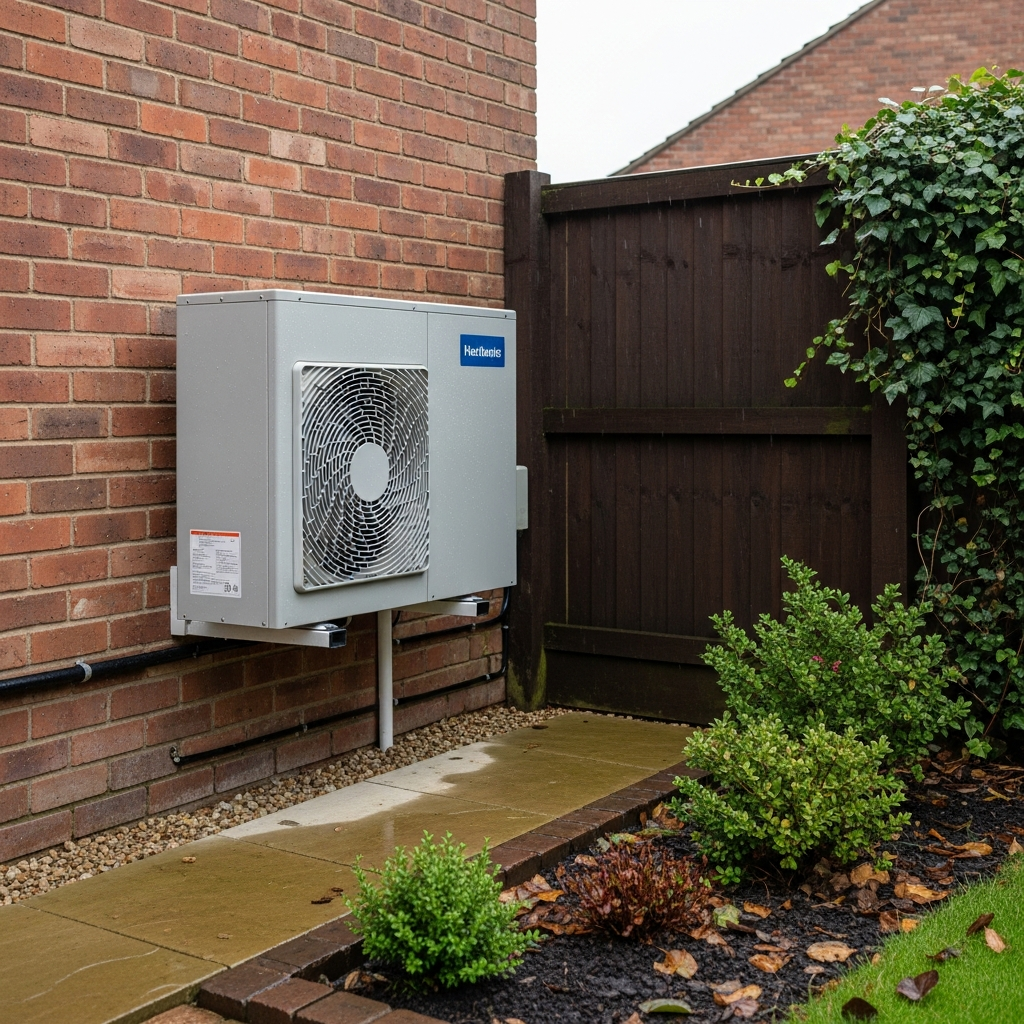
The standard choice for 1960s houses. The outdoor unit sits on a concrete pad alongside the house — typically on the side passage or in the rear garden. Most 1960s homes have ample space for this. An air source heat pump is the most affordable option and the quickest to install (typically two to three days).

Ground source heat pump

A good option if you have a larger garden. Horizontal ground loops (requiring 150 to 300 square metres of garden) or vertical boreholes (requiring minimal space but higher cost) can deliver even higher efficiency — COP of 3.5 to 4.5 — because ground temperatures are more stable than air temperatures. Ground source systems cost more upfront but deliver lower running costs.

Common 1960s House Variations

1960s housing comes in several common forms, each with slightly different considerations:

1960s semi-detached

The most common 1960s house type. Three bedrooms, one shared wall, side passage access. Typically the easiest and most affordable to convert. Heat pump sizing: 6 to 9 kW (well insulated).

1960s detached

Four exposed walls mean higher heat demand, but generous space for the outdoor unit and potential for ground source systems. Heat pump sizing: 7 to 11 kW (well insulated).

1960s terrace

Common on estates and in new towns. Two shared walls keep heat demand low. Outdoor unit placement in the rear garden is the standard approach. Heat pump sizing: 4 to 7 kW (well insulated).

1960s bungalow

Popular on 1960s estates, particularly in coastal and suburban areas. Single-storey construction simplifies installation. Good loft insulation is especially important due to the high roof-to-floor ratio. Heat pump sizing: 5 to 8 kW (well insulated). See our guide on heat pump suitability by property type.

1960s system-built or non-traditional construction

Some 1960s homes were built using non-traditional methods — precast concrete panels (e.g. Airey, Reema, Wates), steel-framed, or timber-framed. These properties can have heat pumps, but insulation approaches vary by construction type. A surveyor experienced with non-traditional builds should assess the property. Cavity wall insulation may not be appropriate for all construction types.

The Pre-Installation Checklist for a 1960s House

Prepare your 1960s home for the best possible heat pump performance:

  1. Verify cavity wall insulation: Check if cavities are filled. If not, arrange for insulation (£400-£800).
  2. Top up loft insulation to 270mm: Check depth and top up if needed (£300-£500 DIY).
  3. Insulate flat roof sections: Particularly porches, extensions, and garages with heated space above (varies).
  4. Draught-proof doors and windows: External doors, loft hatch, and any draughty windows (£100-£300).
  5. Check and replace any single glazing: Upgrade remaining single-glazed windows (£350-£600 each).
  6. Service existing radiators: Bleed radiators, check for sludge, consider a system flush before the heat pump goes in.

Items 1 to 4 can typically be completed for under £1,500 and will bring most 1960s homes into excellent condition for a heat pump. Check your overall readiness with our suitability checker and see our full suitability guide.
Frequently Asked Questions

Are 1960s houses good for heat pumps?

Yes — among the best in the UK housing stock. Cavity walls, concrete floors, standard ceiling heights, and regular construction make them straightforward and affordable to convert. With filled cavities and decent loft insulation, a 1960s house can achieve excellent heat pump performance.

What size heat pump does a 1960s house need?

A well-insulated three-bedroom 1960s semi typically needs a 6 to 8 kW heat pump. A three-bedroom detached needs 7 to 9 kW. Poor insulation increases these figures by 2 to 4 kW — filling cavity walls is the most effective way to keep the size (and cost) down.

How much does it cost to install a heat pump in a 1960s house?

After the £7,500 BUS grant, most 1960s house installations cost £2,000 to £5,000. This is among the most affordable installation costs for any UK house type, thanks to straightforward construction and moderate heat demand.

Do I need to worry about concrete floors with a heat pump?

No — concrete floors are actually an advantage. They lose less heat than suspended timber floors, they do not generate draughts, and they are an excellent base for underfloor heating if you choose to install it. Uninsulated concrete floors do lose some heat to the ground, but this is accounted for in the heat loss survey.

What about flat roof extensions from the 1960s?

Flat roofs are the most common weak point in 1960s houses. If your flat roof is due for re-covering, take the opportunity to add insulation above the deck. If not, internal insulation is a more affordable option. Either way, insulating the flat roof sections will noticeably reduce heat demand.

Will a heat pump save me money in a 1960s house?

With filled cavity walls and reasonable loft insulation, yes. A well-insulated 1960s home with a heat pump typically costs 15 to 30 per cent less to heat than with a gas boiler. Even with average insulation, costs are broadly comparable — and carbon emissions are much lower. Factor in the £7,500 grant and the 20 to 25 year lifespan of a heat pump versus 12 to 15 years for a boiler, and the financial case is strong.