Floor Insulation and Heat Pump Performance
An uninsulated suspended timber floor can bleed 2 to 3 kW of heat out of your home — enough to bump your heat pump up an entire size bracket and add £100+ per year to running costs. Yet floors remain the most overlooked insulation upgrade in UK homes. If you are planning a heat pump, understanding what is happening beneath your feet could save you thousands over the system's lifetime.
Is your home ready for a heat pump?
Check suitability in 60 secondsFree tool — includes floor insulation assessment.
How Floors Lose Heat
Heat escapes through floors in two ways: conduction through the floor material itself, and draughts through gaps in the floor structure. The amount of heat lost depends on several factors:
- Floor type: Suspended timber floors lose more heat than solid concrete floors
- Insulation: Whether any insulation exists beneath or within the floor
- Ground contact: Solid floors in direct contact with the ground lose heat to the earth
- Air gaps: Suspended floors with ventilated voids beneath lose heat to moving air
- Floor area relative to perimeter: The edges of floors lose more heat than the centre
The Building Research Establishment estimates that an uninsulated suspended timber floor has a U-value of around 0.7 to 1.0 W/m2K, while an uninsulated solid concrete floor typically has a U-value of 0.5 to 0.8 W/m2K. For context, modern building regulations require new floors to achieve a U-value of 0.25 W/m2K or better.
Suspended Timber Floors
Suspended timber floors are found in most pre-1960s UK homes, particularly in living rooms and bedrooms on the ground floor. The floor consists of timber joists spanning between walls, with floorboards on top and a ventilated void beneath. Air bricks in the external walls allow air to circulate under the floor, preventing damp but also creating a significant pathway for heat loss.
Why suspended floors lose so much heat
The ventilated void beneath a suspended timber floor means cold air constantly moves under your living space. In winter, this air can be only a few degrees above outside temperature. Heat from your rooms passes through the floorboards and joists into this cold void, and draughts rise through gaps between boards, around pipes, and at the junction of floor and skirting boards.
In a typical three-bedroom semi with 40 square metres of suspended timber floor, heat loss through the floor can be 2 to 3 kW at design temperature — that is 20 to 30 per cent of the entire heating demand of a well-insulated home.
Insulation options for suspended timber floors
Insulation between joists (from below): If you have access to the void beneath the floor — through a cellar, basement, or crawl space — mineral wool or rigid insulation boards can be fitted between the joists from below, held in place with netting or battens. This is the least disruptive method, costing approximately £20 to £35 per square metre installed.
Insulation between joists (from above): If there is no access from below, floorboards must be lifted to install insulation from above. Mineral wool batts or rigid PIR boards are fitted between joists, with a vapour barrier on the warm side. Costs are higher — £30 to £50 per square metre — because of the labour involved in lifting and refitting floorboards.
Spray foam: Expanding spray foam can be applied to the underside of floorboards from the void below. It fills gaps effectively and provides both insulation and draught-proofing. Costs range from £25 to £45 per square metre, but it is important to use an installer experienced with this product, as poor application can cause issues with timber moisture.
Draught-proofing suspended floors
Even without full insulation, draught-proofing a suspended timber floor can make a noticeable difference. Options include filling gaps between floorboards with flexible filler, sealing around pipes and cables, applying sealant at the junction of floorboards and skirting boards, and fitting a breathable membrane over the joists.
Draught-proofing alone can reduce heat loss through a suspended floor by 15 to 25 per cent, and it is cheap — a DIY job costing under £200 for most homes. Combined with the comfort benefit of eliminating cold draughts around your feet, it is one of the best value improvements you can make before a heat pump installation.
Solid Concrete Floors
Solid concrete floors became standard in UK new builds from the 1950s onwards. They consist of a concrete slab — sometimes with a screed on top — sitting directly on the ground. Homes built before the mid-1990s typically have no insulation beneath the concrete. Post-1990s properties usually have rigid insulation below or above the slab.
Why solid floors lose less heat than you might expect
Solid concrete floors in contact with the ground lose heat to the earth, but the ground temperature remains relatively stable at around 10 degrees Celsius year-round. This means the temperature difference — and therefore the heat loss — is much smaller than for a suspended floor exposed to cold air. Most heat escapes around the perimeter, where the slab is closest to the outside air.
Insulation options for solid concrete floors
Insulation above the slab: Rigid insulation boards (typically PIR or EPS) are laid on top of the existing concrete, with a new screed or floating floor on top. This is the most common retrofit approach, costing £40 to £70 per square metre. The main drawback is that it raises the floor level by 70 to 120mm.
Insulation below a new slab: If the existing floor is being dug up and replaced during a major renovation, insulation can be laid beneath the new slab. This is the best-performing option but only practical during significant building work.
Perimeter insulation: Since most heat escapes around the edges of a solid floor, insulating just the perimeter (typically 1 to 1.5 metres in from external walls) can capture much of the benefit at lower cost and with less disruption. This approach costs roughly £15 to £25 per linear metre.
Find out how insulation affects your heat pump costs
Use the free calculatorSee the difference floor insulation makes to system size and running costs.
How Floor Insulation Affects Heat Pump Sizing
Insulating your floor before installing a heat pump can reduce total heat demand enough to allow a smaller unit. For a typical three-bedroom semi:
| Floor condition | Floor heat loss (kW) | Potential saving |
|---|---|---|
| Uninsulated suspended timber | 2.0 to 3.0 | — |
| Insulated suspended timber | 0.6 to 1.0 | 1.4 to 2.0 kW |
| Uninsulated solid concrete (pre-1990s) | 1.0 to 2.0 | — |
| Insulated solid concrete | 0.3 to 0.6 | 0.7 to 1.4 kW |
That 1 to 2 kW reduction might not sound dramatic, but it can be the difference between needing an 8 kW heat pump and a 6 kW unit — a saving of £500 to £1,500 on the heat pump purchase price. It also means lower electricity consumption every year for the 20 to 25 year life of the system.
Floor Insulation and Underfloor Heating
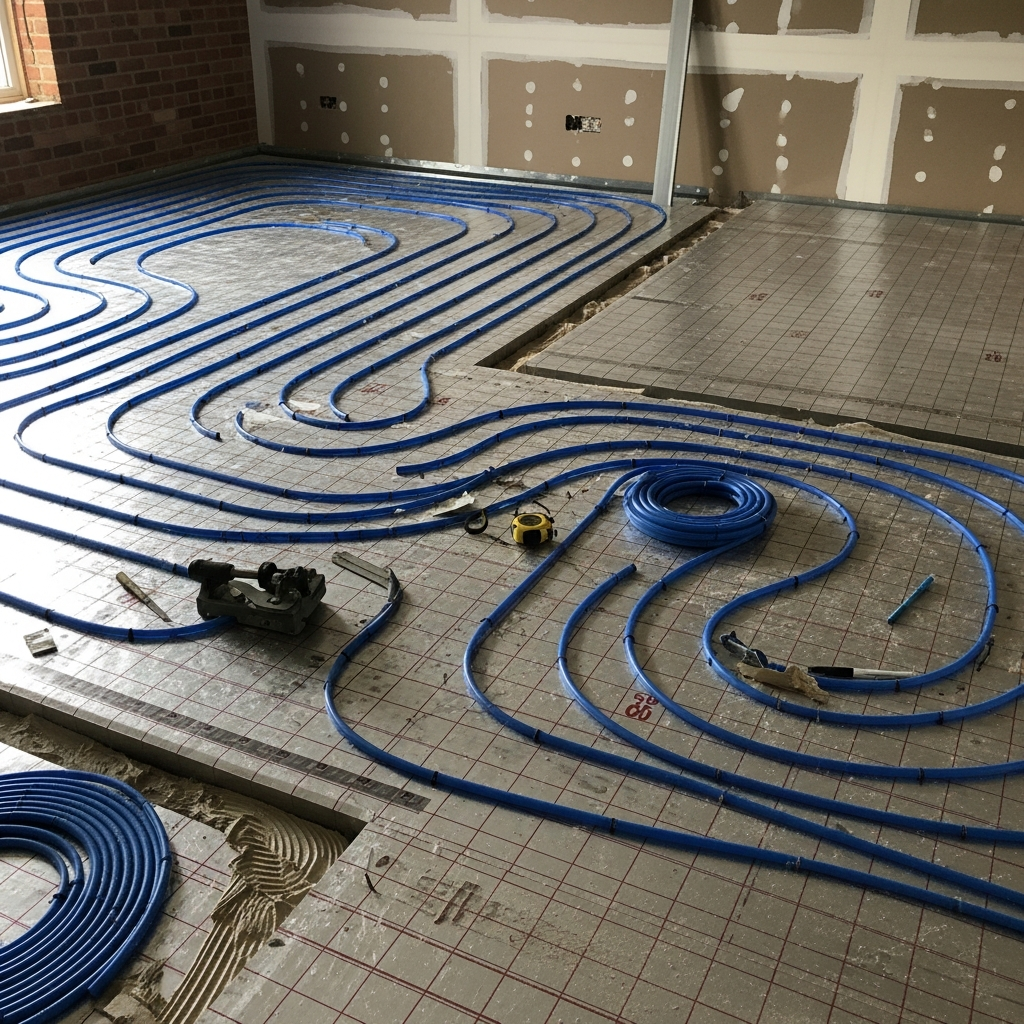
If you are installing underfloor heating alongside your heat pump — an increasingly popular combination — floor insulation beneath the heating pipes is essential, not optional. Without it, a significant proportion of the heat generated by the underfloor system will be lost downwards into the ground or void below, rather than warming your rooms.
The combination of underfloor heating and good floor insulation is ideal for heat pumps. Underfloor heating operates at very low temperatures — 30 to 40 degrees Celsius — which allows the heat pump to run at peak efficiency. Homeowners pairing underfloor heating with solar panels to generate the electricity their heat pump needs often see the best overall energy economics. Learn more about heating emitter options for heat pumps.
Cost-Benefit Analysis: Is Floor Insulation Worth It?
Suspended timber floors with access from below are almost always worth insulating before a heat pump installation. The economics are clear and the disruption is minimal. For solid concrete floors, the investment only makes sense if you are already renovating. Focus your budget on higher-impact improvements first — loft insulation and cavity walls deliver faster returns.
What Your Installer Should Check
During the heat loss survey, your MCS-certified installer will assess your floor construction and insulation level. They should identify your floor type, check for existing insulation, assess its condition, note air bricks and ventilation arrangements, and factor the actual floor U-value into the heat loss calculation.
A good installer will advise whether floor insulation is worth pursuing before the heat pump goes in. They can show you exactly how much difference it makes to heat pump size and running costs. Check your overall home suitability with our heat pump suitability checker.
Get a proper assessment from qualified installers
Request free heat pump quotesMCS-certified installers will assess your floors, insulation, and overall readiness.
Frequently Asked Questions
How much heat is lost through an uninsulated floor?
Typically 10 to 15 per cent of total heat loss in a UK home. For suspended timber floors, it can be higher — up to 20 per cent in draughty older properties. The exact figure depends on floor type, area, and how well the rest of your home is insulated.
Should I insulate my floor before installing a heat pump?
If you have a suspended timber floor with access from below, it is almost always worth doing. For solid concrete floors, the cost-benefit is less clear unless you are already renovating. Your installer can advise based on the heat loss survey.
Can I get a grant for floor insulation?
Floor insulation is not covered by the Boiler Upgrade Scheme, but it may be available through the Great British Insulation Scheme or ECO4 if you are on certain benefits or have a low EPC rating. Check with your local authority for area-specific schemes.
Will floor insulation affect my air bricks?
Air bricks must not be blocked. They provide essential ventilation to prevent damp and timber decay in the void beneath suspended floors. Floor insulation should be installed between the joists, above the ventilated void, not in a way that blocks airflow.
How long does floor insulation take to install?
Insulation from below a suspended floor typically takes one to two days for a typical semi. From above (lifting floorboards) takes two to four days. Solid floor insulation above the slab is usually part of a larger renovation and timescales vary widely.
Does floor insulation help with overall home energy efficiency beyond just heat pumps?
Absolutely. Floor insulation reduces heat loss regardless of your heating system. It makes your home more comfortable, reduces energy bills, and improves your EPC rating. These benefits apply whether you heat with a heat pump, gas boiler, or any other system.
Floor insulation is a key element of the fabric-first approach to heat pump preparation. Reducing floor heat loss allows a smaller air source heat pump, cutting both upfront and running costs. The Boiler Upgrade Scheme covers the heat pump itself, while separate grants may fund insulation. Homeowners seeking maximum energy independence often combine floor insulation, heat pumps, and solar panel systems for the lowest possible energy bills.