What Size Heat Pump Do I Need?
Getting the size of your heat pump right is arguably the most important decision in the entire installation process. Too small and your home will not be warm enough on the coldest days. Too large and you waste money on equipment that cycles inefficiently, increasing wear and reducing the system's lifespan. The sweet spot — a correctly sized heat pump — delivers comfort, efficiency, and value for decades.
This guide explains how heat pump sizing works in the UK, gives you useful rules of thumb to estimate what you might need, and explains why a professional heat loss calculation is essential before you commit to anything. Whether you are at the early research stage or comparing installer quotes, understanding sizing will help you make better decisions.
What "Size" Means for a Heat Pump
When we talk about heat pump size, we mean its heating output measured in kilowatts (kW). This is the amount of heat the system can deliver to your home per hour. A 5 kW heat pump delivers 5 kilowatts of heat, a 10 kW unit delivers 10 kilowatts, and so on.
Importantly, the heating output is different from the electrical input. A heat pump with a heating output of 10 kW might only draw 3 kW of electricity, because it extracts the remaining 7 kW from the air or ground. This ratio — the coefficient of performance (COP) — is what makes heat pumps so efficient.
Heat pump sizes for UK homes typically range from 4 kW for a small flat to 16 kW or more for a large detached house. Most homes fall in the 6 to 12 kW range.
The Quick Rules of Thumb
Before we get into the detail, here are some rough rules of thumb that give you a ballpark figure. These are not a substitute for a proper calculation, but they are useful for initial planning and budgeting.
Rule 1: Floor area method
For a reasonably well-insulated UK home, allow approximately 50 to 80 watts per square metre of heated floor area. This gives you:
- 70 sqm flat: 3.5 to 5.6 kW
- 85 sqm mid-terrace: 4.3 to 6.8 kW
- 100 sqm semi-detached: 5 to 8 kW
- 130 sqm detached: 6.5 to 10.4 kW
- 180 sqm large detached: 9 to 14.4 kW
- 250 sqm+ large house: 12.5 to 20 kW
Use the lower end of the range for well-insulated homes (modern or fully retrofitted with cavity fill, 270mm loft insulation, and double glazing) and the upper end for older or less well-insulated properties.
Rule 2: Current gas consumption method
If you know your annual gas consumption in kWh (it is on your energy bill), you can estimate your heat pump size. Divide your annual gas consumption by 2,500 to get an approximate heat pump size in kW. For example:
- 12,000 kWh gas per year: 12,000 / 2,500 = approximately 5 kW
- 18,000 kWh gas per year: 18,000 / 2,500 = approximately 7 kW
- 25,000 kWh gas per year: 25,000 / 2,500 = approximately 10 kW
- 35,000 kWh gas per year: 35,000 / 2,500 = approximately 14 kW
This is a very rough guide and assumes your gas boiler is reasonably efficient and your heating habits are typical. It is useful as a sanity check but should not be relied upon for final sizing.
Rule 3: Room count method
The simplest rule of all — allow about 1.5 to 2 kW per room (including kitchen and living areas but excluding bathrooms and hallways). A four-room house needs roughly 6 to 8 kW, a six-room house needs 9 to 12 kW. This is the crudest estimate and only useful for very early-stage thinking.
Why Rules of Thumb Are Not Enough
The rules above are useful for getting a general sense of what you need, but they can be dangerously misleading if taken as gospel. Two houses of identical size can have wildly different heat demands:
- A well-insulated modern three-bedroom semi might need just 5 kW
- A draughty Victorian three-bedroom semi might need 12 kW
That is more than double the heat demand for the same number of rooms. The difference comes down to insulation, construction, glazing, exposure, and a dozen other factors that rules of thumb cannot capture. This is why a professional heat loss calculation is absolutely essential.
The Professional Heat Loss Calculation
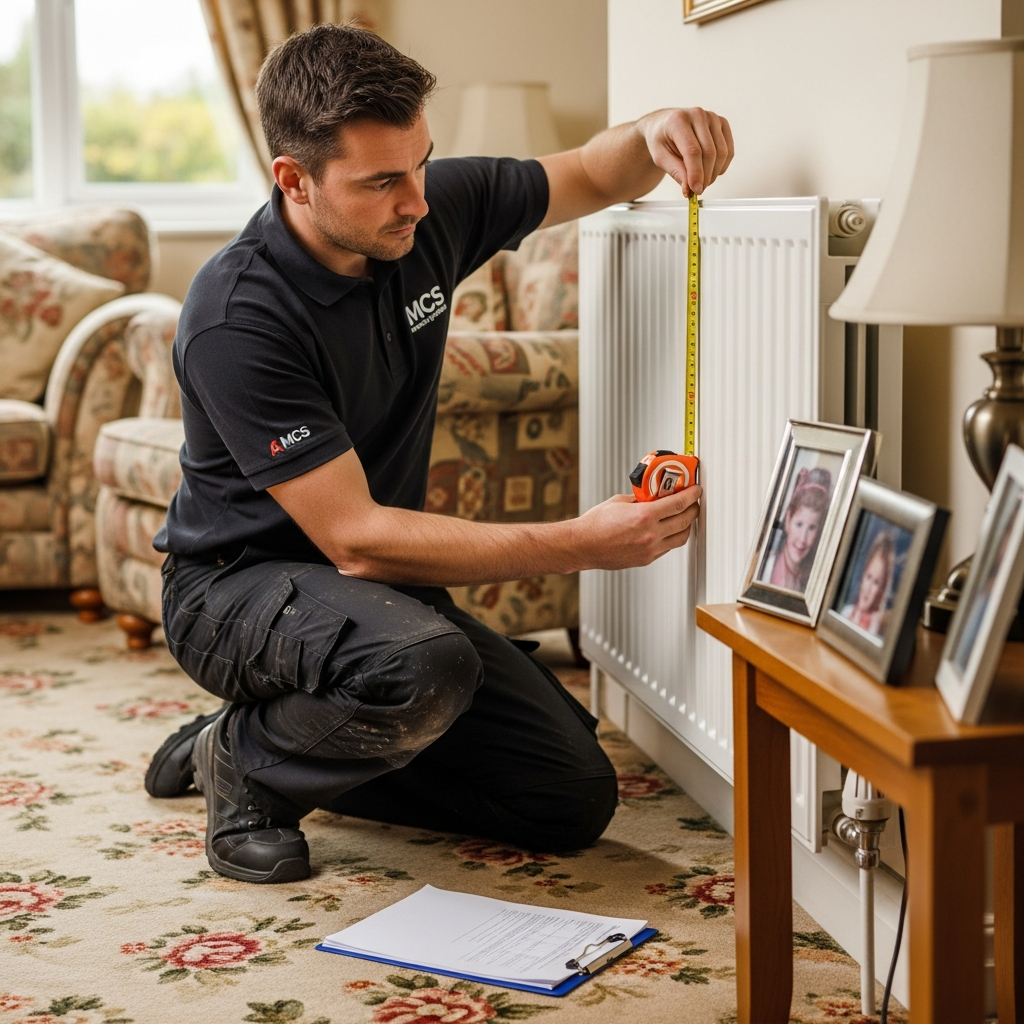
Every legitimate heat pump installation in the UK must be preceded by a room-by-room heat loss calculation conducted by an MCS-certified installer. This is not optional — it is a requirement for the BUS grant and a fundamental part of MCS certification.
What the calculation involves
A surveyor visits your home and measures every room. For each room, they record:
- Dimensions: Floor area, ceiling height, wall areas
- Wall construction: Solid, cavity (filled or unfilled), timber frame
- Insulation levels: Wall, loft, floor insulation type and thickness
- Windows: Number, size, type (single, double, triple glazed), frame material
- Orientation: Which direction each external wall faces
- Ventilation: Air permeability, trickle vents, extractor fans
- Adjacent spaces: What is on the other side of each wall, floor, and ceiling
This data is entered into MCS-approved design software (such as MCS Heat Pump System Design) which calculates the heat loss for each room and the total heat loss for the whole house. The result is your peak heat demand in kW — the amount of heat needed to keep your home warm on the coldest day of the year (typically assumed to be -3 degrees Celsius for most of England and Wales, or -5 degrees for Scotland).
Why room-by-room matters
A whole-house calculation alone is not sufficient. Knowing that your house needs 8 kW in total tells you what size heat pump to buy, but it does not tell you whether each room will be warm enough. A room-by-room calculation ensures that every radiator (or underfloor heating loop) is sized correctly for its specific room. Without this, you might end up with a bedroom that never quite reaches temperature or a living room that overheats.
Heat Pump Sizing by House Type
Here is a more detailed breakdown of typical heat pump sizes by property type, assuming reasonable (not perfect) insulation — filled cavity walls or moderate solid wall insulation, 200mm+ loft insulation, and double glazing:
Flats and apartments
- 1-bedroom flat: 3 to 5 kW
- 2-bedroom flat: 4 to 6 kW
- 3-bedroom flat: 5 to 7 kW
Terraced houses
- 2-bedroom mid-terrace: 4 to 6 kW
- 3-bedroom mid-terrace: 5 to 7 kW
- 3-bedroom end-terrace: 6 to 9 kW
Semi-detached houses
- 2-bedroom semi: 5 to 7 kW
- 3-bedroom semi: 6 to 9 kW
- 4-bedroom semi: 8 to 11 kW
Detached houses
- 2-bedroom bungalow: 5 to 8 kW
- 3-bedroom detached: 8 to 12 kW
- 4-bedroom detached: 10 to 14 kW
- 5-bedroom detached: 12 to 18 kW
For more detail on specific property types, see our guides for detached houses, terraced houses, cottages, and dormer bungalows.
Factors That Increase Heat Pump Size
Several factors push your heat demand upwards, requiring a larger system:
- Poor insulation: The single biggest factor. Uninsulated walls can double your heat loss compared with filled cavity or solid wall insulation.
- Single glazing: Single-glazed windows lose roughly twice as much heat as double glazing.
- High ceilings: Victorian and Georgian homes with 3-metre ceilings have more volume to heat than modern homes with 2.4-metre ceilings.
- Exposed location: A hilltop house in the Scottish Highlands has a higher design temperature differential than a sheltered house in suburban London.
- Large glazed areas: Conservatories, bi-fold doors, and floor-to-ceiling windows lose more heat than insulated walls.
- Detached vs attached: A detached house loses heat from all four walls; a mid-terrace loses heat from only two.
- Extended properties: Extensions, particularly those with flat roofs or large glazed sections, often have higher heat loss per square metre than the original house.
Factors That Reduce Heat Pump Size
Conversely, several factors reduce your heat demand:
- Good insulation: Cavity wall fill, external or internal wall insulation, 270mm loft insulation, and insulated floors all reduce heat loss significantly.
- Triple glazing: Around 20% less heat loss than standard double glazing.
- Airtightness: Modern homes or well-draught-proofed older homes lose less heat through ventilation.
- Sheltered location: A sheltered urban site loses less heat to wind than an exposed rural site.
- Shared walls: Each party wall shared with a heated neighbouring property effectively eliminates heat loss from that wall.
- Solar gain: South-facing homes with large windows gain free heat from the sun, particularly useful during the spring and autumn shoulder months.
What Happens If the Size Is Wrong?
Undersized heat pump
An undersized heat pump will keep your home warm on mild days but struggle during cold snaps. When the outdoor temperature drops to -2 or -3 degrees Celsius, the heat pump cannot deliver enough heat to maintain a comfortable indoor temperature. You may find bedrooms cold in the morning, the house slow to recover after ventilation, and the hot water lukewarm.
Some undersized systems compensate by using a direct electric immersion heater as backup. This works but is expensive — the immersion heater uses electricity at 100% efficiency rather than the 300%+ efficiency of the heat pump. If your system relies heavily on backup electric heating, something has gone wrong with the sizing.
Oversized heat pump
An oversized heat pump costs more to buy and may perform worse than a correctly sized one. The problem is called short-cycling: the heat pump reaches the target temperature quickly, switches off, the temperature drops, and it switches on again. This on-off cycling reduces efficiency, increases wear on the compressor, and can cause uncomfortable temperature fluctuations.
Modern inverter-driven heat pumps mitigate this by modulating their output — they can run at, say, 30% capacity when full output is not needed. But even inverter systems have a minimum output, and if the heat demand is well below this minimum, short-cycling will still occur. Correct sizing avoids this entirely.
Hot Water Sizing
Your heat pump also needs to heat your domestic hot water, and this must be factored into the sizing. In most cases, the heat pump is sized primarily for space heating (because that is the larger demand), and the hot water is provided by the same unit using a stored hot water cylinder.
Typical hot water cylinder sizes:
- 1-2 occupants: 150 litres
- 3-4 occupants: 180 to 210 litres
- 5+ occupants: 250 to 300 litres
In a well-designed system, the heat pump heats the cylinder during off-peak hours and then dedicates its full output to space heating during the day. A larger cylinder can store more hot water, reducing the need for the heat pump to interrupt space heating for a hot water top-up.
Getting Quotes and Comparing Sizes
When you get quotes from different installers, they may recommend slightly different heat pump sizes. This is normal — different design software, different assumptions about internal temperatures, and different approaches to safety margins can lead to variations of 1 to 2 kW between quotes.
What you should worry about is large discrepancies. If one installer quotes an 8 kW system and another quotes a 14 kW system for the same house, something is wrong. Ask each installer to explain their heat loss calculation and show you the room-by-room figures. A competent installer will be happy to walk you through the numbers.
Always get at least three quotes from MCS-certified installers. This gives you a range of recommendations to compare and helps you identify outliers.
Frequently Asked Questions
Can I size a heat pump myself?
You can use the rules of thumb in this guide to get a rough estimate, but a professional heat loss calculation is essential before installation. This is not just good practice — it is a requirement for MCS certification and the BUS grant. Online calculators can give you a ballpark figure, but they cannot substitute for a proper on-site survey.
Is it better to go slightly oversized for safety?
A small margin (10 to 15%) is normal and acceptable. But significant oversizing — say, installing a 12 kW unit when 8 kW would suffice — is wasteful and can cause short-cycling problems. Trust the heat loss calculation rather than adding a large safety margin out of anxiety.
Does the heat pump size affect the BUS grant?
No. The BUS grant is a fixed £7,500 regardless of the heat pump size (for both air source and ground source). However, the system must be correctly sized according to MCS standards — an obviously oversized system could fail the MCS compliance check.
What if my heat demand is between two heat pump sizes?
Heat pumps are available in many sizes (5, 6, 7, 8, 9, 10, 11, 12, 14, 16 kW and more). If your heat loss calculation comes out at, say, 8.5 kW, your installer will typically recommend a 9 or 10 kW unit. Modern inverter heat pumps modulate their output, so a 10 kW unit will comfortably run at 8.5 kW without any efficiency penalty.
Does hot water require a bigger heat pump?
Not usually. The heat pump is sized for space heating, and hot water is heated during periods of lower space heating demand (overnight or during mild weather). The hot water cylinder acts as a thermal store, so the heat pump does not need to deliver all the hot water instantly — it can heat it gradually over a few hours.
How does insulation affect the size I need?
Dramatically. Improving your insulation before installing a heat pump can reduce the size needed by 30 to 50%. For example, adding cavity wall insulation and topping up loft insulation might reduce your heat demand from 12 kW to 8 kW — a smaller, cheaper heat pump with lower running costs. See our sizing guide by house size for detailed tables.