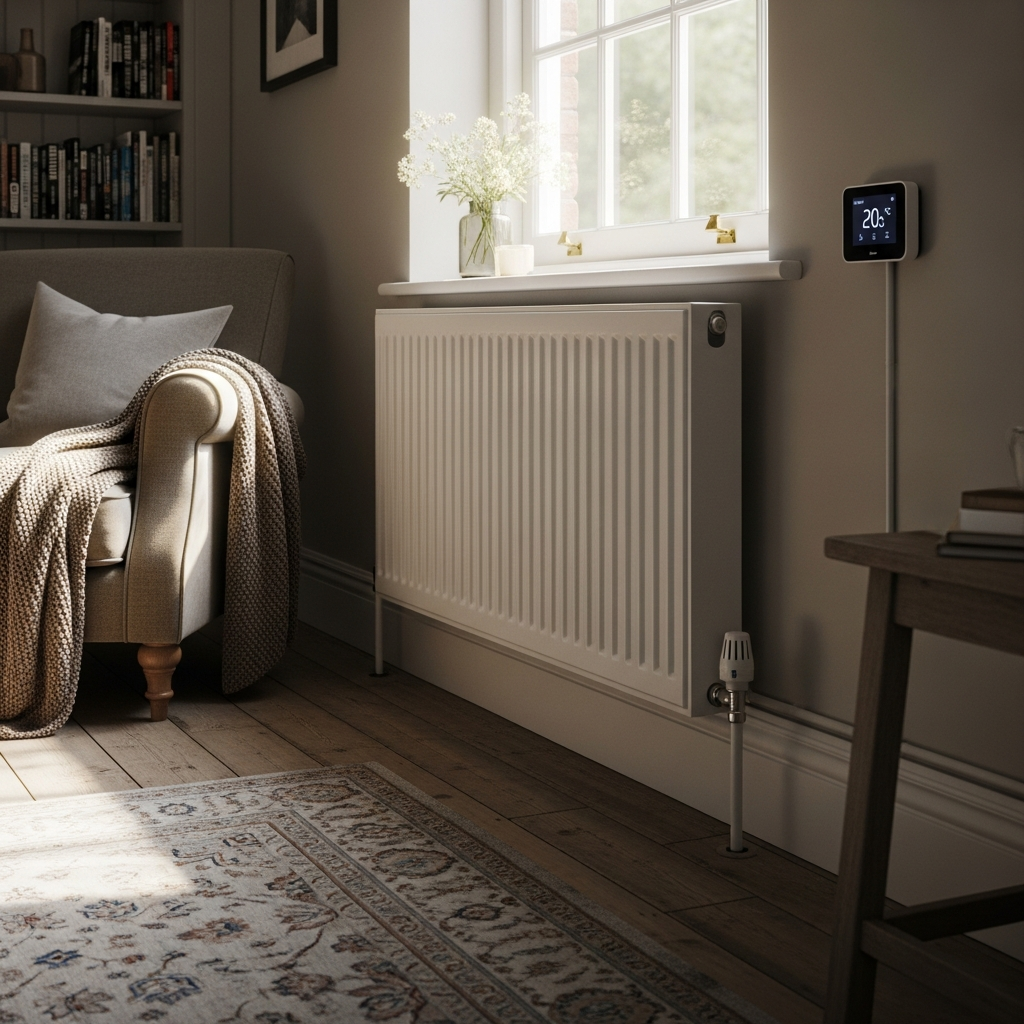
Why Does My Heat Pump Radiator Feel Lukewarm?
You have just had a heat pump installed, and the first thing you do is touch a radiator. It feels warm — not hot. Definitely not the "too hot to hold" temperature you remember from your gas boiler. Your immediate thought: something is wrong.
Nothing is wrong. This is exactly how a heat pump system is supposed to work. Lukewarm radiators are a feature, not a fault. Here is why, and why your home is still being heated perfectly well.
The Temperature Difference Explained
Gas Boiler Radiators: 60°C to 80°C
A gas boiler heats water to between 60°C and 80°C. By the time that water reaches your radiators, the surface temperature is typically 55°C to 70°C. That is hot enough to burn skin with prolonged contact. Children and elderly people are at risk of scalds from boiler-fed radiators.
The boiler operates in short bursts — firing hard, heating the radiators quickly, then switching off. The room temperature fluctuates between heating cycles.
Heat Pump Radiators: 35°C to 45°C
A heat pump heats water to between 35°C and 50°C, depending on outside conditions and the system design. The radiator surface temperature is typically 30°C to 45°C. That feels noticeably warm to the touch — roughly body temperature or slightly above — but certainly not hot.
The heat pump runs for longer periods (often continuously in cold weather), maintaining a steady temperature rather than cycling on and off. The room temperature stays consistent.
Why Lower Temperatures Still Heat the Room
A radiator heats a room by transferring thermal energy from its surface to the surrounding air. The rate of heat transfer depends on the temperature difference between the radiator surface and the room air. A radiator at 60°C in a 20°C room has a 40°C difference. A radiator at 40°C in a 20°C room has a 20°C difference.
With half the temperature difference, the radiator emits roughly half the heat per square metre. So how does the room still reach 21°C? Two factors:
- Larger radiators — heat pump systems use bigger radiators to compensate for the lower output per square metre. A radiator that is twice the size at half the temperature difference delivers the same total heat output
- Longer running time — instead of blasting heat for 20 minutes and resting for 40, the heat pump delivers heat steadily for hours, accumulating the same total energy into the room
The end result is the same room temperature. The path to get there is just gentler.
The Physics of Comfort
Room temperature is what matters for comfort, not radiator temperature. If your thermostat reads 21°C, your room is at 21°C — regardless of whether the radiator is at 40°C or 70°C. The air you breathe, the surfaces you sit on, and the ambient warmth around you are all at 21°C.
In fact, many heat pump owners report that the steady warmth feels more comfortable than the peaks and troughs of a gas boiler. No more cold spots between cycles. No more overheating after the boiler fires. Just consistent, even warmth.
The Radiator Test Trap
Touching the radiator is the worst way to judge whether your heating is working. Your hand is at approximately 33°C to 36°C. A heat pump radiator at 38°C will barely feel warm because the temperature difference is tiny. But that same radiator is pumping heat into a 20°C room perfectly well — the 18°C temperature difference between radiator and room is what drives the heat transfer.
The test you should use is simple: check the thermostat. If the room is at your target temperature, the system is working correctly. End of test.
Why Heat Pumps Use Lower Temperatures
Heat pumps are not limited to low temperatures out of weakness — they use low temperatures by design because it makes them dramatically more efficient.
The efficiency of a heat pump (measured as COP — coefficient of performance) is directly related to the "lift" — the temperature difference between the heat source (outside air) and the heat output (flow temperature). The smaller the lift, the higher the COP.
- Flow temperature 35°C, outside 7°C = lift of 28°C → COP around 4.0
- Flow temperature 45°C, outside 7°C = lift of 38°C → COP around 3.2
- Flow temperature 55°C, outside 7°C = lift of 48°C → COP around 2.5
Running at 35°C instead of 55°C uses 37% less electricity for the same amount of heat delivered. That is a significant saving on your annual heating bills. Your heat pump system is designed to run at the lowest flow temperature that still meets your heating demand, maximising this efficiency advantage.
When Lukewarm Is Not Enough
There are legitimate situations where a lukewarm radiator is genuinely not delivering enough heat. These are installation issues, not problems with the technology.
Undersized Radiators
If your existing radiators were sized for a gas boiler at 70°C flow temperature, they may be too small to deliver sufficient heat at 40°C. This is why a proper MCS installation includes a radiator survey — your installer should calculate whether each radiator is large enough and recommend replacements where needed. Typically, 30% to 50% of radiators in an existing home need upsizing.
Unbalanced System
If some radiators are warm while others are barely tepid, the system may need balancing. Balancing adjusts the flow rate to each radiator so that heat is distributed evenly throughout the house. Without balancing, radiators closest to the heat pump get most of the flow, while distant radiators get little.
Air Locks
Air trapped in radiators prevents water from circulating properly. If a radiator is warm at the bottom but cold at the top, it needs bleeding. This is the same as with a gas boiler — nothing specific to heat pumps.
Flow Temperature Set Too Low
If the weather compensation curve is set too aggressively (favouring efficiency over comfort), the flow temperature may be lower than necessary. Your installer can adjust the heating curve to raise the flow temperature slightly. A 2°C to 3°C increase makes a noticeable difference to radiator output with only a small efficiency penalty.
How to Tell If Your System Is Working Correctly
- Check the room thermostat — if it reads your target temperature (e.g., 21°C), the system is working. Full stop.
- Check all radiators are warm — every radiator in a zone that is calling for heat should be warm to the touch, even if not hot. Cold radiators indicate a problem (air lock, closed valve, or balancing issue).
- Check the flow temperature — most heat pump controllers display the current flow temperature. It should be between 30°C and 50°C depending on outside conditions. If it is below 30°C in cold weather, the weather compensation may need adjusting.
- Check the delta T — the difference between flow and return temperatures should typically be 5°C to 8°C. A larger gap may indicate insufficient flow rate.
Making the Most of Lower Temperature Heating
Trust the System
The hardest adjustment for new heat pump owners is psychological. You have spent decades equating hot radiators with warmth. Retraining your instincts takes a couple of weeks. After that, most people forget about radiator temperature entirely and simply enjoy the consistent comfort.
Use Weather Compensation
Let the heat pump adjust flow temperatures automatically. On mild days, the flow temperature drops to 30°C to 35°C — radiators will feel barely warm, but the room still maintains temperature. On cold days, the flow rises to 45°C or more. This automatic adjustment maximises efficiency without any effort from you.
Avoid the Temptation to Override
Do not manually crank up the flow temperature because the radiators do not feel hot enough. If the room is at 21°C, raising the flow temperature from 40°C to 55°C will not make the room any warmer — the thermostat will just switch off the heating sooner. All you achieve is reduced efficiency and higher electricity bills.
Consider Underfloor Heating
Wet underfloor heating operates at even lower temperatures (30°C to 35°C) and you never touch it, so the "lukewarm" perception never arises. If you are renovating, UFH removes the radiator temperature concern entirely.
Frequently Asked Questions
Is it normal for heat pump radiators to feel lukewarm?
Yes, completely normal. Heat pump radiators run at 35°C to 45°C rather than 60°C to 80°C. They feel warm rather than hot. This is by design — lower temperatures make the heat pump more efficient.
Why is my heat pump radiator not as hot as my old gas boiler radiators?
Because heat pumps operate at lower flow temperatures for efficiency. A gas boiler heats water to 60-80°C; a heat pump heats to 35-50°C. The room still reaches the same temperature — it just takes a gentler, steadier approach.
Should I turn up the flow temperature on my heat pump?
Only if your rooms are not reaching the target temperature. If the thermostat reads 21°C, the flow temperature is correct — do not increase it. If rooms are consistently below target, speak to your installer about adjusting the weather compensation curve or checking radiator sizing.
Will bigger radiators make a difference?
If your current radiators are too small for the lower flow temperatures, yes. Upgrading to larger radiators allows more heat output at the same low flow temperature, maintaining both comfort and efficiency. Your installer should assess this during the heat pump installation.
Are heat pump radiators safe for children?
Much safer than gas boiler radiators. At 35°C to 45°C, heat pump radiators are warm to touch but will not cause burns. This is a genuine safety advantage, particularly for households with young children or vulnerable adults.
My radiator is cold at the top — is that a heat pump issue?
No, that is trapped air. Bleed the radiator using the bleed valve at the top until water comes out. This is the same process as with a gas boiler system and is not related to the heat pump.