Home Heat Pump Guide

How Much Bigger Do Heat Pump Radiators Need to Be?

The short answer: typically 1.5 to 2 times larger than what you would need for a gas boiler system. But the precise answer depends on the flow temperature your heat pump runs at, the type of radiator, and the heat loss of each individual room.

This guide explains exactly how radiator sizing works for heat pumps, provides the correction factors you need, and walks through a practical room-by-room approach to sizing.

Why Heat Pump Radiators Need to Be Bigger

Radiators emit heat based on the temperature difference between the water inside them and the air in the room. This is called Delta T (ΔT). A gas boiler runs water at 70–80°C, creating a Delta T of roughly 50°C with a 21°C room temperature. A heat pump runs at 35–50°C, creating a much smaller Delta T.

The relationship between Delta T and heat output is not linear — it follows an exponential curve. As Delta T drops, heat output falls faster than you might expect. This means a radiator running at half the Delta T does not produce half the heat — it produces significantly less.

To compensate, you need more radiator surface area. More surface area means more heat transfer, even at the lower temperature difference.

The Numbers: How Much Output Drops at Lower Temperatures

Radiator manufacturers rate their products at ΔT50 (which corresponds roughly to a 75°C flow temperature with a 21°C room). Here is how the output changes at different flow temperatures:

Flow Temperature Approximate Delta T Output vs ΔT50 Rating Sizing Factor
75°C (boiler) ΔT50 100% 1.0x
55°C ΔT35 ~65% ~1.5x
50°C ΔT30 ~56% ~1.8x
45°C ΔT25 ~44% ~2.3x
40°C ΔT20 ~34% ~3.0x
35°C ΔT15 ~24% ~4.2x

At a 45°C flow temperature — which is a good target for an efficient heat pump installation — radiators need to be roughly 2.3 times larger than their ΔT50 rating suggests. At 50°C, it is about 1.8 times. At 55°C, about 1.5 times.

This is where the "1.5 to 2 times bigger" rule of thumb comes from — it covers the typical heat pump flow temperature range of 45–55°C.

The Room-by-Room Approach

A blanket "double all your radiators" approach is wasteful. Some rooms in your home may already have oversized radiators. Others may have tiny ones that were barely adequate with the boiler. The correct approach is room by room.

Step 1: Calculate Each Room's Heat Loss

Your MCS installer will calculate the heat loss for each room using software like MCS Heat Loss or similar tools. This considers:

  • Room dimensions (floor area and ceiling height)
  • Wall construction and insulation
  • Window type and area
  • Floor type (ground floor, upper floor, suspended timber)
  • Ceiling/roof insulation
  • Room orientation (north-facing rooms lose more heat)
  • Ventilation rate
  • Design outdoor temperature (typically -3°C to -5°C for the UK)

Step 2: Determine What Each Existing Radiator Can Deliver

For each room, the installer looks at the existing radiator's rated output (at ΔT50) and applies the correction factor for the proposed flow temperature. For example:

  • Living room: Existing radiator rated at 2,000W at ΔT50. At 45°C flow (ΔT25): 2,000 × 0.44 = 880W actual output.
  • Living room heat loss: 1,400W needed.
  • Result: 880W delivered, 1,400W needed. Shortfall of 520W. This radiator needs upgrading.

Step 3: Size the Replacement

For the living room above, you need a radiator that delivers at least 1,400W at ΔT25. Working backwards: 1,400 ÷ 0.44 = 3,182W at ΔT50 rating. So you need a radiator rated at roughly 3,200W or more — which is about 1.6 times the size of the existing one.

Step 4: Check the Wall Space

A radiator rated at 3,200W at ΔT50 in Type 22 configuration might be roughly 600mm high × 1,600mm wide — or 700mm high × 1,400mm wide. If the wall space is available, a standard double-panel convector works perfectly. If not, alternatives include:

  • A taller, narrower radiator (vertical models can be 1,800mm high × 500mm wide)
  • Two smaller radiators on different walls
  • A fan convector radiator that delivers the same output in a smaller physical size

Room-by-Room Examples

Here are typical scenarios for a three-bedroom semi-detached house with moderate insulation, designed at 45°C flow temperature:

Living Room (18m²)

  • Heat loss: 1,400W
  • Existing radiator: 1,800W at ΔT50 (delivers 792W at ΔT25)
  • Verdict: Needs upgrading — replace with a Type 22, 600 × 1600mm (~3,200W at ΔT50)

Kitchen-Diner (14m²)

  • Heat loss: 1,100W
  • Existing radiator: 1,200W at ΔT50 (delivers 528W at ΔT25)
  • Verdict: Needs upgrading — replace with a Type 22, 600 × 1200mm (~2,500W at ΔT50)

Main Bedroom (14m²)

  • Heat loss: 750W
  • Existing radiator: 2,000W at ΔT50 (delivers 880W at ΔT25)
  • Verdict: Adequate — existing radiator is already oversized. No change needed.

Bedroom 2 (10m²)

  • Heat loss: 550W
  • Existing radiator: 1,500W at ΔT50 (delivers 660W at ΔT25)
  • Verdict: Adequate — existing radiator provides sufficient output. No change needed.

Bedroom 3 (8m²)

  • Heat loss: 450W
  • Existing radiator: 900W at ΔT50 (delivers 396W at ΔT25)
  • Verdict: Borderline — slight shortfall. Could upgrade, or accept a slightly lower temperature on the coldest days. Installer's judgement call.

Bathroom (5m²)

  • Heat loss: 400W
  • Existing radiator: Towel rail rated 350W at ΔT50 (delivers 154W at ΔT25)
  • Verdict: Needs upgrading — replace with a larger towel radiator or add a small panel radiator

In this example, 2–3 radiators need upgrading out of 6. This is a very typical result for a moderately insulated UK semi.

How Insulation Affects Radiator Sizing

Improving insulation reduces the heat loss calculation for each room, which in turn reduces the required radiator output. Consider the living room example above:

  • Before cavity wall insulation: Heat loss 1,400W. Existing radiator inadequate.
  • After cavity wall insulation: Heat loss drops to 1,000W. Existing radiator at ΔT25 delivers 792W — still a shortfall, but a smaller one.
  • After cavity wall + loft top-up: Heat loss drops to 850W. Existing radiator at ΔT25 delivers 792W — very close. Running the heat pump at 48°C instead of 45°C would bridge the gap without needing a radiator change.

This illustrates why insulation and radiator sizing are interconnected decisions. Better insulation means fewer radiator upgrades, smaller radiators, and a more efficient heat pump.

What If Wall Space Is Limited?

Not every room has space for a radiator that is 1.5–2 times larger. Practical solutions include:

Vertical Radiators

Tall, narrow radiators (e.g., 1,800mm high × 400–600mm wide) deliver high output while occupying minimal wall width. They look distinctive and work well in hallways, kitchens, and living rooms where horizontal wall space is taken up by furniture or doorways.

Fan Convectors

A fan convector the same physical size as a standard radiator can deliver 2–3 times the heat output at low flow temperatures. They are the go-to solution when you simply cannot fit a larger standard radiator.

Multiple Smaller Radiators

Instead of one large radiator, two smaller ones on different walls can provide the required output while distributing heat more evenly across the room.

Supplementary Underfloor Heating

In rooms where the existing radiator covers most of the heat loss but falls slightly short, adding underfloor heating to part of the floor can make up the difference — particularly effective in kitchens and bathrooms where hard flooring is already in place.

The Flow Temperature Trade-Off

There is a direct trade-off between flow temperature and radiator size. If you cannot physically fit radiators large enough for 45°C operation, your installer may recommend running the heat pump at 50°C or 55°C instead. This reduces the sizing requirement:

  • At 45°C: Radiators need to be ~2.3x larger. Heat pump COP ~3.0–3.5
  • At 50°C: Radiators need to be ~1.8x larger. Heat pump COP ~2.7–3.2
  • At 55°C: Radiators need to be ~1.5x larger. Heat pump COP ~2.3–2.8

Running at 55°C instead of 45°C might save £1,500 on radiator upgrades but cost an extra £150–£250 per year in electricity. Over 15 years, the lower flow temperature with bigger radiators is almost always the more economical choice.

Your installer should present this trade-off clearly and let you make an informed decision based on your budget and priorities.

Common Misconceptions

"All radiators need to be doubled in size"

Not true. The sizing factor depends on the specific flow temperature and room conditions. Some rooms may need radiators 2.3x larger; others may need no change at all. The room-by-room calculation is essential — blanket rules waste money.

"You need special heat pump radiators"

Standard radiators work perfectly well. There is no special manufacturing process for "heat pump radiators." You just need appropriately sized standard radiators — usually double-panel convectors in larger dimensions.

"Bigger radiators look terrible"

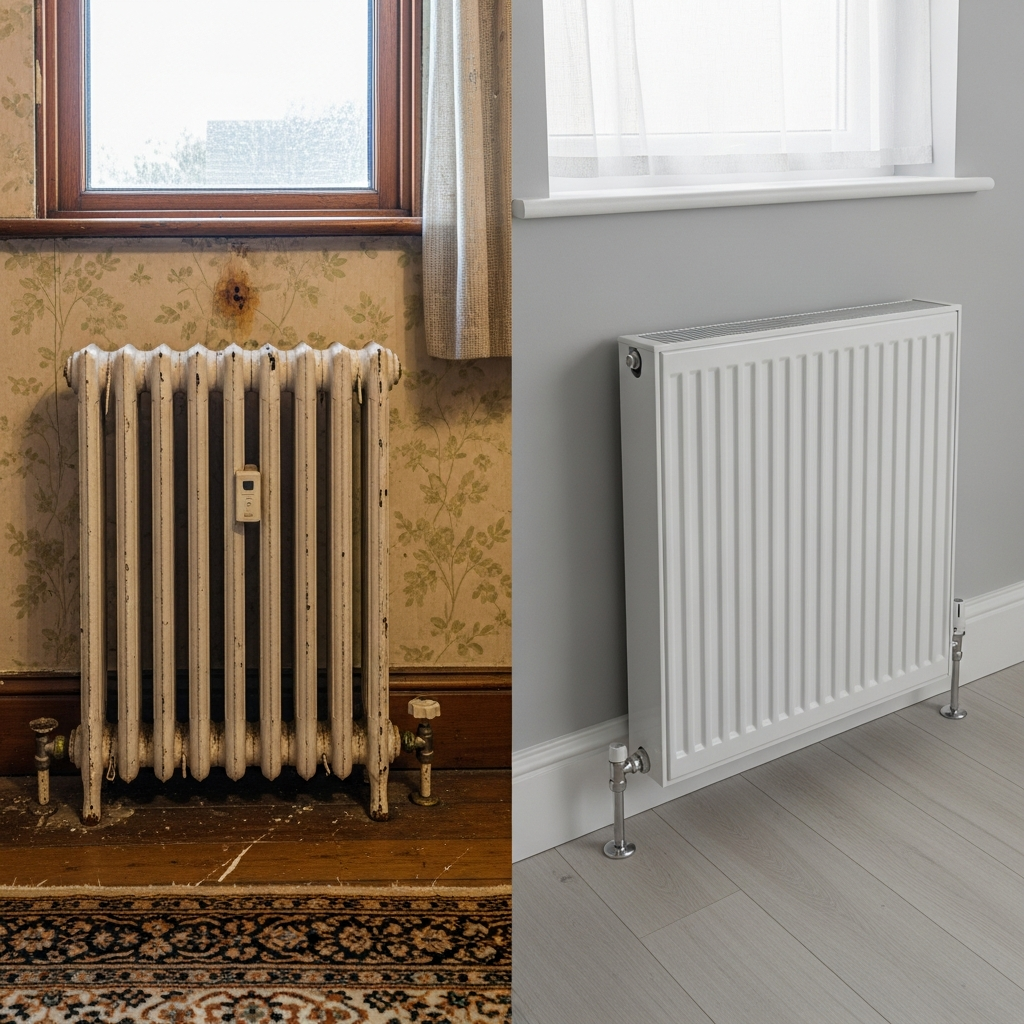
Modern radiators come in a wide range of styles, including sleek vertical panels, slim aluminium columns, and compact fan convectors. A larger radiator does not have to be an eyesore — in fact, many homeowners find the modern options look better than the small, dated radiators they replaced.

"If my radiators are too small, the heat pump will not work"

The heat pump will still work, but it will have to run at higher flow temperatures to compensate. This reduces efficiency and increases running costs. It is not a binary pass/fail — it is a spectrum. Getting the radiators right simply means the system operates at its best.

Frequently Asked Questions

Do I really need radiators 1.5-2x bigger for a heat pump?

As a rule of thumb, yes — when comparing against what a boiler system at 75°C would need. However, many UK homes already have slightly oversized radiators (boiler systems were commonly overspecified), so the actual upgrade needed is often less dramatic than the numbers suggest. The room-by-room calculation gives the definitive answer.

Can I avoid upgrading radiators by running the heat pump at a higher temperature?

Yes, but it comes at a cost. Running at 55°C instead of 45°C reduces the need for larger radiators but lowers efficiency by 15–25%, adding £150–£300 per year to your electricity bills. Over the system's lifetime, upgrading radiators is usually more cost-effective.

How much does it cost to upgrade radiators for a heat pump?

Budget £200–£500 per radiator (supply and fit) for standard double-panel convectors. Most homes need 0–5 upgrades, so the typical additional cost is £0–£2,500 on top of the heat pump installation cost.

Does every room need a bigger radiator?

No. Rooms that already have oversized radiators (common in bedrooms and hallways) often need no change. The rooms most likely to need upgrades are living rooms, kitchens, and bathrooms — especially if they currently have small or single-panel radiators.

Should I upgrade radiators before the installer surveys?

No. Wait for the room-by-room heat loss calculation. Your installer will tell you exactly which radiators need upgrading and to what specification. Pre-emptive upgrades risk choosing the wrong sizes.

What if my radiator is already the biggest that fits on the wall?

Consider a fan convector, a vertical radiator, or splitting the output across two smaller radiators on different walls. Your installer will find a practical solution for each room.

Key Takeaway

Heat pump radiators need to be bigger — but not every radiator, and not always by a fixed amount. The 1.5–2x rule of thumb is a useful starting point, but the real answer comes from a room-by-room heat loss calculation matched against your existing radiators at the proposed flow temperature. A thorough survey by an MCS-certified installer will tell you exactly what needs to change — and what does not.