Home Heat Pump Guide

What Does a Heat Pump Survey Involve?

Before a heat pump can be installed in your home, a detailed survey is essential. This is not a quick glance around the property — a proper heat pump survey is a thorough technical assessment that determines what size system you need, where it will go, what modifications are required, and ultimately how much the installation will cost.

Understanding what the survey involves helps you prepare for the visit and ensures you can ask the right questions. It also helps you distinguish between installers who are doing a thorough job and those who are cutting corners.

Why the Survey Matters

The survey is the foundation of your entire heat pump installation. Get it wrong, and everything that follows is compromised:

  • An undersized heat pump will not keep your home warm on the coldest days, leading to supplementary electric heating and high bills
  • An oversized heat pump will short-cycle (switch on and off frequently), reducing efficiency and accelerating wear on components
  • Incorrect radiator assessment means the system cannot deliver enough heat at the low flow temperatures where heat pumps are most efficient
  • Poor positioning of the outdoor unit can cause noise complaints, reduced performance, or planning issues

Under MCS (Microgeneration Certification Scheme) standards, a detailed heat loss calculation is mandatory for every installation. Any installer who offers to quote without surveying your property is not following MCS requirements and should be avoided.

What the Surveyor Checks: Room by Room

Room Measurements

The surveyor measures every heated room in the property, recording:

  • Length, width, and ceiling height: Using a laser measure for accuracy. These determine the volume of each room and its heating requirement.
  • Window dimensions and type: Single glazed, double glazed, or triple glazed windows all have different thermal properties. The surveyor notes the size and glazing type of every window.
  • Door dimensions and type: External doors are heat loss points. The surveyor notes their size and construction (solid wood, glazed, uPVC, etc.).
  • Wall construction: Solid brick, cavity wall (filled or unfilled), stone, timber frame, or other construction types each have different insulation values. The surveyor may use a borescope or other tools to determine wall construction if it is not obvious.

Insulation Assessment

For each room and the property as a whole, the surveyor evaluates:

  • Loft insulation: Is it present, and how thick is it? Current building regulations recommend at least 270mm of mineral wool in the loft. Less than this increases heat loss and may need addressing before the heat pump is installed.
  • Cavity wall insulation: If the property has cavity walls, are they filled? The surveyor may check by looking for drill marks on the external walls or by using a borescope through a small hole.
  • Solid wall insulation: Older properties with solid walls lose significantly more heat. The surveyor notes whether internal or external insulation has been fitted.
  • Floor insulation: Ground floor type (solid concrete, suspended timber) and whether any insulation is present
  • Draught proofing: The condition of window and door seals, letterbox draught excluders, and any obvious air leakage points

Existing Radiator Assessment

Every radiator in the property is assessed:

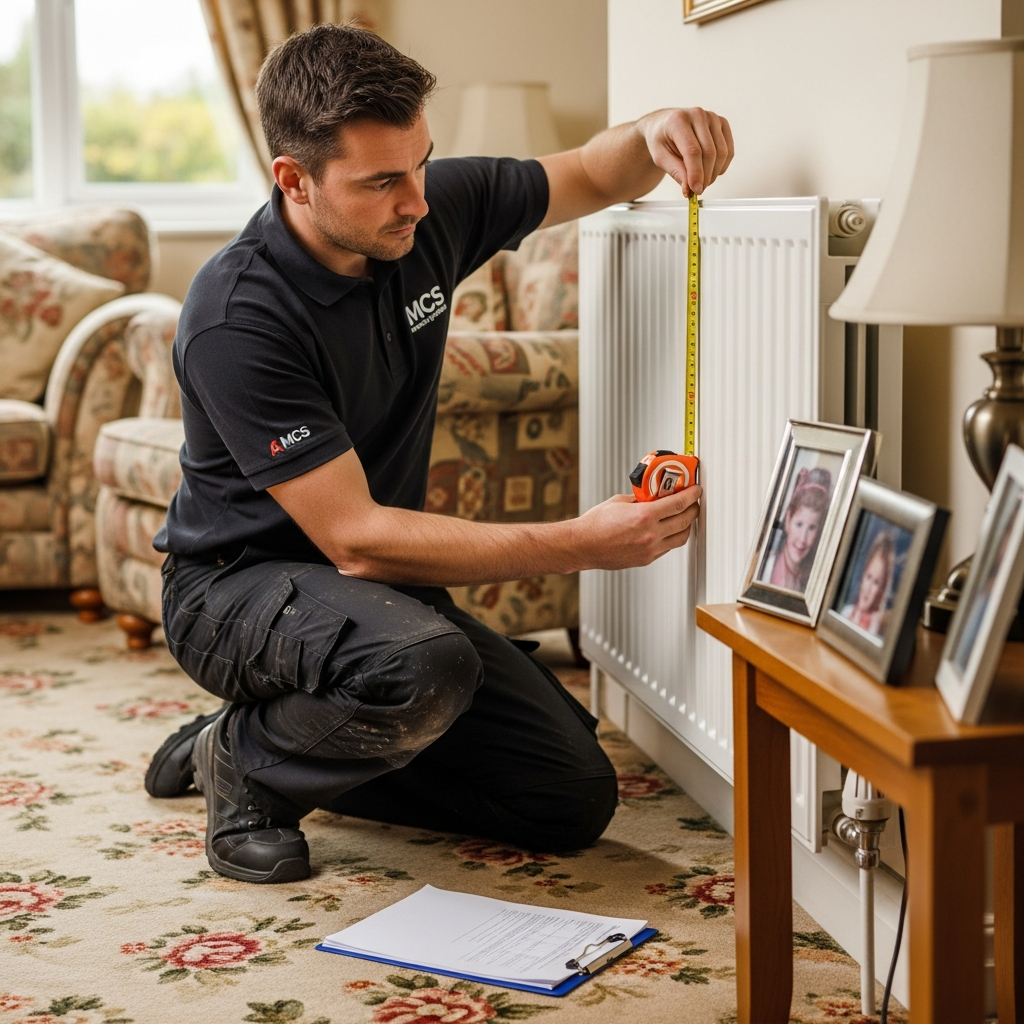
  • Size and type: The surveyor measures each radiator (height, width, and depth) and notes whether it is a single panel, double panel, or convector type. This determines its heat output.
  • Heat output at low flow temperatures: Here is the crucial point. Radiator output is rated at a flow temperature of 75 degrees Celsius (Delta T 50). Heat pumps work most efficiently at flow temperatures of 35 to 45 degrees Celsius. At these lower temperatures, a radiator produces roughly 40 to 60 percent of its rated output. The surveyor calculates whether each radiator is large enough to heat its room at lower flow temperatures.
  • Condition: Old, corroded, or leaking radiators may need replacing regardless of size
  • Thermostatic radiator valves (TRVs): Whether they are fitted, working, and appropriate for heat pump operation

If some radiators are too small for heat pump operation, the surveyor will recommend replacements. This is one of the most common additional costs in a heat pump installation. Not every radiator needs upgrading — typically only the most undersized ones in the rooms with the highest heat loss.

Hot Water Assessment

The surveyor evaluates your hot water needs and current setup:

  • Current cylinder: If you have a hot water cylinder, the surveyor checks its size, condition, and suitability. Heat pumps generally need a larger cylinder than a gas boiler — typically 200 to 300 litres for a typical family home, compared to the 120 to 150 litres common with combi boiler replacements.
  • Space for a new cylinder: If you currently have a combi boiler (no cylinder), the surveyor identifies where a new cylinder will be installed. This is one of the biggest practical challenges in many homes, particularly smaller properties.
  • Hot water demand: Number of bathrooms, showers, and occupants all affect cylinder sizing
  • Immersion heater: Whether the cylinder has (or needs) an immersion heater as a backup or for periodic legionella pasteurisation cycles

Outdoor Unit Positioning

The surveyor spends considerable time assessing where the outdoor unit will go. This involves:

Space and Access

  • Available space: The unit needs a clear area of at least 1 metre by 1 metre, with adequate clearance on all sides for airflow (typically 300mm minimum on the sides and rear, and more at the front where air is drawn in or discharged)
  • Level surface: The unit must sit on a level base. The surveyor assesses whether the ground is suitable for a concrete pad or whether wall brackets are more appropriate.
  • Access for installation: Can the unit be carried to the proposed location? Outdoor units weigh 60 to 120 kilograms and may be too large for narrow side passages.
  • Access for servicing: The unit needs accessible service points. Cramming it into a tight corner may cause problems for future annual servicing.

Noise Assessment

The surveyor considers noise impact:

  • Distance to neighbour boundaries: Under permitted development rules, the heat pump must meet specific noise limits at the nearest neighbour's property
  • Proximity to bedrooms: Both your own and your neighbours' bedroom windows should be considered
  • Reflective surfaces: Walls, fences, and other surfaces near the unit can amplify noise through reflection
  • Shielding options: Whether acoustic barriers or careful positioning can mitigate any noise concerns

Pipe Run Assessment

The route from the outdoor unit to the indoor components is planned:

  • Distance: Shorter pipe runs are more efficient. Very long runs (over 20 to 30 metres) can reduce system performance.
  • Wall penetrations: Where pipes will pass through external walls, and whether this is straightforward or requires specialist drilling through thick stone or structural walls
  • Routing: Whether pipes can run neatly along walls, through voids, or whether external cladding is needed to conceal them

Electrical Supply Assessment

The electrical assessment is often overlooked but is critically important:

  • Main fuse rating: Most domestic heat pumps require a dedicated circuit of 16 to 32 amps. If your property's main fuse is only 60 amps (common in older homes), there may not be enough capacity for a heat pump on top of your existing electrical demand. The surveyor checks the main fuse rating and total demand.
  • Consumer unit: Whether there is a spare way in the consumer unit for a dedicated heat pump circuit, and whether the consumer unit meets current regulations
  • DNO notification: Installations above certain thresholds require notification to the Distribution Network Operator. Your installer handles this, but the surveyor identifies the need early.
  • Three-phase supply: Larger heat pumps (above about 12 to 16 kilowatts) may require a three-phase supply. If this is needed and not already present, it is a significant additional cost.

EPC Review

The surveyor reviews your property's Energy Performance Certificate (EPC):

  • Current rating: Properties rated E, F, or G may need insulation improvements before a heat pump installation makes economic sense
  • Recommended improvements: The EPC lists recommended energy efficiency measures and their estimated impact. The surveyor cross-references these with their own assessment.
  • EPC validity: An EPC is valid for 10 years. If yours is outdated or inaccurate, a new assessment may be needed for grant applications.

Note that EPCs are generated using standardised assumptions and may not perfectly reflect your property's actual heat loss. The surveyor's own heat loss calculation, based on measured data, is more accurate and takes precedence for system design.

What Makes a Good Survey vs a Poor One

The quality of the survey directly affects the quality of the installation. Here are the red flags and green flags:

Signs of a Thorough Survey

  • The surveyor measures every room individually with a laser measure
  • They check wall construction, not just room sizes
  • They measure every radiator
  • They access the loft to check insulation
  • They spend time outside assessing the unit location and noise impact
  • They check the consumer unit and main fuse
  • The visit takes 1.5 to 3 hours
  • They ask about your hot water usage and habits

Warning Signs of a Poor Survey

  • The survey takes less than 45 minutes for a typical house
  • No room-by-room measurements — just a quick walk around
  • They offer a quote based on floor area alone without measuring individual rooms
  • They do not check the loft or wall construction
  • They do not measure radiators
  • They do not assess the electrical supply
  • No heat loss calculation is provided with the quote

How to Prepare for a Heat Pump Survey

You can help the survey go smoothly by:

  • Having your EPC available (you can find it at gov.uk/find-energy-certificate)
  • Knowing your current annual heating costs or energy bills
  • Ensuring all rooms are accessible, including the loft
  • Clearing access to the consumer unit (fuse board)
  • Knowing where your property boundary lines are for noise assessment
  • Having any building plans or renovation records available
  • Thinking about where you could accommodate a hot water cylinder if you do not currently have one

After the Survey

Following the survey, your installer uses the collected data to:

  1. Complete a detailed heat loss calculation (often using MCS-approved software)
  2. Select the correct heat pump size for your property
  3. Design the system layout including cylinder, controls, and any radiator changes
  4. Prepare a comprehensive quotation
  5. Identify any preparatory work needed before installation

This design process typically takes 3 to 7 working days after the survey visit. The quotation you receive should include the full heat loss calculation results, demonstrating that the proposed system is correctly sized for your home. If it does not, ask for it — this is a basic MCS requirement and any reputable installer will provide it.

Frequently Asked Questions

How long does a heat pump survey take?

A thorough survey for a typical 3-bedroom house takes 1.5 to 3 hours. Larger or more complex properties take longer. If a surveyor spends less than an hour in a standard house, they may not be checking everything they should.

Do I have to pay for the survey?

Practice varies between installers. Some offer free surveys as part of the quotation process. Others charge £100 to £300 for a detailed survey, sometimes refundable if you proceed with the installation. A paid survey is not necessarily a negative sign — it often indicates a more thorough assessment.

Should I get multiple surveys?

Yes, getting surveys from at least two or three MCS-certified installers is recommended. Comparing their heat loss calculations, system recommendations, and overall approach helps you identify the best installer and the most appropriate system for your property.

What if the survey reveals my home is not suitable for a heat pump?

This is rare for well-insulated properties, but a good surveyor will be honest if your home needs preparatory work. Common issues include insufficient insulation (particularly solid wall properties without insulation), a very small electrical supply, or no space for a hot water cylinder. These are usually solvable problems, but they add to the overall cost and timeline.

Can a survey be done remotely?

A desktop assessment using EPC data and floor plans can give a rough indication of suitability, but it is no substitute for an in-person survey. The MCS requires a physical survey and room-by-room heat loss calculation. Any installer offering to design a system without visiting your property is not meeting industry standards.

Does the surveyor need to see my energy bills?

It is helpful but not essential. Your energy bills give the surveyor a real-world benchmark to compare against their heat loss calculation. If the calculated heat demand is wildly different from what your bills suggest, it may indicate that the home has unmeasured heat loss (draughts, poor insulation) or that the existing boiler is significantly oversized.