Home Heat Pump Guide

Airtightness and Heat Pump Efficiency

When homeowners think about heat loss, they picture insulation — loft rolls, cavity fill, double glazing. But there is another factor that is just as important and far less understood: airtightness. The gaps, cracks, and unsealed penetrations in your home's structure allow warm air to escape and cold air to infiltrate, and this uncontrolled air leakage can account for 15 to 25 per cent of total heat loss in a typical UK home.

For heat pump owners, airtightness matters more than it does with a gas boiler. This guide explains why, shows you where air leakage occurs, and walks you through the practical steps to improve your home's airtightness before or after a heat pump installation.

What Is Airtightness and How Is It Measured?

Airtightness refers to how well the building envelope resists uncontrolled air movement. It is measured using a blower door test, where a calibrated fan is fitted to an external doorway and used to pressurise or depressurise the home. The result is expressed as air permeability — cubic metres of air leakage per hour, per square metre of building envelope, at a pressure difference of 50 Pascals (written as m3/h/m2 at 50Pa).

To put the numbers in context:

  • 15 to 20 m3/h/m2: Typical older UK home with no airtightness work — very leaky
  • 10 m3/h/m2: Current Building Regulations maximum for new builds
  • 5 m3/h/m2: Good airtightness — achievable in most retrofits with focused work
  • 3 m3/h/m2: Very good — typical of high-performance retrofits
  • 0.6 m3/h/m2 or less: Passivhaus standard — exceptionally airtight

Most existing UK homes sit somewhere between 10 and 20 m3/h/m2. Reducing this to 5 or below makes a significant difference to both heat loss and heat pump performance.

Why Airtightness Matters More for Heat Pumps Than Gas Boilers

Heat Pumps Deliver Heat Gently

A gas boiler can blast hot water through radiators at 70 to 80 degrees Celsius, quickly compensating for heat lost through draughts. A heat pump operates more gently, typically delivering water at 35 to 45 degrees. This lower temperature works brilliantly in a well-sealed home, but in a draughty one, the heat pump may struggle to keep up with the constant influx of cold air.

Air Leakage Increases Heat Loss Calculations

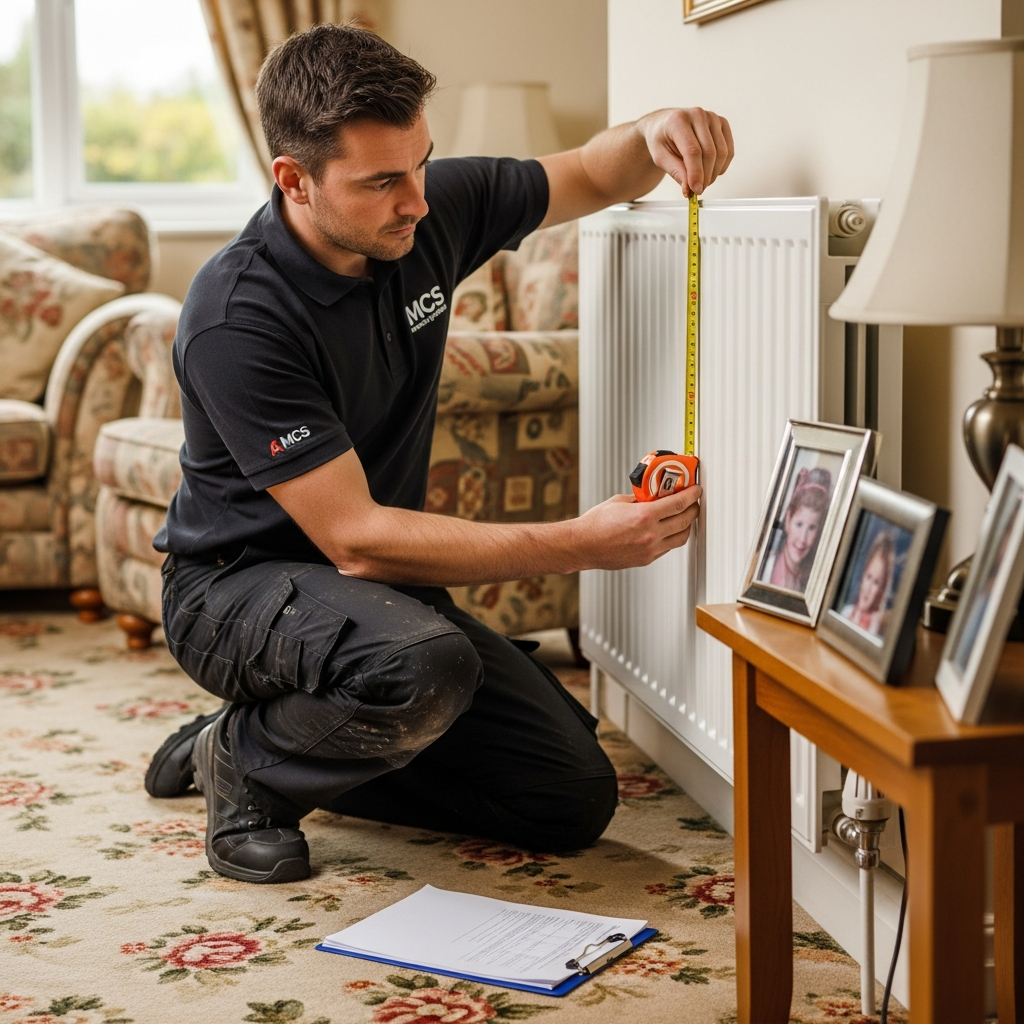
When an MCS installer carries out a heat loss calculation, ventilation heat loss is a significant component. This includes both deliberate ventilation (trickle vents, extractor fans) and uncontrolled air leakage. A leakier house means a higher ventilation heat loss figure, which means a larger heat pump is specified.

Reducing air permeability from 15 m3/h/m2 to 5 m3/h/m2 can reduce the ventilation component of heat loss by 50 per cent or more. In a typical three-bedroom semi, this could reduce the total heat loss calculation by 1 to 2kW, potentially allowing a smaller heat pump to be specified.

COP Stays Higher at Lower Flow Temperatures

The efficiency of a heat pump is expressed as its coefficient of performance (COP). COP is heavily influenced by flow temperature — the lower the flow temperature, the higher the COP. In a draughty home, homeowners often turn up the flow temperature to compensate for the feeling of cold, which directly reduces COP and increases running costs.

A well-sealed home holds heat better and feels warmer at lower air temperatures. This means you can run your heat pump at 35 degrees rather than 45 degrees, improving COP from perhaps 3.0 to 4.0 — a 25 per cent reduction in electricity consumption for the same heat output.

Where Does Air Leak From?

Air leakage is rarely visible. It occurs through hundreds of small gaps, cracks, and unsealed penetrations throughout the building. The most common culprits in UK homes are:

Around Windows and External Doors

Gaps between window frames and walls, worn seals on opening windows, and poorly fitting doors are major sources of air leakage. You can often feel these draughts on a windy day.

Loft Hatches

The loft hatch is one of the biggest single air leakage points in most homes. An unsealed loft hatch allows warm air to rise directly into the cold loft space. Adding a rubber compression seal and latches to hold the hatch firmly closed is a quick and effective fix.

Floorboard Gaps and Service Penetrations

In homes with suspended timber floors, gaps between floorboards and around pipework penetrations allow cold air from below the floor to enter the living space. Sealing these gaps can make a noticeable difference to comfort and heat loss.

Recessed Downlights

Old-style recessed downlights punch holes directly through the ceiling into the loft space, creating both air leakage paths and gaps in the insulation layer. Airtight downlight covers installed from the loft side are an effective solution.

Electrical Sockets and Switches on External Walls

Sockets and switches on external walls often have gaps between the back box and the wall, allowing air to infiltrate from the cavity. Airtight socket gaskets are cheap and easy to fit.

Letterboxes and Keyholes

A standard letterbox can allow a surprising amount of cold air into the hallway. Brush-strip letterbox covers and keyhole covers are simple, inexpensive fixes.

Chimney Flues

Open chimneys act as powerful ventilation stacks, drawing warm air out of the house continuously. If you are no longer using a fireplace, a chimney balloon or chimney sheep can dramatically reduce this heat loss.

How to Improve Airtightness: A Practical Guide

The good news is that many airtightness improvements are low-cost and can be done as DIY projects. Here is a prioritised approach:

Quick Wins (Under £200)

  • Seal the loft hatch with compression strips and add latches — £20 to £40
  • Fit brush strips to letterboxes — £10 to £20
  • Install chimney balloons or chimney sheep — £20 to £35 each
  • Add draught excluders to external doors — £5 to £15 per door
  • Fit airtight covers over recessed downlights from the loft side — £3 to £5 each
  • Seal gaps around pipework penetrations with expanding foam or mastic — £10 to £20
  • Fit socket gaskets behind sockets on external walls — £1 to £2 each

Medium Investment (£200 to £1,000)

  • Replace worn window and door seals — £100 to £300 for a whole house
  • Seal gaps between floorboards and around skirting boards — £100 to £400
  • Professional draught-proofing of sash windows — £100 to £200 per window

Larger Investment (£1,000+)

  • Replace old, poorly sealed windows with modern units — £300 to £800 per window
  • Install a continuous airtightness membrane during renovation — varies widely
  • Commission a professional blower door test to identify leakage points — £200 to £400

Airtightness and Ventilation: Getting the Balance Right

A common concern is that making a home too airtight will cause condensation, damp, or poor indoor air quality. This is a valid concern, but the solution is straightforward: as you improve airtightness, move from uncontrolled ventilation (draughts) to controlled ventilation (purpose-designed systems).

For most UK homes being retrofitted with a heat pump, the practical options are:

  • Trickle vents in windows: These provide background ventilation and are required by Building Regulations in new windows.
  • Mechanical extract ventilation (MEV): Continuous low-level extraction from wet rooms, with air entering through trickle vents. Simple and relatively inexpensive.
  • Mechanical ventilation with heat recovery (MVHR): The gold standard for airtight homes. An MVHR system extracts stale air from kitchens and bathrooms while supplying fresh, filtered air to living rooms and bedrooms, recovering up to 90 per cent of the heat from the extracted air. MVHR works best in homes with air permeability below 5 m3/h/m2.

An MVHR system pairs exceptionally well with a heat pump. The heat recovery reduces the ventilation heat loss further, meaning the heat pump needs to do even less work. Installation costs for MVHR range from £3,000 to £7,000, which is a significant investment but delivers excellent long-term energy savings in well-sealed homes.

How Much Difference Does Airtightness Make?

To illustrate the impact, consider a typical 1970s three-bedroom semi-detached house:

  • Before airtightness work: Air permeability 15 m3/h/m2. Heat loss calculation: 10.5kW. Requires a 11kW heat pump. Estimated annual electricity consumption for heating: 4,200 kWh (£1,008 at 24p/kWh).
  • After airtightness work: Air permeability reduced to 5 m3/h/m2. Heat loss calculation: 8.5kW. Requires a 8-9kW heat pump. Estimated annual electricity consumption for heating: 3,200 kWh (£768 at 24p/kWh).

That is a saving of roughly £240 per year in running costs, plus potentially £1,000 to £2,000 saved upfront on a smaller heat pump. The airtightness improvements that achieve this — loft hatch seal, draught-proofing, chimney balloon, socket gaskets — might cost £300 to £500 in total. The payback is rapid.

Should You Get a Blower Door Test?

A blower door test costs £200 to £400 and gives you an exact measurement of your home's airtightness along with identification of the main leakage points. It is not essential for every homeowner, but it is valuable if you are planning a comprehensive retrofit and want to measure the impact of your improvements.

Some MCS installers include an airtightness assessment as part of their heat pump survey. Ask your installer whether they consider airtightness when sizing your system.

Frequently Asked Questions

Can a house be too airtight for a heat pump?

No. A very airtight house is ideal for a heat pump because it minimises heat loss and allows the system to run at maximum efficiency. However, very airtight homes do need controlled ventilation — either trickle vents and extract fans, or ideally an MVHR system — to maintain good indoor air quality.

How much does it cost to improve airtightness?

Basic draught-proofing measures can be done for £200 to £500 as a DIY project. Professional draught-proofing of a typical three-bedroom home costs £300 to £800. A blower door test to measure results costs £200 to £400.

Will improving airtightness cause damp or condensation?

Not if you maintain adequate ventilation. As you seal up uncontrolled draughts, ensure trickle vents in windows are open and that extract fans in kitchens and bathrooms are working. For very airtight homes (below 5 m3/h/m2), consider MVHR for the best balance of air quality and energy efficiency.

Should I improve airtightness before or after installing a heat pump?

Before, if possible. This allows the heat loss calculation to reflect the improved building, resulting in a correctly sized (smaller) heat pump. If your heat pump is already installed, airtightness improvements will still reduce running costs — they just will not affect the size of unit already fitted.

Do I need to improve airtightness if I already have good insulation?

Yes. Insulation and airtightness address different types of heat loss. Insulation reduces conductive heat loss through walls, floors, and roofs. Airtightness reduces convective heat loss — warm air physically leaving the building through gaps. A home needs both to perform well with a fabric first approach.

What is a good airtightness target for an existing UK home with a heat pump?

Aim for 5 m3/h/m2 or below. This is achievable in most homes through focused draught-proofing work and is the level at which you start to see significant improvements in heat pump performance and comfort. Going below 3 m3/h/m2 is excellent but typically requires more extensive work and an MVHR system for ventilation.