UK Heat Pump Installations: Monthly Tracker and Trend Report
The UK installed approximately 105,000 heat pumps in 2025 — a record year, but still only a fraction of what is needed to meet decarbonisation targets. This regularly updated tracker shows monthly installation numbers, quarterly trends, regional breakdowns, and how the UK compares to its own targets. The data comes from MCS installation records, DESNZ BUS grant statistics, and industry sources.
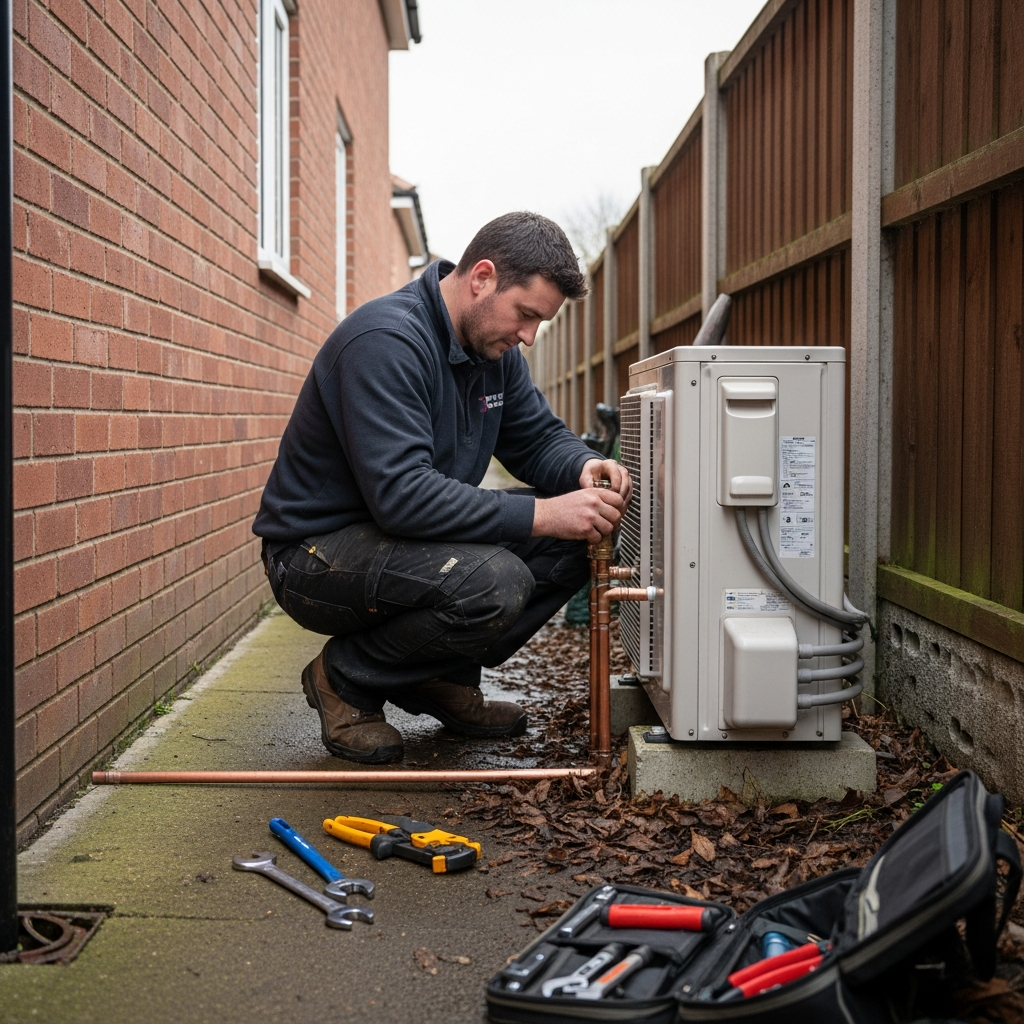
Tracking heat pump installations matters because the numbers tell us whether the UK is making genuine progress on decarbonising home heating — or whether the government's targets are just aspirational. The data also reveals where the market is working, where it is stalling, and what policy changes might be needed.
We update this tracker quarterly using official data sources. The most recent update covers data through February 2026.
Ready to become one of these statistics?
Calculate your heat pump costsFree, instant estimates based on your property and location.
Headline Numbers for 2026
~105,000
Total UK heat pump installations in 2025
8,750
Average monthly installations (2025)
+37%
Year-on-year growth (2025 vs 2024)
17.5%
Progress toward 600,000/year target
The growth rate is encouraging but the absolute numbers remain far short of what is needed. At current growth rates, the UK would not reach 600,000 annual installations until the mid-2030s — several years behind the government's 2028 target. The Climate Change Committee has repeatedly flagged this gap in its progress reports.
Monthly Installation Data
| Month | 2024 | 2025 | YoY Change |
|---|---|---|---|
| January | 5,200 | 7,100 | +37% |
| February | 5,400 | 7,400 | +37% |
| March | 6,100 | 8,200 | +34% |
| April | 6,300 | 8,600 | +37% |
| May | 6,800 | 9,100 | +34% |
| June | 6,600 | 8,900 | +35% |
| July | 6,200 | 8,500 | +37% |
| August | 5,800 | 7,900 | +36% |
| September | 7,200 | 10,100 | +40% |
| October | 7,800 | 10,800 | +38% |
| November | 7,400 | 10,200 | +38% |
| December | 6,100 | 8,200 | +34% |
Source: MCS installation database. Figures include air source and ground source heat pump installations. Some installations may occur without MCS certification and are not captured here.
The seasonal pattern is clear: installations peak in September-November (as homeowners prepare for winter) and dip in December-February (when installation conditions are less favourable and holiday periods reduce working days). This seasonality is expected but creates workforce utilisation challenges for installers.
Quarterly Trends
The quarterly view shows steady acceleration. Q4 2025 saw 29,200 installations — almost double Q4 2023's 16,400. The compound annual growth rate across these two years is approximately 33%.
Regional Breakdown
Heat pump adoption varies significantly by region. The following table shows 2025 installation totals by region, alongside per-capita adoption rates:
| Region | 2025 Installations | Share of UK Total | Per 100,000 Households | YoY Growth |
|---|---|---|---|---|
| South West | 14,700 | 14.0% | 582 | +42% |
| South East | 14,200 | 13.5% | 389 | +35% |
| East of England | 12,600 | 12.0% | 492 | +38% |
| Scotland | 11,200 | 10.7% | 445 | +44% |
| North West | 10,500 | 10.0% | 328 | +36% |
| West Midlands | 9,400 | 9.0% | 375 | +40% |
| Yorkshire & Humber | 8,800 | 8.4% | 372 | +34% |
| East Midlands | 7,600 | 7.2% | 376 | +32% |
| London | 6,800 | 6.5% | 189 | +28% |
| Wales | 5,200 | 5.0% | 380 | +38% |
| North East | 3,900 | 3.7% | 338 | +30% |
Source: MCS installation data 2025, ONS household estimates. Per-capita rate based on total households per region.
The South West leads on both absolute numbers and per-capita adoption, driven by its high proportion of off-gas-grid homes that benefit most from switching to heat pumps. London lags significantly — its per-capita adoption rate is roughly one-third of the South West's, reflecting higher costs, more complex properties, and a predominantly gas-heated housing stock.
Scotland's strong growth (+44%) reflects the impact of additional Scottish Government funding through Home Energy Scotland, which tops up the BUS grant. For more detail on regional grant availability, see our grants guide, and for regional cost differences, see our heat pump cost guide.
BUS Grant Uptake
The Boiler Upgrade Scheme remains the primary financial incentive for heat pump adoption. According to DESNZ statistics, BUS grant applications have followed a similar growth trajectory to overall installations:
72,400
BUS grant applications in 2025
68,100
Applications approved (94% approval rate)
£511m
Total grant funding disbursed in 2025
65%
Share of all installations using BUS grant
Approximately 65% of all heat pump installations use the BUS grant, meaning about 35% of installations proceed without it. This includes new-build properties (not eligible), social housing schemes (which use separate funding), and some homeowners who do not meet the eligibility criteria or choose not to apply. For a deep dive into grant data, see our BUS grant data report.
Check if you qualify for the £7,500 BUS grant
Get quotes from MCS installersMCS-certified installers handle the grant application for you.
How the UK Compares to Its Targets
The government has set ambitious targets for heat pump adoption as part of its Net Zero strategy. Here is how current progress measures up:
| Target | Required By | Current Progress | On Track? |
|---|---|---|---|
| 600,000 installations per year | 2028 | ~105,000 in 2025 (17.5%) | No |
| 1 million homes with heat pumps | 2030 | ~420,000 cumulative | Possible |
| All new builds with low-carbon heating | 2025 (Future Homes Standard) | ~75% of new builds | Nearly |
| No new gas boiler installations | 2035 | 1.6m gas boilers sold in 2025 | No |
Sources: DESNZ policy documents, CCC progress reports, MCS data, HHIC boiler sales data
The gap between current progress and the 600,000 target is the most concerning metric. Closing it would require a six-fold increase in annual installations over just two years — something the Climate Change Committee has described as "extremely challenging without transformative policy intervention."
International Comparison
The UK's heat pump adoption rates look particularly modest when compared to European peers:
The UK installs roughly 3.7 heat pumps per 1,000 households — less than a seventh of Norway's rate and less than half of Germany's. The Scandinavian countries demonstrate that cold climates are no barrier to mass heat pump adoption — a point that undermines one of the most common objections. If you are curious about cold weather performance, see our analysis of heat pump running costs guide.
What Needs to Happen Next
Based on our analysis of the installation data and market dynamics, several interventions would accelerate adoption:
- Rebalance electricity and gas prices. The current price ratio (electricity roughly 3.6x gas per kWh) makes heat pumps uncompetitive on running costs for many gas-heated homes. Shifting environmental levies from electricity bills to gas bills or general taxation would improve the economics immediately.
- Extend and increase the BUS grant. Grant certainty drives consumer confidence. Short funding cycles create boom-bust demand that destabilises the installer market.
- Mandate heat pump readiness in all home sales. Requiring an EPC with heat pump assessment data at point of sale would normalise the technology and create natural switching points.
For homeowners considering the switch now, the combination of the BUS grant, growing installer competition driving prices down (as shown in our heat pump cost guide), and improving technology makes 2026 a strong year to act. If you are also considering solar panels, combining both installations can maximise savings and simplify the process.
Frequently Asked Questions
How many heat pumps are installed in the UK each month?
As of early 2026, approximately 8,000-10,000 heat pumps are being installed per month in the UK according to MCS data. This represents a 35-40% increase on 2024 monthly figures but remains below the trajectory needed for the government's 2028 target.
Is the UK on track for its 600,000 heat pump target?
No. Current run rates of around 100,000-120,000 per year mean the UK is achieving roughly 17-20% of the 600,000 target. Significant acceleration in installation rates, installer training, and grant funding would be needed to close this gap.
Which regions install the most heat pumps?
The South West, South East, and East of England consistently lead on installation numbers, driven by higher proportions of off-gas-grid properties and stronger installer networks. Scotland also shows strong per-capita adoption thanks to additional grant funding.
Are heat pump installation rates accelerating?
Yes. Year-on-year growth has been approximately 35-40% in 2025-2026. The acceleration is driven by increased BUS grant values, growing installer numbers, falling equipment costs, and rising consumer awareness.
Join the growing number of UK heat pump owners
Calculate your costs and savingsFree, instant, personalised to your property. See what a heat pump would actually cost you.
UK Heat Pump Adoption in Context
Heat pump installation rates are a barometer of the UK's progress on home heating decarbonisation. Every installation contributes to reducing the 14% of UK carbon emissions that come from heating buildings. The data connects to government grant policy, installation costs, installer workforce capacity, and the competitiveness of heat pumps versus gas boilers. Alongside solar energy, improved insulation, and smart energy management, heat pumps form a cornerstone of the UK's path to net zero homes.