Home Heat Pump Guide

Heat Pump Radiator Cost Per Room

When you switch from a gas boiler to a heat pump, some of your existing radiators may need upgrading. Heat pumps run at lower flow temperatures (35°C to 50°C compared to 60°C to 80°C for a gas boiler), which means radiators need to be larger to deliver the same heat output. Not every radiator will need replacing — typically 30% to 50% — but budgeting for upgrades is an important part of planning your heat pump installation.

This guide breaks down radiator costs room by room and by house size, so you know what to expect.

Why Heat Pump Systems Need Larger Radiators

A radiator's heat output depends on the temperature difference between the radiator surface and the room air. With a gas boiler running at 70°C in a 20°C room, the temperature difference is 50°C, and a standard double-panel radiator delivers its full rated output.

With a heat pump running at 45°C in a 20°C room, the temperature difference is only 25°C — half as much. The same radiator delivers roughly 40% to 50% of its rated output. To compensate, you need a bigger radiator with more surface area.

The good news is that "bigger" does not always mean enormous. Upgrading from a 600mm x 1000mm double-panel radiator to a 600mm x 1400mm double-panel radiator — or switching to a double-panel plus (P+) type — often provides the additional output needed. The difference is noticeable but rarely dramatic.

Radiator Cost Per Room

Here are typical costs for supplying and installing a correctly sized radiator for a heat pump system, by room type. These prices are for mid-range panel radiators — the most common type used in UK homes.

Living Room

  • Typical radiator size: 600mm x 1400mm to 600mm x 1800mm double-panel plus (K2/P+)
  • Radiator cost: £120 to £250
  • Installation labour: £100 to £180
  • Total per radiator: £220 to £430
  • Notes: Living rooms often need two radiators, one either side of a large window or on opposite walls. Budget for £440 to £860 for a large living room

Kitchen

  • Typical radiator size: 600mm x 1000mm to 600mm x 1200mm double-panel plus
  • Radiator cost: £80 to £180
  • Installation labour: £100 to £160
  • Total per radiator: £180 to £340
  • Notes: Kitchens generate heat from cooking, so the radiator can sometimes be smaller. Wall space is often limited by units and appliances — consider a vertical radiator or skirting board heating

Main Bedroom

  • Typical radiator size: 600mm x 1000mm to 600mm x 1400mm double-panel
  • Radiator cost: £80 to £200
  • Installation labour: £100 to £160
  • Total per radiator: £180 to £360
  • Notes: Bedrooms are typically set to 18°C rather than 21°C, so the heat demand is lower. Existing radiators may be adequate without replacement

Second/Third Bedroom

  • Typical radiator size: 600mm x 800mm to 600mm x 1000mm double-panel
  • Radiator cost: £60 to £150
  • Installation labour: £100 to £150
  • Total per radiator: £160 to £300
  • Notes: Smaller rooms with lower temperature targets. Often the existing radiator is sufficient

Bathroom

  • Typical radiator size: Heated towel rail 1200mm x 500mm or 1800mm x 500mm
  • Radiator cost: £80 to £200
  • Installation labour: £100 to £160
  • Total per radiator: £180 to £360
  • Notes: Towel rails at low flow temperatures may not provide enough heat for a bathroom — consider adding underfloor heating beneath tiles or supplementing with a larger towel rail

Hallway/Landing

  • Typical radiator size: 600mm x 600mm to 600mm x 800mm single or double-panel
  • Radiator cost: £50 to £120
  • Installation labour: £80 to £140
  • Total per radiator: £130 to £260
  • Notes: Hallways and landings have low heat demands and smaller existing radiators may be adequate. Space is often tight — vertical radiators or compact designs work well

Total Radiator Budget by House Size

Not every radiator needs replacing. A good MCS installer will survey each radiator and calculate whether its output at the heat pump flow temperature meets the room's heat demand. Typically, 30% to 50% of radiators need upgrading.

2-Bedroom Flat (5-6 radiators)

  • Radiators needing replacement: 2 to 3
  • Total radiator budget: £400 to £900

3-Bedroom Semi-Detached (8-10 radiators)

  • Radiators needing replacement: 3 to 5
  • Total radiator budget: £700 to £1,800

4-Bedroom Detached (10-14 radiators)

  • Radiators needing replacement: 4 to 7
  • Total radiator budget: £1,000 to £2,800

5-Bedroom Detached (14-18 radiators)

  • Radiators needing replacement: 5 to 9
  • Total radiator budget: £1,400 to £3,600

These figures cover standard mid-range panel radiators. Designer radiators, vertical radiators, or column radiators cost more — often double or triple the price of a standard panel radiator.

What Determines Whether a Radiator Needs Replacing?

Your installer will calculate the heat output of each existing radiator at the proposed heat pump flow temperature (typically 45°C for a retrofit) and compare it to the room's heat demand from the room-by-room heat loss calculation.

Radiators That Usually Survive

  • Large double-panel or double-panel-plus radiators in small rooms
  • Radiators in well-insulated rooms with low heat demand
  • Bedroom radiators (lower target temperature means lower demand)
  • Radiators that were originally oversized for the room

Radiators That Usually Need Replacing

  • Small single-panel radiators in large rooms
  • Radiators in rooms with high heat loss (large windows, poor insulation, external walls)
  • Living room radiators — these rooms have the highest demand and existing radiators are often borderline
  • Towel rails in bathrooms — most standard towel rails provide insufficient heat at low flow temperatures
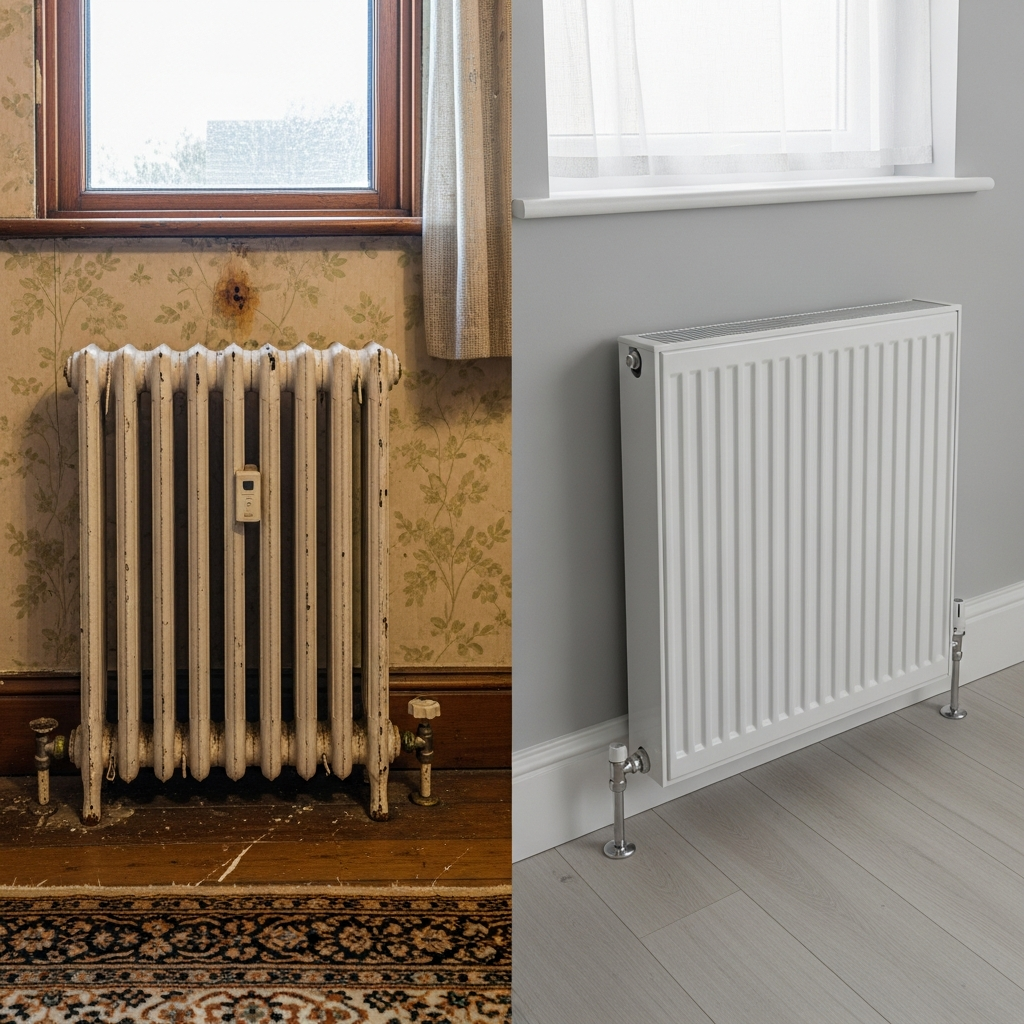
  • Old cast iron radiators — unless they are very large, their output at low temperatures is often inadequate

Ways to Reduce Radiator Replacement Costs

Improve Insulation

Better insulation reduces the heat demand in each room, which means smaller radiators can do the job. Loft insulation, cavity wall insulation, and draught-proofing can all reduce the number of radiators that need upgrading. Consider tackling insulation before or alongside your heat pump installation.

Accept a Slightly Higher Flow Temperature

Running the heat pump at 48°C instead of 42°C reduces the radiator upgrade requirement — more existing radiators will be adequate. The trade-off is a small reduction in heat pump efficiency (roughly 5% to 10% lower COP). For some homes, this is a pragmatic choice that saves money on radiators while only marginally increasing running costs.

Combine Radiators with UFH

Installing underfloor heating in key ground-floor rooms (kitchen, living room) eliminates the need for radiators in those spaces entirely. The remaining upstairs radiators may be adequate because bedrooms have lower heat demands.

Radiator Reflector Panels

Fitting reflective panels behind radiators on external walls directs heat into the room rather than into the wall. This can improve effective radiator output by 5% to 10% and costs only £10 to £20 per radiator. Not enough to avoid replacement on its own, but it helps borderline cases.

Retain and Add

In some rooms, adding a second small radiator alongside the existing one is cheaper than replacing it with a single large radiator — especially if the pipework is easy to extend. Two radiators together provide the increased output needed.

Types of Radiators for Heat Pump Systems

Standard Panel Radiators

The workhouse of UK heating. Available in single-panel (Type 11/K1), double-panel (Type 22/K2), and double-panel-plus (Type 21/P+) configurations. Double-panel-plus offers the best output-to-size ratio and is the most common recommendation for heat pump systems. Brands like Stelrad, Purmo, and Henrad offer wide ranges at competitive prices.

Vertical Radiators

Tall and narrow, vertical radiators work well in rooms with limited wall space — hallways, kitchens, and under windows where standard horizontal radiators cannot fit. They cost more than equivalent horizontal models (typically 30% to 50% premium) but solve layout problems.

Low Surface Temperature (LST) Radiators

Designed for environments where burns are a risk — care homes, nurseries, schools. The outer casing stays below 43°C. With a heat pump running at 40°C to 45°C, standard radiators are already close to these safe temperatures, potentially making LST radiators unnecessary. However, they are still required in certain regulated settings.

Fan-Assisted Radiators

Fan convectors use a small electric fan to blow air over a compact heat exchanger, dramatically increasing output from a small unit. They deliver full rated heat at flow temperatures as low as 35°C, making them ideal for heat pump systems where wall space is limited. Brands like Jaga and Biddle offer models specifically designed for low-temperature heating. They cost £300 to £800 per unit but can replace a much larger conventional radiator.

Is Radiator Replacement Included in the Heat Pump Installation Cost?

It depends on the installer and the quote. Some MCS installers include a radiator survey and a set number of replacements in their overall installation price. Others quote the heat pump installation separately and itemise radiator upgrades as extras.

When comparing quotes for your heat pump installation, always check what is included regarding radiators. A quote that looks cheaper may exclude radiator replacements, making the final cost higher than a more comprehensive quote.

The Boiler Upgrade Scheme grant of £7,500 covers the heat pump and associated installation work, which can include radiator upgrades if they are part of the MCS-certified installation. Check with your installer whether radiator costs are included in the grant-eligible work.

Frequently Asked Questions

How much does it cost to replace radiators for a heat pump?

Individual radiators cost £130 to £430 supplied and installed, depending on size and type. For a three-bedroom house, expect to replace 3 to 5 radiators at a total cost of £700 to £1,800.

Do all radiators need replacing for a heat pump?

No. Typically 30% to 50% of existing radiators need upgrading. Radiators that are already generously sized or in well-insulated rooms may be perfectly adequate at heat pump flow temperatures.

Can I keep my old radiators with a heat pump?

Possibly, but each one must be assessed. Your MCS installer will calculate whether each radiator delivers enough heat at the lower flow temperature. Those that do can stay; those that do not should be replaced.

Are bigger radiators ugly?

Modern panel radiators come in sleek, low-profile designs. A 1400mm wide radiator does not look dramatically different from a 1000mm one. Vertical radiators can actually be more attractive than standard horizontal types. Designer options are available if aesthetics are a priority.

Can I install the radiators myself to save money?

If you are competent at basic plumbing, you can swap like-for-like radiators (same pipe connections, same location). However, if new pipework is needed or the system needs rebalancing, a qualified heating engineer should do the work. Any work forming part of an MCS installation should be done by the certified installer.

What about cast iron radiators — can I keep them?

Cast iron radiators have lower output per unit area than modern steel panels, but they are often very large. If your cast iron radiators are big enough to compensate for the lower output at heat pump temperatures, they can stay. Their thermal mass (slow to heat but slow to cool) actually pairs well with heat pump constant heating strategies.