Heat Pump for a Large House (5+ Bedrooms)
If you own a large house — five bedrooms or more — you might wonder whether a heat pump can really keep up. The answer is a definitive yes. Large houses across the UK are being heated by heat pumps right now, from Georgian country houses to modern executive homes. The approach simply requires more thoughtful design: bigger systems, potentially multiple units, and smart zoning to deliver comfort throughout a larger floor area.
This guide explains how heat pumps scale up for large properties, when to consider two units instead of one, why ground source becomes particularly attractive at this scale, and what you should expect to pay.
Heat Demand in Large Houses
A large house has more volume to heat, more surface area losing heat, and often features like high ceilings, large glazed areas, and extensions that increase the thermal demand further. Understanding your heat demand is the starting point for everything else.
Typical heat demand ranges
- 5-bedroom house (well insulated): 12 to 16 kW
- 5-bedroom house (average insulation): 16 to 20 kW
- 6+ bedroom house (well insulated): 16 to 22 kW
- 6+ bedroom house (average insulation): 20 to 30 kW
- Large period property (poorly insulated): 25 to 40 kW+
These are broad ranges, and the actual figure for your home could be anywhere within them depending on construction, insulation, exposure, and location. A professional heat loss calculation is absolutely non-negotiable for a large house — the consequences of over- or under-sizing at this scale are expensive.
Why insulation matters even more for large houses
The financial case for insulating before installing a heat pump is even stronger for large homes than small ones. The difference between needing a 16 kW system and a 22 kW system can be £3,000 to £5,000 in equipment costs alone, plus higher running costs every year for the life of the system. Investing £5,000 to £10,000 in insulation improvements could save you twice that amount on the heat pump installation and running costs over its lifetime.
Single Unit vs Twin System
Most domestic air source heat pumps top out at around 16 kW of heating capacity. For a well-insulated five-bedroom house, that is usually sufficient. But for larger or less well-insulated properties, you may need more than a single unit can deliver.
When one unit is enough
If your heat loss calculation comes in at 16 kW or below, a single air source heat pump will do the job. Several manufacturers offer models in the 14 to 16 kW range that are well suited to larger homes. A single unit keeps the installation simpler, costs less, and is easier to maintain.
When two units make sense
For heat demands above 16 kW, a twin system — two smaller heat pumps working together — is often the best approach. This might be two 10 kW units for a 20 kW demand, or two 12 kW units for a 24 kW demand. Twin systems offer several advantages for large houses:
- Better part-load efficiency: On mild days (which is most of the UK heating season), only one unit runs. Two units at half load are more efficient than one unit at full load.
- Redundancy: If one unit needs servicing, the other keeps your house warm. With a single large unit, a breakdown leaves you without heating entirely.
- Zoning flexibility: Each unit can serve different zones of the house — for example, one for the ground floor and one for the first floor, or one for the main house and one for an extension.
- Noise distribution: Two smaller units are typically quieter individually than one large unit, and they can be placed in different locations around the property.
Cascade and master-slave configurations
Modern twin heat pump systems use intelligent controls to manage the two units as a single system. In a cascade configuration, the controller brings on the second unit only when the first cannot meet demand. This maximises efficiency during mild weather and provides full capacity when it is needed on the coldest days. Your installer will configure the control logic as part of the commissioning process.
Ground Source: The Large House Advantage
Large houses are where ground source heat pumps truly come into their own. While the upfront cost is higher, the economics improve as the system gets larger, and the benefits over air source become more pronounced.
Why ground source suits large houses
- Higher efficiency: Ground source systems typically achieve an SCOP of 3.5 to 4.5, compared with 2.8 to 3.5 for air source. On a large house with high heat demand, that efficiency difference translates to hundreds of pounds per year in saved electricity.
- No outdoor unit noise: For large properties in quiet rural settings, the silence of a ground source system is a significant advantage. There is no outdoor unit at all — everything is underground or indoors.
- Available in larger sizes: Ground source heat pumps are readily available in sizes from 10 kW to 45 kW as a single unit, eliminating the need for twin systems in most cases.
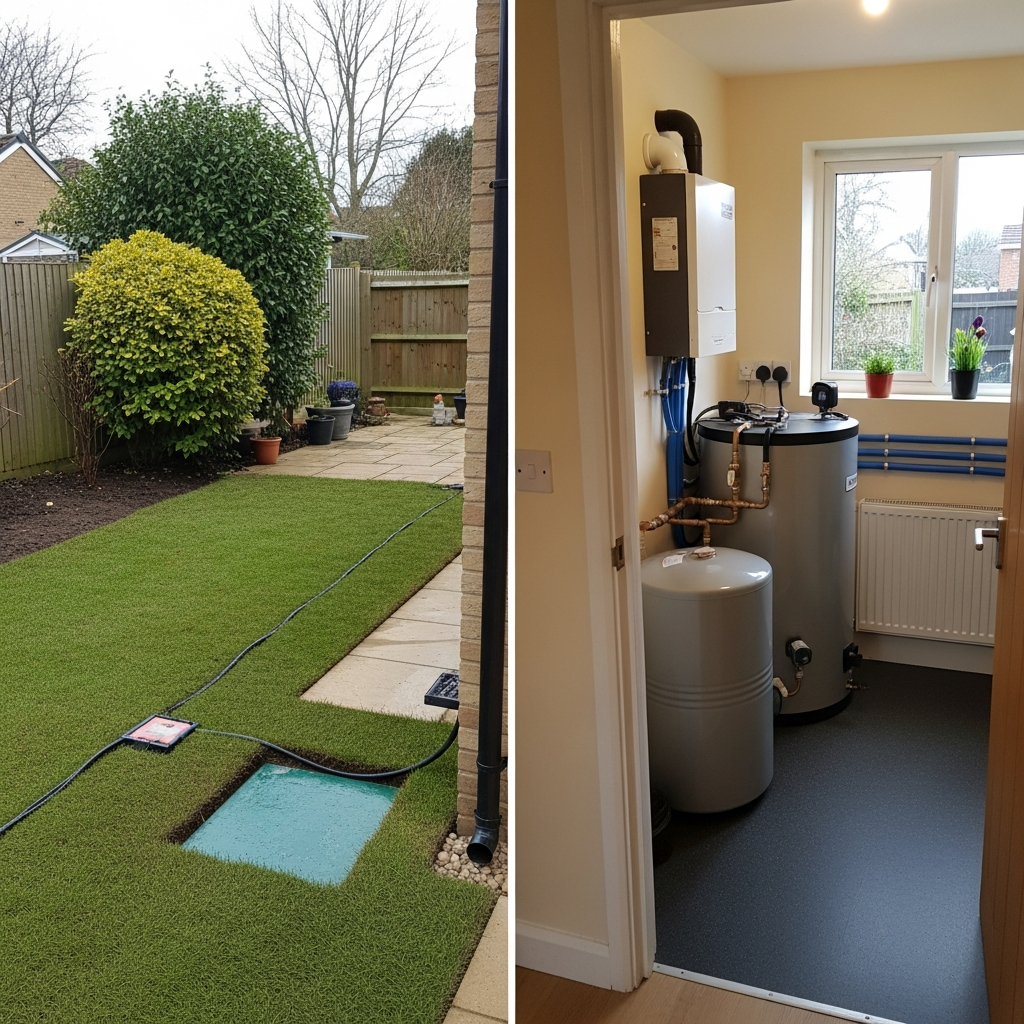
- Garden space: Large houses typically have the garden space needed for horizontal ground loops (around 200 to 400 square metres per 10 kW) or access for borehole drilling.
- Longer lifespan: The ground loop lasts 50+ years and the pump unit 20 to 25 years, making the long-term cost per year of heating very competitive.
Borehole vs horizontal loops
For large houses, borehole systems are often preferred because they require less garden space. Typically, one borehole of 100 to 150 metres depth is needed per 5 to 6 kW of heat demand. A 20 kW system would need three or four boreholes, drilled about five metres apart. The drilling takes a few days and leaves very little surface disruption once the boreholes are capped and connected.
Horizontal loops (also called slinky loops) need more space — roughly 200 to 400 square metres of garden per 10 kW. For a 20 kW system, you would need 400 to 800 square metres of garden to be trenched. This is feasible for properties with large gardens but impractical for others.
Zoning a Large House
Heating a large house efficiently means delivering heat where and when it is needed, not wasting energy heating unused rooms. Zoning is essential.
How zoning works with a heat pump
A zoned system divides your house into separate heating zones, each controlled by its own thermostat and motorised valves. Common zone configurations for large houses include:
- Two zones: Ground floor and first floor
- Three zones: Living areas, bedrooms, and ancillary rooms (utility, study, guest rooms)
- Four or more zones: Individual wings or sections of the house
Zoning allows you to keep living areas at a comfortable temperature while bedrooms run cooler during the day, or to turn down heating in a guest wing that is not in use. This can reduce overall energy consumption by 10 to 20% in a large house, which adds up to significant savings over the heating season.
Weather compensation
All good heat pump installations include weather compensation — the system automatically adjusts its output based on the outside temperature. In a large house, this is particularly important because the thermal mass of the building is greater, meaning it takes longer to heat up and cool down. Weather compensation ensures the heat pump produces just enough heat to maintain comfort without overshooting, which is critical for efficiency.
Hot Water for Large Households
Large houses often have large families, and hot water demand can be substantial. A five-bedroom house with a family of six or seven will use significantly more hot water than a couple in a two-bedroom flat.
For large households, a bigger hot water cylinder is essential — typically 250 to 300 litres rather than the 150 to 200 litres that suffices for smaller homes. Some very large properties use twin cylinders or a thermal store to ensure there is always enough hot water available, even during peak demand periods (morning and evening).
Your installer should size the hot water cylinder based on the number of occupants and bathrooms, not just the heat demand of the house. A house with four bathrooms and six occupants has very different hot water needs from the same-sized house with two bathrooms and two occupants.
Costs for Large House Heat Pump Installations
Large house installations are at the premium end of the domestic heat pump market, but the BUS grant still applies and the long-term economics are sound.
Air source systems
- Single unit (12-16 kW): £12,000 to £18,000 installed
- Twin system (20-28 kW): £18,000 to £28,000 installed
- Radiator upgrades: £1,000 to £3,000
- Large hot water cylinder (250-300L): £800 to £1,500
- BUS grant: -£7,500
Ground source systems
- 15-20 kW system with boreholes: £25,000 to £40,000 installed
- 20-30 kW system with boreholes: £35,000 to £55,000 installed
- BUS grant: -£7,500
After the grant, air source systems for large houses typically cost £6,000 to £24,000, while ground source systems cost £18,000 to £48,000. The higher ground source cost is offset by lower running costs — typically £500 to £1,000 less per year than air source for a large house, which adds up over the 25 to 30 year lifespan. See our cost guide for detailed breakdowns.
Running Costs for Large Houses
Annual heating and hot water costs for a large house with a heat pump depend on the system type, insulation, and electricity tariff:
- Air source (well-insulated 5-bed, SCOP 3.0): £1,200 to £1,800 per year
- Air source (average 5-bed, SCOP 2.8): £1,600 to £2,400 per year
- Ground source (well-insulated 5-bed, SCOP 4.0): £900 to £1,400 per year
- Comparable gas boiler costs: £1,500 to £2,500 per year
These figures assume standard tariff electricity at around 24p per kWh. Using a smart tariff with off-peak rates (such as Octopus Agile or a dedicated heat pump tariff) can reduce these costs by 20 to 30%.
Frequently Asked Questions
Can a single heat pump heat a five-bedroom house?
In most cases, yes. A well-insulated five-bedroom house typically needs 12 to 16 kW, which is within the range of a single air source unit. For ground source, units are available up to 45 kW, so a single unit can heat even the largest homes. Only if your heat demand exceeds 16 kW and you prefer air source will a twin system be needed.
Is ground source worth the extra cost for a large house?
Often, yes. The higher efficiency of ground source (SCOP 3.5 to 4.5 vs 2.8 to 3.5 for air source) saves £500 to £1,000 per year on a large house, and the ground loop lasts 50+ years. If you plan to stay in the property long-term and have the garden space, ground source is an excellent investment.
Do I need to upgrade my electricity supply?
Possibly. A large heat pump (16 kW+) draws 4 to 6 kW of electricity at peak load. If your property has an older or smaller supply, your installer may recommend an upgrade. Contact your electricity distribution network operator to check your current capacity. Upgrades are usually free or low cost for domestic properties.
Can I heat a swimming pool with the same heat pump?
It is possible but not usually recommended. A dedicated pool heat pump is more efficient for this purpose and allows the main system to focus on space heating and hot water. However, some ground source systems can be designed to serve both the house and a pool efficiently.
What about listed buildings?
Large listed houses can have heat pumps, but air source units need planning permission as they are visible and produce sound. Ground source is often the better option for listed buildings — the indoor unit is hidden in a plant room and the boreholes are invisible once complete. Many listed houses across the UK have been successfully fitted with ground source heat pumps.
How do I find an installer experienced with large properties?
Look for MCS-certified installers who specifically mention experience with properties above 200 square metres or 15 kW systems. Ask for references from similar-sized installations. Large house systems require more sophisticated design, so an installer's track record at this scale is important. See our guide to choosing an installer for more advice.