Heat Pump Electrical Requirements UK
A heat pump runs on electricity, so your home's electrical supply needs to be up to the job. For most UK homes, the existing single-phase supply is perfectly adequate — but there are some requirements that need checking before installation begins. Understanding these upfront avoids surprises and delays during the installation process.
This guide covers everything you need to know about the electrical side of a heat pump installation: supply types, circuit requirements, consumer unit upgrades, meter considerations, and costs.
Single Phase vs Three Phase: Which Do You Need?
Single Phase (Most UK Homes)
The vast majority of UK homes have a single-phase electricity supply — 230V, typically with a 60A or 100A main fuse. This is the standard domestic supply and is sufficient for most air source heat pumps.
A typical air source heat pump for a three-bedroom semi-detached house has a maximum electrical input of around 3-5kW. This is well within the capacity of a standard single-phase supply, even accounting for other household electrical loads like cooking, lighting, and appliances.
Single-phase heat pumps are available in sizes up to about 14-16kW heat output (which equates to roughly 4-5kW electrical input at peak load). This covers the heating needs of the vast majority of UK homes.
Three Phase
A three-phase supply (400V) is typically found in larger properties, farms, and some older rural homes. You may need a three-phase supply if:
- Your heat pump has a heat output above 16kW (very large homes, typically 5+ bedrooms)
- You are installing a ground source heat pump with a large compressor
- Your total household electrical demand is very high (e.g., heat pump plus EV charger plus electric cooker plus solar battery system)
- Your existing single-phase supply has a 60A fuse that cannot be upgraded
Getting a three-phase supply installed where one does not exist is possible but expensive — typically £1,000-£5,000 depending on the distance from the nearest three-phase cable and local Distribution Network Operator (DNO) charges. In most cases, it is more cost-effective to choose a single-phase heat pump model.
How to Check What Supply You Have
Look at your electricity meter and the main fuse (known as the service fuse or cut-out). A single-phase supply has two thick cables entering the meter — one live and one neutral. A three-phase supply has four cables — three lives and one neutral. Your installer or electrician can confirm this during the survey.
Main Fuse and Supply Capacity
Your main fuse (service fuse) determines the maximum current your home can draw from the grid. Common ratings in UK homes are:
- 60A: Older supply, common in pre-1990s homes. May be tight with a heat pump plus other loads.
- 80A: Intermediate — generally adequate for a heat pump.
- 100A: Standard modern supply. Comfortably accommodates a heat pump plus normal household loads.
Do You Need a Main Fuse Upgrade?
Your installer should calculate the total electrical demand — the heat pump's maximum draw plus the existing household demand — and compare it to your main fuse rating. If the total exceeds around 80% of the fuse rating, an upgrade is advisable.
For example: a 100A supply can safely handle a heat pump drawing 20A at peak, plus cooking (30A), lighting and sockets (20A), and other loads, with plenty of headroom.
A 60A supply with the same loads would be very tight. In this case, upgrading the main fuse to 80A or 100A is recommended. This is done by your Distribution Network Operator (DNO) and is usually free or low cost (typically £0-£200), though it can take 2-6 weeks to arrange.
DNO Notification
For any heat pump installation, your installer or electrician must notify the local DNO. This is a standard process — the DNO needs to know about significant new electrical loads on their network. Notification is usually done electronically and is straightforward.
If the DNO determines that the local network cannot support the additional load (rare in urban areas, more possible in rural locations), they may require network reinforcement before the heat pump can be connected. Your installer should check this early in the process.
Dedicated Circuit Requirements
A heat pump must have its own dedicated electrical circuit from the consumer unit (fuse board). It cannot share a circuit with other appliances. The requirements for this circuit are:
Cable Size
The cable must be sized for the heat pump's maximum current draw plus a safety margin. Common requirements:
- Small heat pump (up to 3kW electrical input): 4mm² or 6mm² cable, protected by a 20A or 25A MCB
- Medium heat pump (3-5kW electrical input): 6mm² or 10mm² cable, protected by a 25A or 32A MCB
- Large heat pump (5kW+ electrical input): 10mm² or 16mm² cable, protected by a 32A or 40A MCB
The exact specification depends on the cable length, installation method (clipped, in conduit, buried), and the ambient temperature. Your electrician will calculate this per BS 7671.
RCD Protection
The heat pump circuit must have RCD (Residual Current Device) protection. The type of RCD depends on the heat pump:
- Type A RCD: Suitable for most heat pumps
- Type B RCD: Required for some inverter-driven heat pumps that can produce DC fault currents
Check the heat pump manufacturer's installation manual for the specific RCD type required. A Type B RCD is more expensive (£100-£200 vs £30-£50 for Type A), but using the wrong type could be dangerous.
Isolator Switch
A local isolator switch must be installed near the outdoor unit, allowing the heat pump to be safely disconnected for maintenance or emergency. This is typically a weatherproof rotary isolator mounted on the wall adjacent to the unit.
Consumer Unit (Fuse Board) Upgrades
If your consumer unit is old, full, or does not comply with current regulations, it may need upgrading as part of the heat pump installation.
When an Upgrade Is Needed
- No spare ways: If there is no room for a new MCB for the heat pump circuit
- Old rewirable fuses: Homes with old-style rewirable fuse boxes should upgrade to a modern consumer unit with MCBs and RCDs
- No RCD protection: If the existing board has no RCD protection, the entire board may need replacing to meet current BS 7671 standards
- Metal consumer unit required: Current regulations require non-combustible (metal) consumer units
Cost of a Consumer Unit Upgrade
A full consumer unit replacement typically costs £400-£800 including labour. If only a small upgrade is needed (adding a way or an RCD), it could be £100-£300.
While a consumer unit upgrade adds to the installation cost, it also improves the safety of your entire electrical installation — which is a worthwhile benefit regardless of the heat pump.
Cable Routing
The dedicated cable needs to run from the consumer unit to the heat pump's outdoor unit. The route depends on your home's layout:
- Internal route: Through the house, possibly through the loft space, and out through the wall near the outdoor unit. Less exposed to weather but may involve more disruption.
- External route: Along the outside wall in weatherproof conduit or trunking. Easier to install but more visible.
- Underground route: Buried in a trench from the house to the outdoor unit. Neatest finish but more labour-intensive.
Cable runs up to about 20 metres are straightforward. Longer runs may require thicker cable to compensate for voltage drop. Your electrician will calculate the appropriate cable size for the distance.
Meter and Tariff Considerations
Smart Meter
A smart meter is not strictly required for a heat pump, but it is highly recommended. Smart meters enable:
- Accurate monitoring of your heat pump's electricity consumption
- Access to time-of-use tariffs that can significantly reduce running costs
- Half-hourly consumption data for optimising your system
Smart meters are available free of charge from your energy supplier. If you do not already have one, arrange installation before or alongside your heat pump installation.
Economy 7 / Economy 10
If you currently have an Economy 7 or Economy 10 meter (with cheaper overnight electricity), this can be advantageous for a heat pump. You can programme the heat pump to heat the hot water cylinder during the cheaper rate period.
However, dedicated time-of-use tariffs designed for heat pumps (such as Octopus Cosy or similar) often offer better savings than Economy 7. Discuss tariff options with your energy supplier.
Separate Meter for the Heat Pump
Some homeowners consider a separate electricity meter for the heat pump. This was more common historically when heat pump tariffs required a dedicated meter, but modern smart meters can track consumption on the main supply without a second meter. A separate meter is rarely necessary or cost-effective today.
Electrical Work During Installation: What to Expect
The electrical work for a heat pump installation typically involves:
- Survey and design (before installation day): The electrician assesses the existing supply, plans the cable route, and specifies the circuit components
- Cable installation: Running the dedicated cable from the consumer unit to the outdoor unit location
- Consumer unit work: Installing the new MCB, RCD, and any necessary upgrades
- Outdoor connections: Fitting the isolator switch and connecting the cable to the heat pump
- Control wiring: Connecting the heat pump controller, outdoor temperature sensor, and thermostat
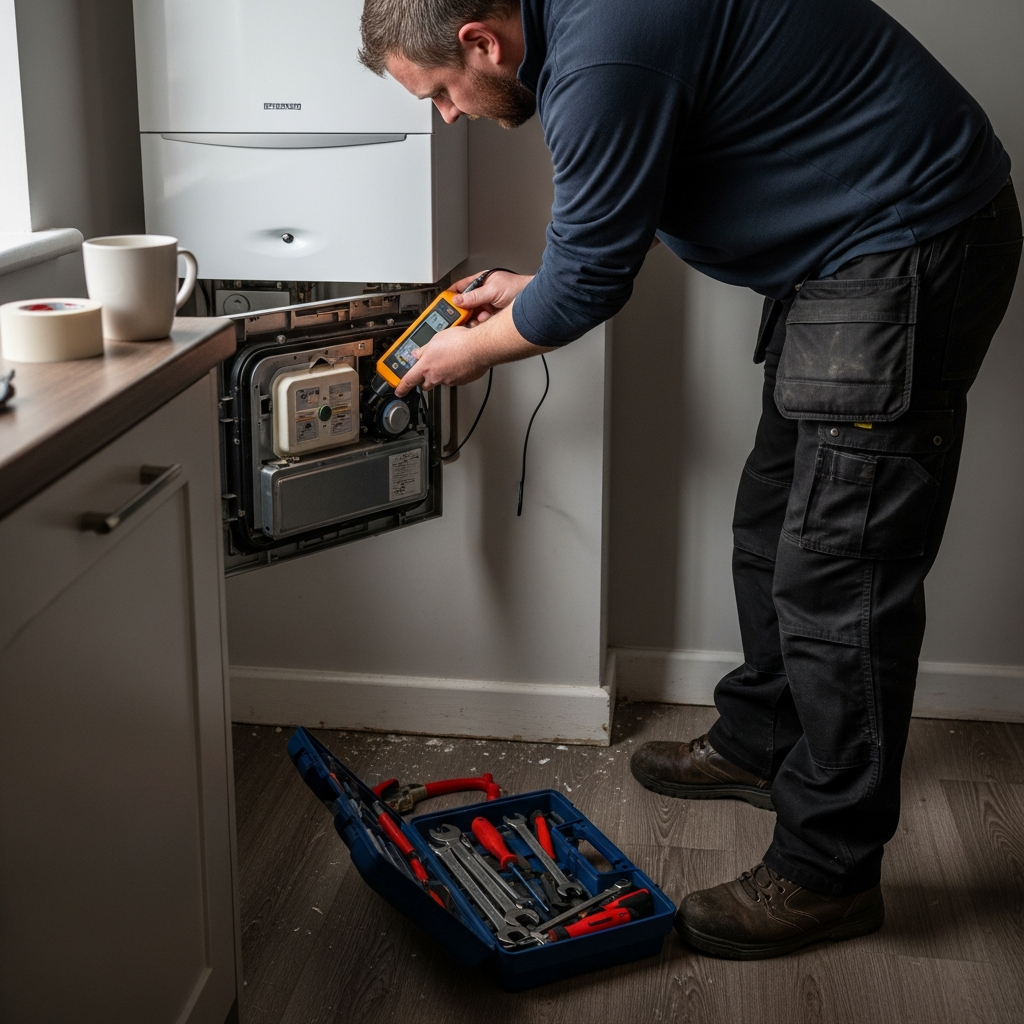
- Testing and certification: Carrying out insulation resistance, earth fault loop impedance, and RCD trip tests
- Certification: Issuing an Electrical Installation Certificate or Minor Works Certificate
The electrical work typically takes half a day to a full day and is usually done as part of the main installation visit. The electrician may be a separate tradesperson working alongside the heating engineer, or some MCS-certified installers have electricians on their team.
Costs Summary
- Dedicated circuit (standard run): £200-£500
- Consumer unit upgrade (if needed): £400-£800
- Main fuse upgrade (via DNO): £0-£200
- Three-phase supply (if needed, rare): £1,000-£5,000
- Type B RCD (if required): £100-£200
- Isolator switch: £50-£100
For a typical installation on an existing single-phase supply with a modern consumer unit, the electrical costs are usually £300-£600. This is included in the overall installation quote and covered by the BUS grant.
Frequently Asked Questions
Does a heat pump need a dedicated circuit?
Yes. A heat pump must have its own dedicated circuit from the consumer unit with appropriate MCB and RCD protection. It cannot share a circuit with other appliances.
Will I need to upgrade my electricity supply?
Most homes with a 100A supply will not need an upgrade. Homes with a 60A supply may need the main fuse upgrading — this is done by the DNO and is usually free or low cost. Your installer will assess this during the survey.
Can I install a heat pump with a 60A supply?
Possibly, if your other electrical loads are modest. However, upgrading to 80A or 100A is recommended for headroom, especially if you plan to add an EV charger or other high-load appliances in future.
Do I need three-phase electricity for a heat pump?
Almost never for a standard UK home. Single-phase heat pumps are available up to about 16kW heat output, which covers most domestic applications. Three-phase is only needed for very large homes or unusually high electrical demand.
Who does the electrical work — the heat pump installer or a separate electrician?
This varies. Some MCS-certified installers have qualified electricians on their team. Others subcontract the electrical work to a registered electrician. Either approach is fine as long as the electrician is Part P registered or works under a competent person scheme.
Is the electrical work covered by the BUS grant?
Yes. All necessary electrical work for the heat pump installation — including the dedicated circuit, consumer unit upgrade, and isolator — is covered as part of the BUS grant.
Concerned about your home's electrical supply? Get free quotes from MCS-certified installers who will assess your electrical requirements as part of the survey. Check our cost guide for realistic installation prices, or use the suitability checker for an initial assessment.