How Far Should a Heat Pump Be from the House?
Where you place your heat pump matters more than many homeowners realise. The location affects noise levels, efficiency, planning compliance, and even your relationship with neighbours. Get it right and you will barely notice the unit is there. Get it wrong and you could face complaints, planning issues, or a system that underperforms.
This guide covers the UK rules and practical considerations for heat pump placement, including distance from boundaries, windows, neighbours, and the house itself.
Permitted Development Rules for Heat Pumps
In England, most air source heat pumps can be installed under permitted development rights — meaning you do not need to apply for planning permission. However, there are conditions that must be met:
Key Permitted Development Conditions (England)
- Only one heat pump per property: You cannot install multiple air source heat pumps under permitted development
- Not on a pitched roof: The unit can be on a flat roof or on the ground, but not on a sloping roof
- Noise limit: Must not exceed 42dB(A) at the nearest neighbouring property's habitable room window (measured as a rating level including any tonal or impulsive characteristics)
- Volume of unit: Must not exceed 0.6 cubic metres
- Distance from boundary: The unit must be at least 1 metre from the property boundary
- Not in a conservation area or World Heritage Site: If facing a highway — additional restrictions apply
- Listed buildings: Permitted development does not apply — you need planning permission and possibly listed building consent
Rules in Scotland, Wales, and Northern Ireland
Permitted development rules vary across the UK:
- Scotland: Similar rules but with some differences in noise limits and placement restrictions. The unit must not be visible from the front of the property in some cases.
- Wales: Generally follows English rules but check with your local planning authority for any additional requirements.
- Northern Ireland: Has its own planning regulations — check with your local council.
Your MCS-certified installer should be familiar with the relevant rules for your location and will advise on compliance during the survey.
Distance from the Property Boundary
Under permitted development in England, the heat pump must be at least 1 metre from any property boundary. This includes:
- Side boundaries with neighbours
- Rear boundary (garden fence or wall)
- Front boundary (though front-of-house placement is generally avoided for aesthetic and noise reasons)
The 1-metre distance is measured from the nearest part of the heat pump unit to the nearest point of the boundary. It includes any projecting parts of the unit (handles, pipe connections, etc.) but not the base or plinth.
Practical Considerations Beyond the 1-Metre Rule
While 1 metre is the legal minimum, there are good reasons to leave more space if possible:
- Maintenance access: Engineers need to access all sides of the unit for servicing. At least 500mm clearance around the back and sides is recommended.
- Airflow: The unit needs to draw in air freely. Placing it too close to a wall or fence restricts airflow and reduces efficiency.
- Noise: Greater distance from boundaries means lower noise levels at neighbouring properties, making it easier to comply with the 42dB limit.
Distance from the House Wall
There is no strict regulatory minimum for how close the heat pump can be to your own house wall, but practical considerations apply:
Minimum Recommended Clearances
- Behind the unit (against the wall): At least 200-300mm for airflow and pipe connections
- Sides of the unit: At least 300-500mm for airflow and maintenance access
- Front of the unit (air discharge): At least 1,000-3,000mm clear space — this is where the fan blows air out, and it must not be obstructed
Different heat pump models have different clearance requirements — always follow the manufacturer's installation manual, which specifies minimum distances for your specific unit.
Vibration and Noise
Placing the heat pump directly against the house wall can transmit vibrations through the wall into the living space. If the unit must be close to the wall:
- Use quality anti-vibration mounts
- Ensure pipework connections to the house use flexible joints rather than rigid connections
- Consider a vibration-isolating bracket if wall-mounted
The 42dB Noise Rule Explained
The most important distance-related requirement is noise. Under MCS planning standards (MIS 3005), the heat pump must not produce a rating level exceeding 42dB(A) at the nearest neighbouring habitable room window.
What Does 42dB Sound Like?
42dB is roughly the sound level of a quiet library or a refrigerator humming. It is barely noticeable during the day and only just audible at night in a quiet area. For context:
- 30dB — very quiet room
- 40dB — quiet library
- 42dB — the heat pump limit
- 50dB — quiet conversation
- 60dB — normal conversation
How Distance Affects Noise
Sound levels decrease with distance. As a rough guide, doubling the distance from the sound source reduces the level by about 6dB. So if a heat pump produces 55dB at 1 metre:
- At 2 metres: approximately 49dB
- At 4 metres: approximately 43dB
- At 5 metres: approximately 41dB
- At 8 metres: approximately 37dB
This means that for a typical unit producing 55-60dB at 1 metre, you need roughly 4-8 metres between the heat pump and the nearest neighbouring window to meet the 42dB limit. In practice, walls, fences, and other structures provide additional sound screening.
MCS Noise Assessment
Your MCS-certified installer must carry out a noise assessment as part of the installation design. This calculation takes into account:
- The heat pump's sound power level (from the manufacturer's data sheet)
- Distance to the nearest neighbouring habitable room window
- Any screening from walls, fences, or barriers
- Reflective surfaces that might amplify sound
- Any tonal characteristics that add a penalty to the rating level
If the calculation shows the 42dB limit would be exceeded, the installer must either reposition the unit, add acoustic screening, or specify a quieter model.
Optimal Placement: Balancing All Factors
The ideal heat pump location balances several competing requirements:
Close to the House (But Not Too Close)
Shorter pipe runs between the outdoor unit and the indoor components mean less heat loss and lower installation costs. The most efficient location is typically at the side or rear of the house, close to where the pipework enters the building. Aim for the unit to be 1-3 metres from the house wall.
Away from Bedrooms
If possible, position the unit away from bedroom windows — both your own and your neighbours'. Heat pumps run at night during cold weather, and even at low noise levels, the sound can be noticeable in a quiet bedroom.
Not in a Corner or Recess
Placing a heat pump in a tight corner between walls restricts airflow and can create noise problems through sound reflection. The air discharge side (front of the unit) should face into open space.
Consider Prevailing Wind
Facing the air intake into the prevailing wind can slightly improve efficiency (more airflow across the evaporator). However, this is a minor factor compared to the other placement considerations.
Access for Maintenance
Engineers need to access the unit for annual servicing and occasional repairs. Ensure there is at least 500mm clearance on all accessible sides and that the location is reachable without moving heavy objects or climbing over obstacles.
Common Placement Locations
Side of the House
The most common location for UK installations. The side passage typically provides good airflow, reasonable distance from neighbours, and short pipe runs. The unit is relatively hidden from the front of the property.
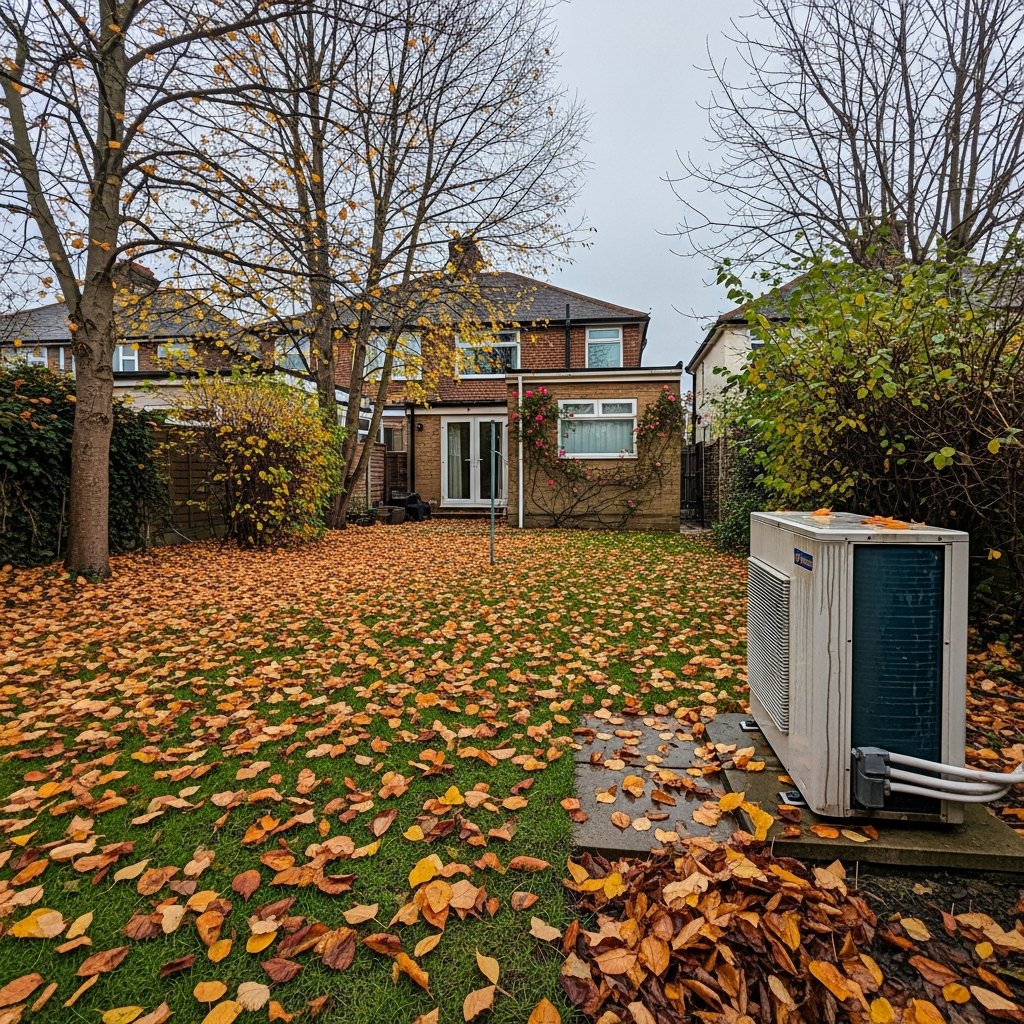
Rear Garden
Good for detached and semi-detached houses. Provides flexibility on positioning and distance from neighbours. However, pipe runs may be longer, and the unit may be more visible from the house.
Front of the House
Less common due to aesthetic concerns and proximity to the street. Some planning authorities and homeowners prefer to avoid front-of-house placement. However, there is no specific restriction under permitted development (except in conservation areas).
Flat Roof
Possible under permitted development, provided the unit is not on a pitched roof. Flat roof installation can solve ground-space problems but requires structural assessment and careful vibration isolation.
What About Acoustic Barriers?
If positioning alone cannot meet the 42dB noise limit, acoustic barriers or screening can help:
- Solid fence or wall: A solid barrier between the heat pump and the neighbour's window can reduce noise by 5-10dB. The barrier must be taller and wider than the unit to be effective.
- Acoustic fencing: Specialist fencing with sound-absorbing properties can reduce noise by 10-15dB. More expensive than standard fencing but very effective.
- Landscaping: Dense hedges and planting provide modest noise reduction (2-5dB) and visual screening. Not sufficient as the sole noise mitigation measure but useful as a supplement.
Important: acoustic barriers must not restrict airflow to the heat pump. Leave adequate clearance between the barrier and the unit — typically at least 1 metre.
Frequently Asked Questions
What is the minimum distance from the property boundary?
Under permitted development in England, the heat pump must be at least 1 metre from any property boundary. This is measured from the nearest part of the unit to the boundary.
How close can a heat pump be to my neighbour's window?
There is no fixed minimum distance, but the noise must not exceed 42dB(A) at the nearest neighbouring habitable room window. In practice, this usually means 3-8 metres depending on the heat pump model and any screening.
Can I put a heat pump in my front garden?
Yes, under permitted development (in England). However, if you are in a conservation area, the unit must not face a highway. Most homeowners prefer side or rear placement for aesthetic reasons.
Do I need planning permission for a heat pump?
Most domestic air source heat pumps in England can be installed under permitted development without planning permission, provided all conditions are met. Listed buildings, flats, and properties in certain designated areas may require a planning application.
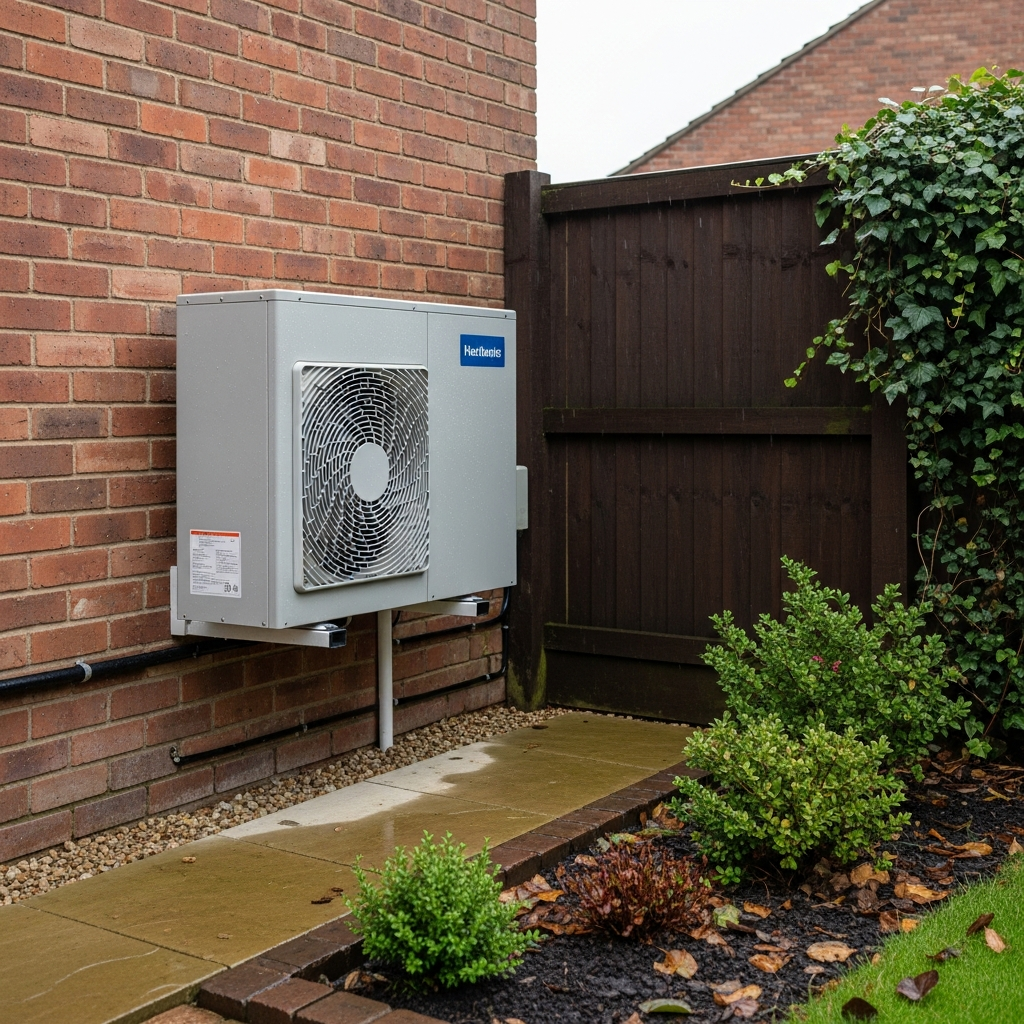
Can I put the heat pump on a wall instead of the ground?
Yes, wall mounting is possible using heavy-duty brackets. The wall must be strong enough to support the weight (60-120kg) and vibration isolation is critical. See our base requirements guide for more detail.
What if my garden is too small for a heat pump?
Even very small gardens can usually accommodate a heat pump. The unit itself is typically only 800-1,000mm wide and 300-400mm deep. Wall mounting is an option where ground space is extremely limited. Discuss options with your installer during the survey.
Does the heat pump need to face a particular direction?
No — heat pumps work in any orientation. However, avoid pointing the fan discharge directly at a wall, fence, or walkway, as this can create noise and draught issues. The discharge should face into open space.
Need advice on where to place your heat pump? Get free quotes from MCS-certified installers who will carry out a full site survey and noise assessment. Read our installation guide for the complete process, or use the suitability checker to see if a heat pump is right for your home.