Social Housing Heat Pump Rollout: Progress by Housing Association
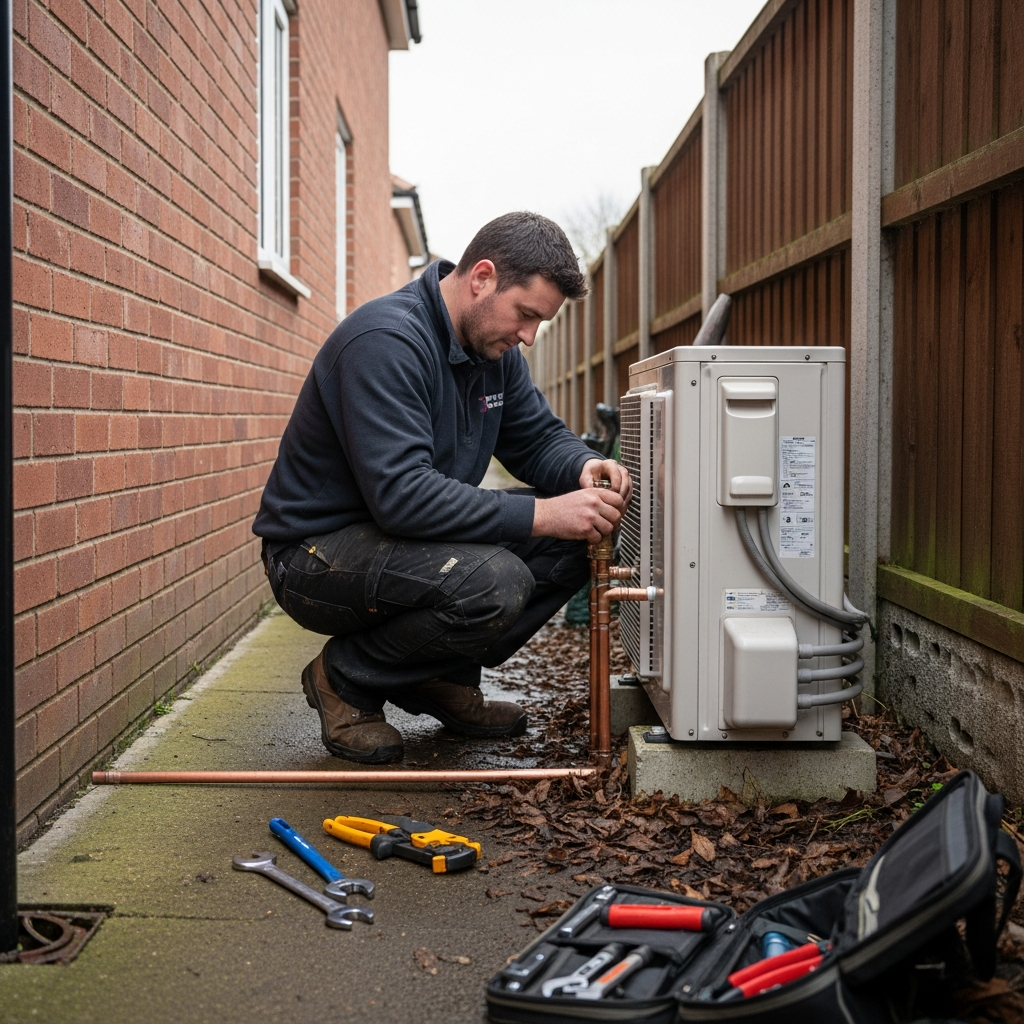
The UK's 4 million social housing properties house some of the most fuel-poor households in the country. With the Social Housing Decarbonisation Fund (SHDF) providing hundreds of millions in funding, housing associations are now installing heat pumps at scale — and the data they are generating is invaluable for the entire industry. This report examines which housing associations are leading, what they are spending, what tenants think, and what the social housing experience tells us about heat pump viability for everyone.
Curious about heat pump costs for your own home?
Get Your Free EstimateSocial housing data shows real costs — see what it would cost for your property.
The Scale of the Challenge
The UK has approximately 4 million social housing properties managed by local authorities and housing associations. According to DESNZ statistics, around 85% of these are heated by gas boilers, with a further 10% on electric storage heaters and 5% on other fuels including oil and LPG.
The Climate Change Committee (CCC) recommends that all social housing should reach EPC Band C by 2030 and be decarbonised (no fossil fuel heating) by 2035. That means replacing roughly 3.4 million gas boilers — a monumental undertaking that has barely started.
Funding: SHDF, ECO4, and Beyond
The government's primary funding mechanism is the Social Housing Decarbonisation Fund (SHDF), administered by DESNZ. The fund covers up to two-thirds of eligible costs, with housing associations contributing the remaining third.
| Funding Wave | Period | Total Funding | Homes Targeted | Key Focus |
|---|---|---|---|---|
| SHDF Demonstrator | 2021-2022 | £62 million | ~2,300 | Testing approaches |
| SHDF Wave 1 | 2022-2023 | £179 million | ~15,000 | EPC D-G homes to Band C |
| SHDF Wave 2 | 2023-2025 | £778 million | ~90,000 | Scaled rollout + heat pumps |
| SHDF Wave 3 | 2025-2027 | £1.2 billion (est.) | ~130,000 | Accelerated decarbonisation |
| ECO4 (social housing element) | 2022-2026 | Varies | ~50,000 | Fuel poverty reduction |
Source: DESNZ SHDF programme data and Nesta analysis. Wave 3 figures are estimated based on government spending review commitments.
Beyond SHDF, housing associations can access ECO4 funding through energy suppliers, the Home Upgrade Grant (HUG) for off-gas properties, and various devolved funding streams in Scotland (Social Housing Net Zero Fund), Wales (Optimised Retrofit Programme), and Northern Ireland.
Housing Associations Leading the Way
Some housing associations are significantly ahead of others in heat pump deployment. The leaders share common traits: strong net zero strategies, access to SHDF funding, and a fabric-first approach that insulates properties before installing heat pumps.
| Housing Association | Stock Size | Heat Pumps Installed | Target (2030) | Approach |
|---|---|---|---|---|
| Nottingham City Homes | 25,000 | 1,200+ | 8,000 | Fabric-first + ASHP |
| Clarion Housing Group | 125,000 | 2,500+ | 15,000 | Mixed (ASHP + hybrid) |
| L&Q | 105,000 | 1,800+ | 12,000 | New build + retrofit |
| Gentoo (Sunderland) | 28,000 | 900+ | 5,000 | ASHP + insulation |
| Octavia Housing | 5,000 | 450+ | 2,500 | Whole-house retrofit |
| Peabody | 66,000 | 1,500+ | 10,000 | Phased programme |
| Sanctuary Housing | 100,000 | 1,000+ | 8,000 | SHDF Wave 2 focus |
| Scottish housing associations (combined) | 600,000+ | 4,000+ | 30,000 | SHNZ Fund + HEEPS |
Source: Housing association annual reports, SHDF award announcements, and sector analysis from Inside Housing (2025-2026).
Costs Per Dwelling
Social housing heat pump installations are delivering useful cost benchmarks for the wider industry. Because housing associations procure at scale, their per-unit costs are typically lower than individual private installations.
| Measure | Cost Per Dwelling | Notes |
|---|---|---|
| ASHP only (without fabric improvements) | £8,000–12,000 | Unit, installation, commissioning |
| ASHP + basic insulation | £12,000–18,000 | Loft + cavity wall + ASHP |
| Whole-house retrofit (deep) | £25,000–45,000 | External wall insulation + ASHP + ventilation |
| GSHP (shared loop systems) | £15,000–22,000 | Per dwelling on communal schemes |
| Radiator upgrades (if needed) | £1,500–3,500 | Larger radiators for low-temp system |
Source: SHDF programme cost returns and Nesta retrofit cost analysis, 2025.
The cost per dwelling varies enormously depending on whether the property needs fabric improvements first. A well-insulated 1960s house might need only an ASHP at £8,000–10,000, while a solid-wall Victorian terrace could require external wall insulation, floor insulation, and new radiators before the heat pump even arrives — pushing the total to £35,000+.
With SHDF covering two-thirds, the housing association's contribution is typically £3,000–15,000 per dwelling. This is comparable to the cost of a new gas boiler with associated works (£2,500–5,000) — making the business case increasingly viable, especially when lifecycle costs are considered.
What would a heat pump cost for your home?
Calculate Your CostsPrivate homeowners can access the £7,500 BUS grant — check your estimate.
What Tenants Say
Tenant feedback is critical to understanding whether heat pumps work for real households — particularly those on low incomes who cannot afford higher energy bills. The data from social housing programmes is broadly positive but reveals important nuances.
According to tenant satisfaction surveys published by several housing associations and analysed by Nesta:
Source: Combined data from Nottingham City Homes, Gentoo, and Octavia Housing tenant satisfaction surveys, 2024-2025.
The 45% figure for needing help with controls is significant. Heat pumps operate differently from gas boilers — they work best at lower flow temperatures, running for longer periods, with minimal manual intervention. Tenants accustomed to turning the boiler on and off throughout the day often struggle initially. The housing associations with the best satisfaction scores invest heavily in tenant education and ongoing support.
The 29% who reported higher bills were disproportionately in poorly insulated properties where the fabric-first approach had not been fully implemented. This reinforces the critical importance of insulating before installing a heat pump — a lesson equally applicable to private homeowners considering the switch.
The Fabric-First Approach
The most successful social housing programmes follow a strict fabric-first methodology: insulate the building envelope first, then install the heat pump. This sequence matters enormously because heat pumps are most efficient in well-insulated properties — and because tenants in poorly insulated homes with heat pumps are the ones most likely to face higher bills.
According to the Energy Saving Trust, a typical 3-bedroom semi-detached social housing property needs:
- Loft insulation topped up to 300mm — cost: £300–500
- Cavity wall insulation (if applicable) — cost: £500–1,000
- Window upgrades to double glazing (if single-glazed) — cost: £3,000–5,000
- Draught-proofing — cost: £200–400
- External wall insulation (solid walls only) — cost: £8,000–14,000
The evidence from SHDF programmes shows that properties insulated to EPC Band C or above before heat pump installation achieve running costs comparable to or lower than gas. Properties where the heat pump was installed without adequate insulation show running costs 20–40% higher than gas equivalents — which is unacceptable for fuel-poor tenants.
Challenges and Lessons Learned
The social housing sector's experience provides invaluable lessons for the entire heat pump industry.
1. Tenant Engagement Is Non-Negotiable
Housing associations that skip or rush tenant engagement see lower satisfaction scores and higher complaint rates. The best programmes include pre-installation home visits, clear written information about how heat pumps work differently from boilers, and post-installation follow-up at 1 week, 1 month, and 3 months.
2. Installer Capacity Is the Bottleneck
Finding enough MCS-certified installers to deliver large-scale programmes remains challenging. Several housing associations have invested in their own heat pump installation guide or formed long-term partnerships with installer firms to guarantee capacity.
3. One Size Does Not Fit All
Different property types need different solutions. High-rise flats may suit communal heat pump systems or individual exhaust air heat pumps. Terraced houses may need hybrid systems where full insulation is not feasible. Detached houses are the easiest to convert. The best housing associations assess each property individually rather than applying a blanket approach.
4. Running Costs Must Be Protected
For fuel-poor tenants, any increase in heating costs is unacceptable. This means either insulating to a high standard before installing the heat pump, or providing tariff support. Some housing associations have negotiated bulk electricity tariffs or enrolled tenants in heat pump-specific tariffs to ensure bills do not rise. Combining heat pumps with solar panels on suitable properties can further protect tenants from electricity costs.
5. Maintenance Must Be Planned From Day One
Housing associations need maintenance contracts and trained staff to service heat pumps at scale. Several early programmes suffered from inadequate maintenance planning, leading to performance degradation and tenant complaints.
The Road to 2030
The government's target of EPC Band C for all social housing by 2030 will require a dramatic acceleration in heat pump installations. Current run rates of approximately 15,000–20,000 per year need to reach 100,000+ per year to meet the trajectory.
Key factors that will determine success:
- SHDF Wave 3 and beyond — continued government funding at increasing scale
- Electricity pricing reform — removing green levies from electricity bills would improve heat pump economics significantly
- Installer training — the sector needs thousands more MCS-certified installers
- Technology standardisation — simplified, pre-packaged heat pump systems designed for social housing retrofit
- Tenant protection — guaranteeing that no tenant pays more for heating after the switch
The Climate Change Committee notes that social housing is both a challenge and an opportunity: the sector can achieve economies of scale, generate real-world performance data, and demonstrate to private homeowners that heat pumps work in homes similar to their own.
Frequently Asked Questions
How many social housing properties have heat pumps?
Approximately 35,000–45,000 as of early 2026, representing roughly 1% of the 4 million social housing stock. The SHDF programme is accelerating installations significantly.
Do tenants pay more with a heat pump?
In well-insulated properties, tenants typically pay the same or less. In poorly insulated homes, costs can be higher. The best housing associations insulate first, then install the heat pump, to protect tenant bills.
Which housing associations are leading?
Nottingham City Homes, Clarion, L&Q, Gentoo, Peabody, and Octavia Housing are among the leaders, driven by SHDF funding and net zero commitments.
What funding is available?
The SHDF covers up to two-thirds of costs. ECO4, HUG, and devolved funds in Scotland, Wales, and Northern Ireland provide additional support. Private homeowners can access the £7,500 BUS grant.
What are the biggest challenges?
Fabric-first insulation requirements, tenant engagement, installer capacity, upfront costs, and ensuring running costs do not increase for low-income tenants.
Can tenants refuse a heat pump?
Generally yes — most housing associations seek tenant consent. However, effective engagement programmes achieve acceptance rates of 85-90%.
Ready to explore heat pumps for your own home?
Get Free Installer QuotesMCS-certified installers in your area — no obligation.
Social Housing and the Energy Transition
The social housing sector is a bellwether for the UK's broader heating transition. Every challenge it faces — costs, insulation requirements, running costs, tenant education — mirrors what private homeowners encounter. The solutions being developed at scale — fabric-first retrofit, smart tariff integration, and solar panel combinations — are equally applicable to owner-occupied homes. Whether you live in social housing or own your home, the BUS grant and falling costs mean that heat pumps are increasingly within reach for everyone.