Home Heat Pump Guide

Slinky Ground Source Heat Pump Systems

One of the biggest barriers to ground source heat pump adoption is the perception that you need acres of land for the ground loops. While it is true that standard horizontal ground loops require significant garden space, slinky coil systems offer a clever alternative — fitting more pipe into less ground. If you have been told your garden is too small for ground source, a slinky system may change the equation.

This guide explains how slinky ground loops work, how they compare to standard horizontal and vertical systems, what they cost, and whether they are the right choice for your property.

What Is a Slinky Ground Loop?

A slinky ground loop is a type of horizontal ground loop where the pipe is coiled in overlapping loops — resembling the shape of a stretched-out spring or slinky toy — rather than being laid in straight runs. The coils are typically 600mm to 1,000mm in diameter and overlap each other by about one-third to one-half.

This coiling technique packs more pipe into a shorter trench. Where a standard horizontal loop might need 150-200 metres of trench length for a typical house, a slinky system can achieve the same pipe length in 50-80 metres of trench. The trench itself is usually wider — around 900mm to 1,200mm compared to 600mm for a straight loop — but the overall land area required is significantly less.

How the Coils Are Laid

There are two main configurations for slinky coils:

  • Horizontal slinky: The coils are laid flat in the bottom of a trench, typically at 1.2-1.5 metres depth. This is the most common configuration and uses the least land.
  • Vertical slinky: The coils stand upright in a narrow trench, like a row of wheels. This requires a narrower trench but a deeper one (1.5-2 metres). It can be useful where the trench width is constrained.

Both configurations achieve the same goal: maximising the length of pipe in contact with the ground within a smaller area, allowing heat to be extracted efficiently.

For a full overview of all ground source configurations, see our ground source heat pump guide.

How Much Land Does a Slinky System Need?

The land requirement depends on the heat demand of your property and the soil type, but here are typical figures for a 3-bedroom detached house requiring around 10-12 kW of heat:

Standard Horizontal Loops

  • Trench length: 150-200 metres (multiple parallel trenches)
  • Land area: 250-400 m²

Slinky Coil Loops

  • Trench length: 50-80 metres (multiple parallel trenches)
  • Land area: 100-200 m²

Vertical Boreholes

  • Land area: 20-40 m² (just the drilling area)

A slinky system requires roughly half to two-thirds of the land that standard horizontal loops need. That can make the difference between a ground source installation being feasible or not — particularly for properties with medium-sized gardens.

How Well Do Slinky Systems Perform?

Slinky systems extract heat from the ground in exactly the same way as straight horizontal loops. The fluid circulates through the pipe, absorbs heat from the surrounding soil, and carries it to the heat pump. The efficiency of the heat pump itself is unchanged — a slinky system achieves the same COP as any other ground loop configuration, provided it is properly designed.

However, there is one important consideration. Because the pipe is concentrated in a smaller area, the soil around a slinky loop is subjected to more intensive heat extraction. In severe winters or with undersized installations, the soil temperature in the immediate vicinity of the coils can drop more than it would with widely spaced straight loops. In extreme cases, this can cause the ground to freeze around the pipes, reducing efficiency.

Soil Recovery

The soil needs the summer months to recover its temperature after winter heat extraction. With slinky coils in a smaller area, this recovery process is concentrated too. In most UK installations, the ground recovers fully over summer and the system works well year after year. But if the system is undersized or the soil conditions are poor (dry, sandy soil conducts less heat), there is a risk of gradual soil temperature decline over several years.

This is why proper design is critical. A reputable MCS-certified installer will calculate the ground loop requirements based on your specific heat demand, soil type, and local conditions — not just use a rule of thumb.

Costs of a Slinky Ground Loop System

Slinky systems are typically priced between standard horizontal loops and vertical boreholes:

Ground Loop Costs Only

  • Standard horizontal loops: £3,000-£6,000
  • Slinky coil loops: £4,000-£7,000
  • Vertical boreholes: £8,000-£15,000

Why Slinky Costs Slightly More Than Straight Loops

Although slinky systems need less trenching, they use more pipe per metre of trench (because the pipe is coiled rather than straight). The pipe itself is the main material cost, so the total material cost is similar to — or slightly higher than — straight loops. Labour costs may be lower due to less digging, but the assembly and laying of slinky coils takes more care.

Total System Costs

Including the heat pump unit, hot water cylinder, controls, and internal work, a complete slinky-based ground source system costs:

  • Before BUS grant: £19,000-£30,000
  • After BUS grant (£7,500): £11,500-£22,500

For a complete cost overview, see our heat pump cost guide.

Slinky vs Straight Horizontal Loops: Pros and Cons

Advantages of Slinky Coils

  • Less land required: The main advantage — roughly half the garden area compared to straight loops
  • Shorter trenches: Less disruption to the garden, faster to dig and backfill
  • No borehole drilling needed: Avoids the high cost of vertical borehole systems
  • Same heat pump efficiency: The COP is identical to any other ground loop type

Disadvantages of Slinky Coils

  • More pipe used: Higher material cost per metre of trench
  • More intensive soil heat extraction: Greater risk of soil temperature decline if undersized
  • Wider trenches: The trenches are wider than for straight loops, which can be an issue in constrained spaces
  • Slightly more complex installation: Laying and connecting coils requires more precision than straight pipe runs
  • Still need reasonable garden space: 100-200 m² is still substantial — not suitable for small urban gardens

When Is a Slinky System the Right Choice?

A slinky ground loop system is typically the best option when:

  • Your garden is large enough for slinky coils (100-200 m²) but too small for standard horizontal loops
  • You want ground source heat pump benefits without the high cost of borehole drilling
  • The soil on your property is suitable for horizontal installation (not solid rock close to the surface)
  • You are willing to accept slightly higher ground loop costs than straight horizontal pipes in exchange for using less land

When Slinky Is Not the Right Choice

  • Very small gardens (under 80 m² available) — you will likely need boreholes instead
  • Very large gardens with no space constraints — straight horizontal loops will be cheaper and perform slightly more reliably long-term
  • Poor soil conditions (dry sand, gravel) — the concentrated heat extraction of slinky coils is more likely to cause soil temperature issues in poor-conducting soil

Installation Process

The installation of slinky ground loops follows a similar process to standard horizontal loops, with a few differences:

Step 1: Site Survey

A site survey assesses your garden's size, soil type, access for machinery, and any underground services (drains, cables, water pipes). The installer will design the slinky layout to maximise heat extraction while avoiding obstacles.

Step 2: Trenching

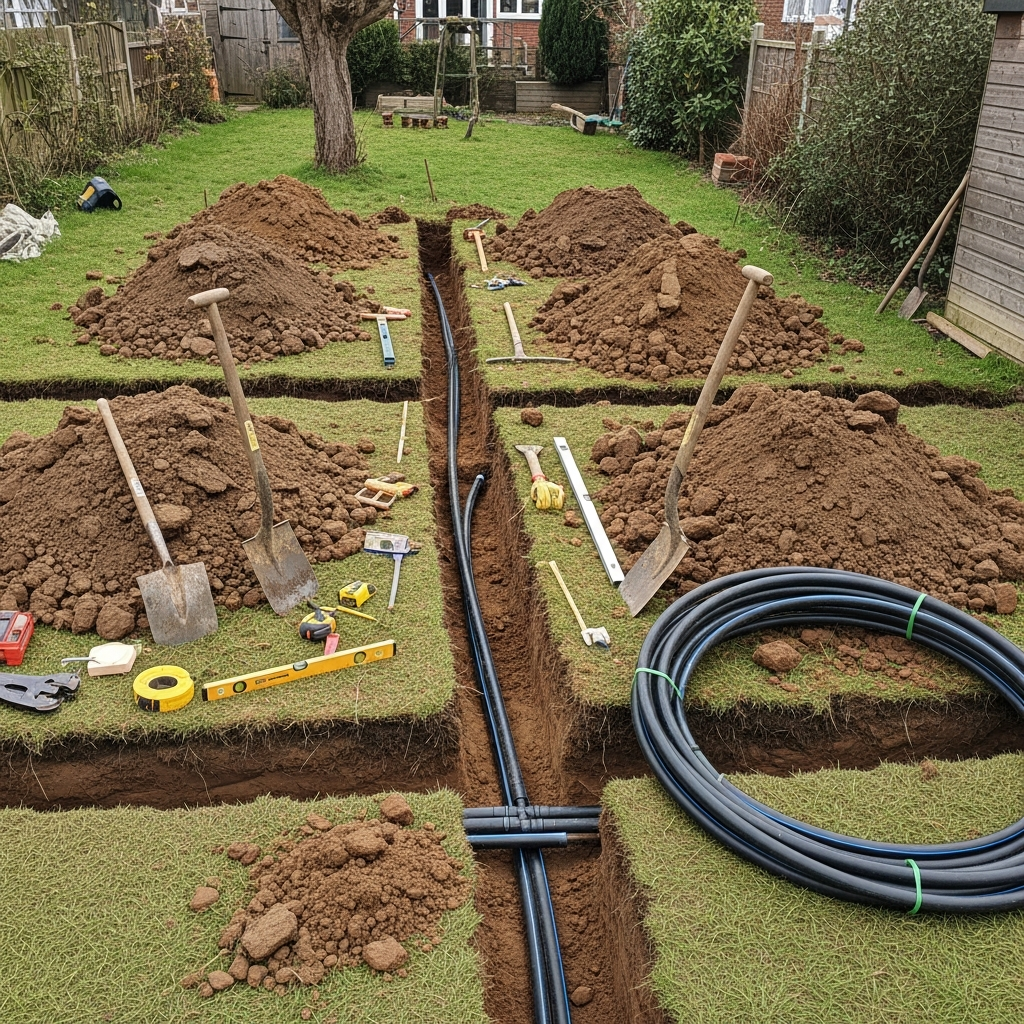
Trenches are dug using a mini excavator — typically 1.2-1.5 metres deep and 900mm-1,200mm wide. Multiple parallel trenches are usually needed, spaced at least 3 metres apart to prevent them from interfering with each other.

Step 3: Laying the Slinky Coils

The pre-coiled pipe is laid into the trench. Each coil is positioned carefully to ensure consistent overlap and contact with the soil. Sand or fine soil may be used as backfill immediately around the pipes to ensure good thermal contact.

Step 4: Connection and Pressure Testing

The coil circuits are connected to manifolds and the system is pressure tested to check for leaks before backfilling the trenches.

Step 5: Backfilling and Reinstatement

The trenches are backfilled and the garden surface reinstated. Expect some settlement over the following months. Most gardens recover fully within one growing season, though you may want to delay any expensive landscaping until the ground has settled.

Total ground loop installation time is typically 3-5 days, with the internal heat pump installation taking an additional 3-5 days.

Soil Types and Slinky Performance

Soil type significantly affects ground loop performance. The thermal conductivity of the soil determines how effectively heat can be extracted:

  • Clay (moist): Excellent — high thermal conductivity, retains moisture well. Ideal for slinky coils.
  • Loam: Good — moderate thermal conductivity, common in UK gardens.
  • Sand (moist): Moderate — reasonable conductivity when wet, but can dry out in summer reducing performance.
  • Sand (dry) or gravel: Poor — low thermal conductivity, not ideal for slinky coils. Longer loops may be needed to compensate.
  • Rock: Cannot trench in rock. Boreholes are the only option.
  • Waterlogged ground: Very good for heat extraction (water conducts heat well), but trenching may require dewatering.

In the UK, most garden soil is some form of clay or loam, which performs well with slinky coils. Your installer should assess the soil conditions during the site survey.

Frequently Asked Questions

Can I still use the garden above slinky ground loops?

Yes. Once backfilled, you can use the garden normally — grow lawn, plant flowers, even grow vegetables. Avoid planting deep-rooted trees directly above the loops, as roots can damage the pipes over time. Also avoid building permanent structures (patios, sheds, driveways) over the loops, as this restricts the ground's ability to absorb solar heat for thermal recovery.

How long do slinky ground loops last?

The high-density polyethylene (HDPE) pipe used for ground loops has an expected lifespan of 50-100 years. The pipe is chemically inert and buried in stable conditions, so there is very little to cause degradation. The ground loops will almost certainly outlast the heat pump unit itself.

Can slinky coils be installed under a driveway?

It is not recommended. The ground above the loops needs to receive solar radiation and rainfall to recharge thermally over summer. A driveway or hard surface blocks this natural recharging process and can lead to gradual soil temperature decline. If you have no choice, it can work in some cases, but the system may need oversizing to compensate.

Is a slinky system less efficient than a borehole system?

Not necessarily. Both systems deliver the same working fluid to the same heat pump, so the COP is similar. However, borehole systems access deeper, more thermally stable ground, which can provide slightly more consistent performance in extreme conditions. For most UK properties and climates, the difference is negligible.

Can I install slinky loops myself to save money?

The ground loop element is theoretically DIY-able — it is just digging trenches and laying pipe. However, the system must be designed by a qualified engineer, and the heat pump installation and commissioning must be done by an MCS-certified installer if you want to claim the BUS grant. Most homeowners find the potential saving from DIY trenching does not justify the risk and effort, but it is an option worth discussing with your installer.

What happens if a slinky coil develops a leak?

Leaks in ground loops are extremely rare due to the quality of the HDPE pipe and the joint fusion techniques used. If a leak does occur, it is detected by a drop in system pressure. Repair involves locating the leak (sometimes using thermal imaging), excavating that section, and repairing or replacing the damaged pipe. This is disruptive but very uncommon.