Heat Pump on Single Phase vs Three Phase
When your heat pump installer carries out their initial survey, one of the first things they check is your electrical supply. Most UK homes have a single-phase electricity supply, and the good news is that this is perfectly adequate for the vast majority of air source heat pump installations. But there are situations where three-phase supply becomes relevant — particularly for larger homes or when a heat pump is combined with other high-demand electrical systems.
This guide explains the difference, when it matters, and what to do if your home needs an upgrade.
Single Phase vs Three Phase: What Is the Difference?
Single Phase
A single-phase supply delivers electricity through one live wire and one neutral wire. It provides a maximum of approximately 60 to 100 amps at 230 volts, giving a maximum power capacity of roughly 14 to 23 kW (depending on your fuse rating). The vast majority of UK homes — estimated at over 95% — have a single-phase supply.
Your main fuse (also called the cut-out fuse or service fuse) determines your maximum capacity. Common ratings are:
- 60 amp: Maximum ~14 kW (older properties)
- 80 amp: Maximum ~18 kW (common in properties built 1970s-2000s)
- 100 amp: Maximum ~23 kW (newer properties and upgrades)
Three Phase
A three-phase supply uses three live wires, each carrying electricity at a different phase angle. This effectively triples the available capacity — a three-phase supply typically provides 60 to 100 amps per phase, giving a total capacity of approximately 42 to 69 kW.
Three-phase supply is standard for commercial and industrial buildings but relatively unusual for UK homes. You are most likely to find it in:
- Large detached homes, particularly rural properties
- Converted barns and farmhouses
- Properties that previously had workshops or light industrial use
- Some newer housing developments where the developer specified it
What Size Heat Pump Can Run on Single Phase?
Most residential air source heat pumps are available in single-phase versions and are designed for the standard UK domestic supply. Here is the general picture:
Comfortably Single Phase
- 5 to 12 kW heat pumps: These cover the vast majority of UK homes — from 2-bed flats to 4-bed detached houses. They draw a maximum of 2 to 5 kW of electrical power (remember, the kW rating is heat output, not electrical input). A single-phase supply handles this easily with plenty of headroom for other household appliances.
Manageable on Single Phase
- 12 to 16 kW heat pumps: Larger systems for bigger or less well-insulated homes. These draw 4 to 7 kW of electrical power. Still fine on a single-phase supply in most cases, but your installer will check the total electrical load to ensure there is enough capacity alongside your other electrical demands (oven, shower, EV charger, etc.).
May Need Three Phase
- 16 to 25+ kW heat pumps: Very large systems for big properties, multi-zone setups, or commercial installations. These may only be available in three-phase versions, or the electrical demand may exceed what a single-phase supply can safely deliver alongside other household loads.
The Real Constraint: Total Household Load
The heat pump itself is rarely the problem. The real issue is the total electrical demand of your entire household, particularly if you are adding multiple high-power systems at the same time.
Consider a modern home with:
- 10 kW heat pump (drawing ~3.5 kW electrical)
- 7 kW EV charger
- 10 kW electric shower
- 3 kW oven/hob
- 2 kW kettle, lights, and miscellaneous
If all of these run simultaneously, the total demand is approximately 25.5 kW — which exceeds a 100-amp single-phase supply (23 kW maximum). In practice, the main fuse would blow or the supply would trip.
Why It Rarely Happens in Practice
In reality, all of these appliances rarely run at full power simultaneously:
- The heat pump's compressor cycles, and its average draw is much lower than the peak
- The oven is not at full power for extended periods
- Smart EV chargers can reduce their power when other loads increase
- Electric showers are typically short duration
A competent installer will calculate your maximum demand — the realistic peak load considering diversity (the fact that not everything runs at maximum simultaneously) — and determine whether your single-phase supply has adequate headroom.
How Your Installer Assesses Your Electrical Supply
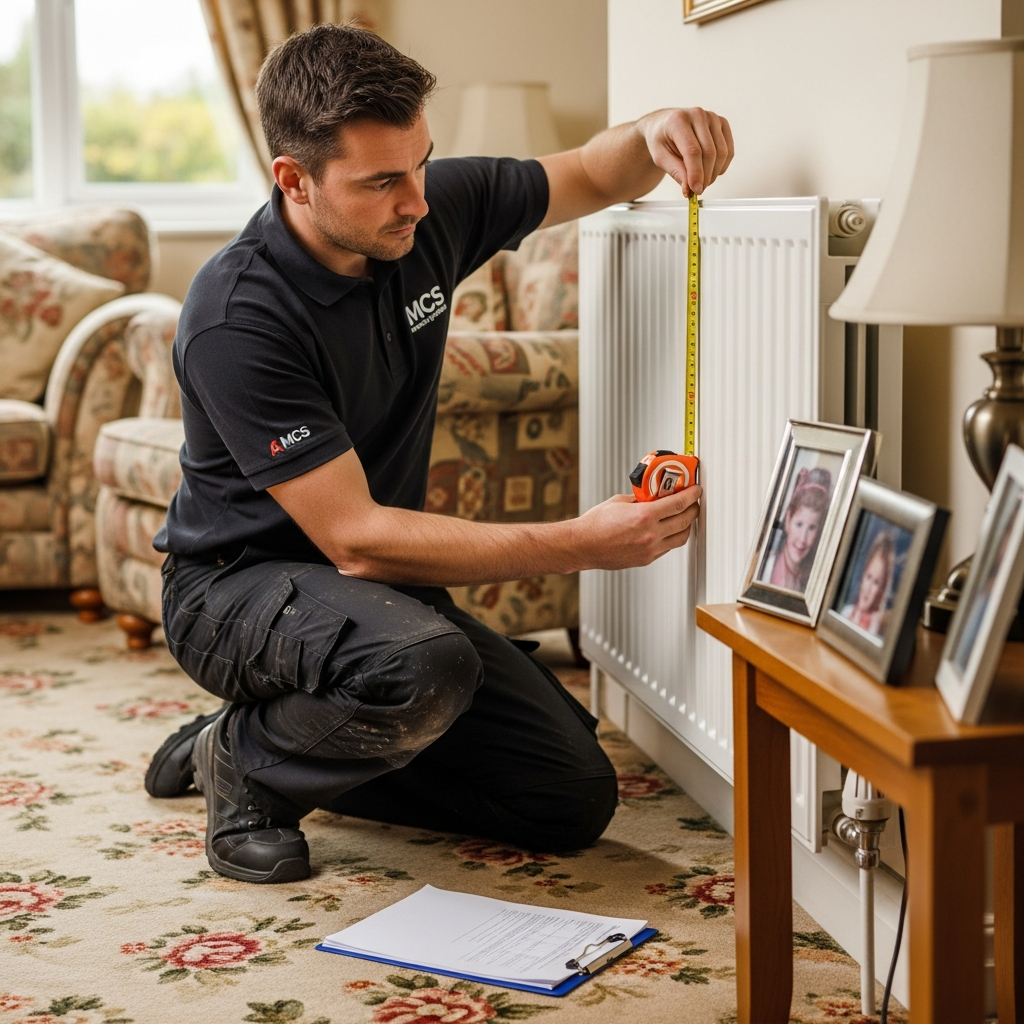
During the initial survey, your heat pump installer (or their electrician) will:
- Check your main fuse rating: This is the large fuse in the cut-out box, usually near your electricity meter. It sets the upper limit of your supply.
- Assess your consumer unit: Is there capacity for a dedicated heat pump circuit? Modern installations require a dedicated MCB (miniature circuit breaker) for the heat pump.
- Calculate maximum demand: Adding up the expected peak loads from the heat pump plus existing household circuits, factoring in diversity.
- Check cable sizes: The cable from the consumer unit to the heat pump must be adequate for the expected load, and the cable from the meter to the consumer unit must handle the total household demand.
- Determine if an upgrade is needed: If the numbers are tight, they will recommend either a main fuse upgrade, a load management system, or in rare cases, a three-phase supply upgrade.
Options If Your Supply Is Not Sufficient
Option 1: Upgrade Your Main Fuse
If you have a 60-amp or 80-amp fuse, upgrading to 100 amps is often the simplest solution. This is done by your Distribution Network Operator (DNO) — the company that manages the electricity network in your area (UK Power Networks, Western Power Distribution, etc.).
- Cost: Usually free or low cost (typically under £100) if the existing cable from the street to your property can handle 100 amps
- Timescale: 2 to 6 weeks from application
- Process: Your installer or electrician submits the application on your behalf
Option 2: Load Management / Smart Systems
A load management system monitors your household's total electrical demand in real time and automatically reduces the power to one device when others are drawing heavily. For example:
- If the electric shower is running and the EV is charging, the system temporarily reduces the EV charger's power
- If the heat pump is in a high-demand cycle, the EV charger pauses until the heat pump backs off
Devices like the myenergi zappi (for EV charging) and some heat pump controllers have built-in load management. This is often the most cost-effective solution for homes with multiple high-power systems on a single-phase supply.
Option 3: Upgrade to Three Phase
A full three-phase upgrade involves installing new cabling from the street to your property and a new three-phase meter and consumer unit. This is the most expensive option and is only necessary for the largest domestic installations.
- Cost: £1,000 to £5,000+ depending on the distance from the street and the work involved. Some DNOs charge more if significant groundwork is required.
- Timescale: 4 to 12 weeks from application, sometimes longer in rural areas
- When it is justified: Large homes (5+ bedrooms), properties needing 16+ kW heat pumps, homes with heat pump + EV charger + large solar/battery systems
Which Heat Pump Brands Offer Three-Phase Models?
If you do have or are getting a three-phase supply, most major manufacturers offer three-phase options for their larger models:
- Vaillant aroTHERM plus: Available in both single and three-phase versions up to 15 kW
- Daikin Altherma 3: Three-phase versions available for 11 kW and above
- Mitsubishi Ecodan: Three-phase models for 14 kW and above
- Samsung EHS Mono: Three-phase options for larger capacities
- Nibe: Three-phase models available across the range
- Grant Aerona3: Three-phase versions for 13 kW and above
Three-phase heat pumps draw the same total electrical power as their single-phase equivalents — the power is simply distributed across three wires rather than one, reducing the load on each wire and allowing larger compressors to operate more smoothly.
Ground Source Heat Pumps and Electrical Supply
Ground source heat pumps generally have similar electrical requirements to air source units of the same output capacity. However, because ground source systems tend to be installed in larger properties with greater heat demands, three-phase supply is more commonly needed. If you are considering a ground source system above 12 kW, discuss the electrical supply requirements with your installer early in the process.
The DNO Notification Process
Regardless of whether you need a supply upgrade, your installer must notify your DNO when installing a heat pump. This is a standard requirement under G98/G99 regulations. The notification tells the DNO that a new significant electrical load is being connected, which helps them manage the local network.
For most installations (single-phase, up to 16 amps per phase), this is a simple notification rather than an application for approval. Your installer handles this as part of the installation process — you should not need to contact the DNO yourself.
Frequently Asked Questions
How do I check if I have single phase or three phase?
Look at your electricity meter and the incoming supply cable. A single-phase supply has one main fuse and typically a two-wire cable (plus earth). A three-phase supply has three main fuses (or a three-phase isolator) and a four-wire cable. If you are unsure, your installer or electrician can tell you during their survey.
Can I run a heat pump and EV charger on single phase?
In most cases, yes. A typical heat pump draws 2 to 5 kW of electrical power, and a 7 kW EV charger draws 7 kW — together, that is 9 to 12 kW, well within a 100-amp single-phase supply. A load management system ensures they do not conflict during peak household demand. See our guide on heat pumps and EV chargers for full details.
Will upgrading to three phase increase my standing charge?
It should not — domestic three-phase supplies are typically charged at the same standing charge as single-phase. However, check with your energy supplier to confirm, as policies can vary.
Is a three-phase heat pump more efficient than single phase?
There is no meaningful difference in efficiency (COP) between single and three-phase versions of the same heat pump model. Three phase simply distributes the electrical load more evenly, which is an advantage for the electrical supply rather than the heat pump's performance.
Can my installer upgrade my main fuse?
No — the main fuse belongs to your Distribution Network Operator (DNO), and only they can change it. Your installer or electrician can submit the application on your behalf. The upgrade is usually free if the existing cable from the street can handle the higher rating.
What happens if I exceed my single-phase capacity?
If the total load exceeds your main fuse rating, the fuse will blow, cutting power to your entire home. This is a safety mechanism. A competent installer will ensure this cannot happen through proper load calculations and, where necessary, load management systems that automatically limit demand.
The Bottom Line
For the vast majority of UK homes, single-phase electricity is perfectly adequate for a heat pump. Systems up to 12 kW (which cover most 2 to 4-bedroom properties) run comfortably on a standard single-phase supply, and even larger systems up to 16 kW are usually manageable with a 100-amp fuse and sensible load management.
Three-phase supply is only typically needed for very large homes requiring heat pumps above 16 kW, or properties combining multiple high-power electrical systems without load management. Your installer will assess your supply during the initial survey and advise on any upgrades needed — this is a standard part of the process and should not be a source of anxiety.
If you are told you need a supply upgrade, the cost and timescale are usually modest. Do not let electrical supply concerns put you off a heat pump — there is almost always a practical, affordable solution.