The True Lifetime Cost: Heat Pump vs Gas Boiler Over 20 Years
Most heat pump vs gas boiler comparisons focus on year-one running costs. That is like comparing cars by only looking at fuel efficiency on the test drive. The real question is: over the full 20-year life of the system, including purchase price, fuel, maintenance, repairs, and replacement — which one actually costs less? We built a comprehensive model, and the answer is clearer than you might expect.
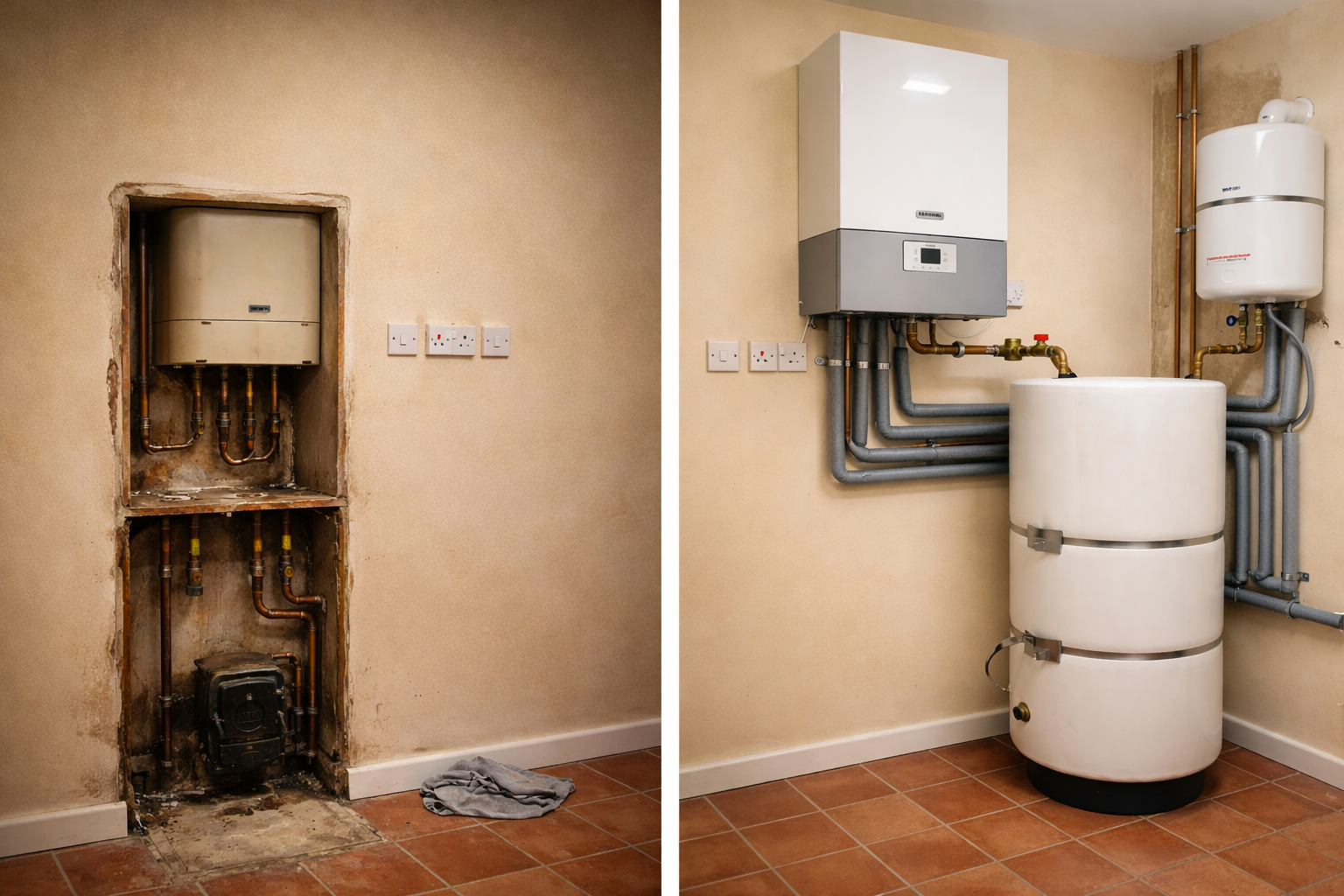
The year-one running cost comparison between a heat pump and a gas boiler is finely balanced at current tariff rates — the heat pump is slightly cheaper or slightly more expensive depending on the installation quality and tariff. But year-one costs tell a misleading story, because they ignore several critical long-term factors: gas boilers need replacing after 12-15 years, gas prices are projected to rise faster than electricity prices, and maintenance costs differ significantly over time.
We modelled every relevant cost over a 20-year period using real 2026 installation costs from our heat pump cost guide, real-world COP data from our heat pump running costs guide, and fuel price projections from DESNZ and the Climate Change Committee.
See your 20-year cost comparison
Use the free calculatorPersonalised to your property, current fuel, and location. Instant results.
What We Modelled
Our base case property is a 3-bed semi-detached house in the Midlands with an annual heat demand of 15,000 kWh. We model two scenarios:
- Scenario A — Gas boiler: New A-rated combi boiler installed in 2026, replaced once at year 13, annual servicing throughout
- Scenario B — Air source heat pump: New ASHP installed in 2026 with BUS grant, 250L cylinder, annual servicing, no replacement needed within 20 years
For both scenarios, we model three fuel price trajectories: flat (no real-terms change), DESNZ central projection, and DESNZ high projection. This captures the range of plausible futures.
The Seven Cost Components
| Cost Component | Gas Boiler (20 Years) | Heat Pump (20 Years) |
|---|---|---|
| 1. Initial purchase & install | £2,500 | £10,600 (£3,100 after grant) |
| 2. Replacement at mid-life | £3,200 (year 13) | £0 (lasts 20-25 years) |
| 3. Annual fuel costs | £22,180 – £28,500 | £17,400 – £22,100 |
| 4. Annual servicing | £2,000 (£100/yr) | £3,000 (£150/yr) |
| 5. Repairs & parts | £1,800 (avg over life) | £1,200 (avg over life) |
| 6. Standing charges | £2,190 (gas + elec) | £1,825 (elec only) |
| 7. Decommissioning at end | £300 | £500 |
Illustrative calculation by Home Heat Pump Guide — total-cost-of-ownership model (modelled figures, not measured field data). Fuel costs show range from flat to high projection. 3-bed semi, 15,000 kWh/yr heat demand. SCOP 2.8 for HP.
Two things stand out. First, the gas boiler replacement at year 13 adds a significant cost that heat pump owners avoid entirely. Second, fuel costs — the biggest line item for both — increasingly favour the heat pump under every plausible price projection.
Base Case: 3-Bed Semi with BUS Grant
Here are the 20-year total costs under each fuel price scenario:
| Fuel Price Scenario | Gas Boiler 20-Year Total | Heat Pump 20-Year Total | HP Saving/(Extra Cost) |
|---|---|---|---|
| Flat (no real-terms change) | £34,170 | £31,325 | HP saves £2,845 |
| DESNZ central projection | £37,480 | £30,120 | HP saves £7,360 |
| DESNZ high projection | £40,670 | £32,180 | HP saves £8,490 |
Illustrative calculation by Home Heat Pump Guide — total-cost-of-ownership model (modelled figures, not measured field data). 3-bed semi, Midlands costs, BUS grant applied, SCOP 2.8, standard electricity tariff.
£2,845 – £8,490
Heat pump saves over 20 years (with grant)
Year 8-11
When heat pump becomes cheaper overall
£0
Mid-life replacement cost for heat pump
£3,200
Gas boiler replacement at year 13
Even under the most conservative assumption — flat fuel prices forever — the heat pump saves nearly £3,000 over 20 years. Under the central DESNZ projection (which assumes gas prices rise faster than electricity due to carbon pricing), the saving exceeds £7,000. The gas boiler's replacement cost at year 13 is the key inflection point — once the gas boiler owner has to buy a second boiler, the heat pump's cost advantage accelerates.

Without the BUS Grant
Removing the £7,500 grant changes the picture significantly:
| Fuel Price Scenario | Gas Boiler 20yr | Heat Pump 20yr (No Grant) | Difference |
|---|---|---|---|
| Flat prices | £34,170 | £38,825 | Gas saves £4,655 |
| DESNZ central | £37,480 | £37,620 | Roughly equal |
| DESNZ high | £40,670 | £39,680 | HP saves £990 |
Illustrative calculation by Home Heat Pump Guide — total-cost-of-ownership model (modelled figures, not measured field data). Same assumptions as base case but without BUS grant.
Without the grant, the heat pump breaks even only under the DESNZ central projection and edges ahead under the high projection. At flat fuel prices, the gas boiler is cheaper over 20 years by about £4,600. This underlines how critical the BUS grant is to the current financial case for gas-to-heat-pump switching.
Gas Price Scenarios in Detail
The future trajectory of gas and electricity prices is the single most uncertain variable. Here is what the main projections assume:
- DESNZ central projection: Gas prices rise 3.5% per year in real terms (driven by carbon pricing and declining North Sea production). Electricity prices fall 1% per year in real terms (driven by lower renewable generation costs).
- DESNZ high projection: Gas rises 5% per year (higher carbon tax, global supply constraints). Electricity flat in real terms.
- CCC Net Zero pathway: Gas rises 4-6% per year, electricity falls 2-3% per year. This is the most optimistic scenario for heat pumps.
All of these projections see the gas-electricity price ratio narrowing over time, which progressively improves the heat pump's position. The Climate Change Committee has recommended moving environmental levies from electricity bills to gas bills, which would accelerate this rebalancing.
Model your own 20-year comparison
Get personalised quotesMCS installers can provide detailed cost projections during the survey stage.
Larger Homes: Where Heat Pumps Win Bigger
The 20-year advantage for heat pumps grows with property size, because larger homes use more fuel — amplifying any per-kWh cost advantage:
| Property Type | Annual Heat Demand | 20yr HP Saving (DESNZ Central, With Grant) |
|---|---|---|
| 2-bed terrace | 10,000 kWh | £4,200 |
| 3-bed semi | 15,000 kWh | £7,360 |
| 4-bed detached | 22,000 kWh | £12,400 |
| 5-bed detached | 28,000 kWh | £16,800 |
Illustrative calculation by Home Heat Pump Guide — total-cost-of-ownership model (modelled figures, not measured field data). DESNZ central fuel price projections. BUS grant applied.
A 4-bed detached home saves over £12,000 across 20 years. For larger homes, particularly those currently on oil or LPG, the savings can be transformative. These are the properties where the financial case for a heat pump is strongest — see our payback analysis for the full range of scenarios.
The Carbon Cost Dimension
While this is primarily a financial analysis, the carbon dimension is worth quantifying. Over 20 years, a typical 3-bed semi produces:
- Gas boiler: Approximately 55 tonnes of CO2 (15,000 kWh x 0.183 kg/kWh x 20 years)
- Heat pump (2026 grid): Approximately 19 tonnes of CO2 (declining each year as the grid decarbonises)
- Heat pump (projected 2036 grid): Approximately 8 tonnes total over 20 years
The heat pump saves 36-47 tonnes of CO2 over its lifetime. As carbon pricing feeds through to consumer gas prices, this carbon advantage will increasingly translate into a financial advantage too. For a detailed carbon comparison, see our carbon footprint analysis, and our main heat pump vs gas boiler comparison.
Impact on Property Value
An often-overlooked component of lifetime cost is the impact on your property's value. Estate agent surveys suggest heat pumps add £5,000-£15,000 to property value, depending on the property type and location. Even conservative estimates of £5,000 would offset a significant portion of the upfront cost premium.
If you are also considering adding solar panels, the combined value uplift of solar + heat pump can exceed £15,000-£20,000 for larger properties — making the investment even more attractive from a total return perspective.

Frequently Asked Questions
Is a heat pump cheaper than a gas boiler over 20 years?
In most scenarios with the BUS grant, yes. Our model shows savings of £2,800-£8,500 over 20 years for a typical 3-bed semi. Without the grant, it is roughly cost-neutral under central fuel price projections.
What is the total 20-year cost of a gas boiler?
For a 3-bed semi, approximately £32,000-£38,000 including two boilers, fuel, maintenance, and repairs. The range depends on fuel price trajectory.
How long do heat pumps last compared to gas boilers?
Heat pumps typically last 20-25 years, compared to 12-15 years for gas boilers. This means gas boiler owners face an additional replacement cost during the heat pump's lifespan.
Will gas prices go up over the next 20 years?
Most projections say yes. DESNZ central projections show gas prices rising 40-60% in real terms by 2040, driven by carbon pricing increases. Electricity prices are expected to fall as renewable generation costs decline.
See your personal 20-year cost comparison
Get your estimateFree, instant, personalised to your property and current heating system.
Lifetime Costs in the Energy Transition
The 20-year cost comparison is the most honest way to evaluate heat pump vs gas boiler economics. It accounts for upfront costs, running costs, the gas boiler replacement cycle, and projected fuel price changes. When combined with solar panels, the lifetime savings increase further. The BUS grant significantly improves the financial case, making early adoption more rewarding than waiting. As the UK's energy system evolves, heat pump owners are positioned on the right side of the cost curve.