Heat Pump Flow Temperature Settings Explained
Flow temperature is arguably the single most important setting on your heat pump. It determines how warm the water is that gets sent to your radiators or underfloor heating, and it has a direct impact on how efficiently your system runs. Get it right and you will enjoy low running costs and a comfortable home. Get it wrong and you will be paying more than you need to for less comfort.
This guide explains what flow temperature is, why heat pumps use much lower temperatures than boilers, and how to optimise your settings for maximum efficiency.
What Is Flow Temperature?
Flow temperature is the temperature of the water leaving your heat pump and heading towards your radiators, underfloor heating, or fan convectors. It is the "outgoing" temperature — the hottest point in the heating circuit.
The water circulates through the heating system, gives off heat into your rooms, and returns to the heat pump cooler than when it left. This return temperature is typically 5-8°C lower than the flow temperature. The difference between flow and return is called the temperature differential or "delta T" (ΔT).
For example, if your flow temperature is 40°C and the delta T is 5°C, the water returns to the heat pump at 35°C. The heat pump then warms it back up to 40°C and sends it round again.
Heat Pump vs Boiler Flow Temperatures
This is where the fundamental difference between heat pumps and boilers becomes clear:
- Gas or oil boiler: Typically runs at 60-80°C flow temperature
- Air source heat pump: Typically runs at 35-50°C flow temperature
- Ground source heat pump: Typically runs at 30-45°C flow temperature
This is not a limitation — it is by design. A heat pump operates on the principle of moving heat from outside to inside, and the lower the temperature it needs to produce, the less work the compressor has to do. Less work means less electricity consumed, which means lower running costs.
The Efficiency Impact
The efficiency of a heat pump is measured by its Coefficient of Performance (COP). A COP of 4.0 means the heat pump produces 4kWh of heat for every 1kWh of electricity consumed. Here is roughly how COP changes with flow temperature for a typical air source heat pump on a 7°C day:
- Flow temp 35°C: COP around 4.5
- Flow temp 40°C: COP around 3.8
- Flow temp 45°C: COP around 3.2
- Flow temp 50°C: COP around 2.8
- Flow temp 55°C: COP around 2.3
The pattern is clear: every 5°C reduction in flow temperature improves efficiency significantly. Running at 35°C instead of 55°C nearly doubles the efficiency. This is why getting flow temperature right is so important — and why your installer should spend time on this during commissioning.
Recommended Flow Temperature Settings
The ideal flow temperature depends on your heating system type:
Underfloor Heating
Flow temperature: 25-35°C
Underfloor heating is the ideal partner for a heat pump. The large surface area of the floor means it can emit plenty of heat even at very low water temperatures. This allows the heat pump to run at maximum efficiency. If your home has underfloor heating throughout, you can expect excellent COPs of 4.0 or higher.
Oversized Radiators
Flow temperature: 35-45°C
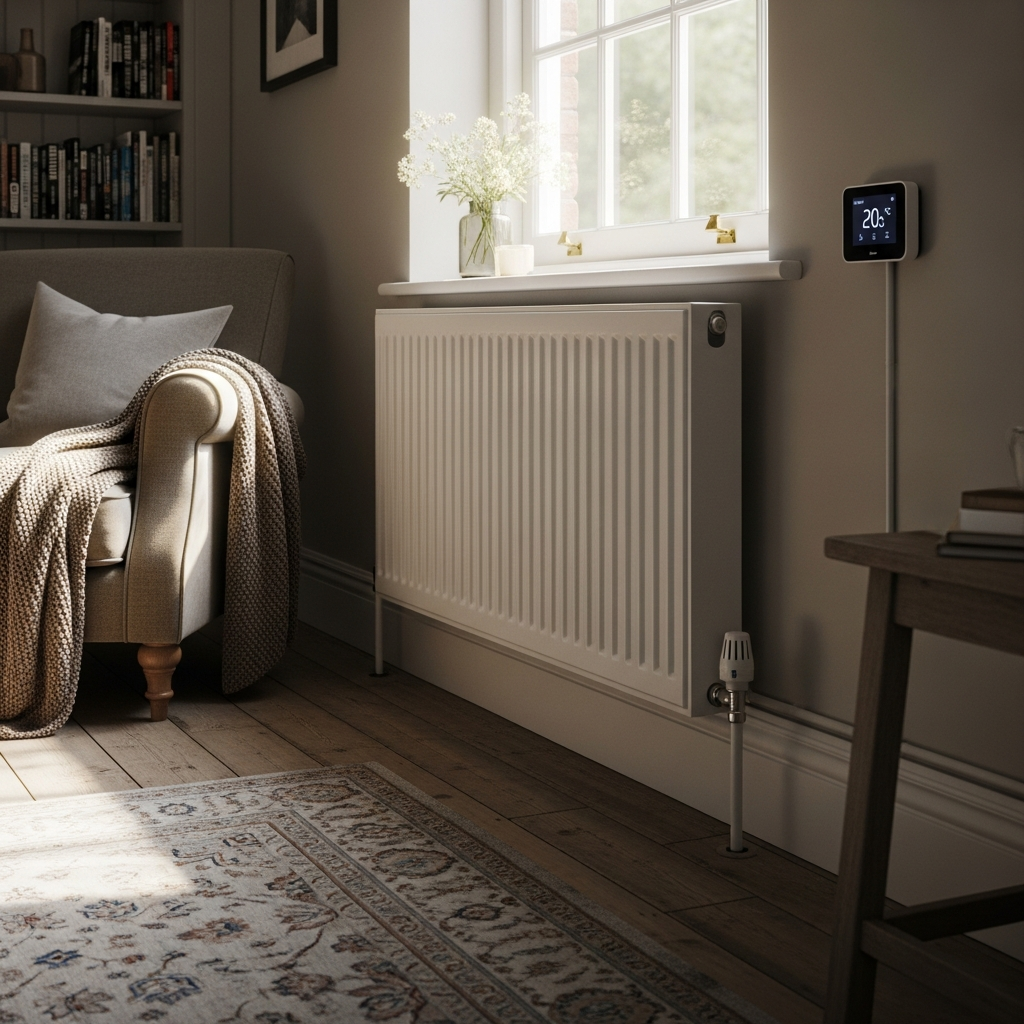
If your radiators have been upgraded or were already generously sized, they can work effectively at these lower temperatures. Many modern homes have radiators that are slightly oversized for a boiler but perfectly suited to a heat pump. This is the sweet spot for most heat pump installations with radiators.
Standard Radiators
Flow temperature: 45-55°C
If you have standard-sized radiators designed for a boiler running at 70°C, they will struggle to heat rooms adequately at 35°C. You may need to run at 45-55°C, which reduces efficiency. In many cases, it is worth upgrading a few key radiators rather than running the whole system at a higher flow temperature.
Your installer should assess your radiators as part of the compatibility check and advise which ones, if any, need upgrading.
Hot Water
Flow temperature for hot water: 48-55°C
Domestic hot water needs to be stored at a higher temperature than space heating — typically 48-52°C for daily use, with a weekly boost to 60°C for legionella protection. This is managed separately from the space heating flow temperature in most systems. Read our guide to hot water cylinders for more detail.
Weather Compensation: Automatic Flow Temperature Control
Rather than setting a fixed flow temperature, the best approach is to use weather compensation. This automatically adjusts the flow temperature based on the outdoor temperature:
- Mild day (15°C outside): Flow temperature drops to perhaps 28°C
- Cool day (8°C outside): Flow temperature rises to perhaps 38°C
- Cold day (0°C outside): Flow temperature increases to perhaps 45°C
- Very cold day (-5°C outside): Flow temperature peaks at perhaps 50°C
This ensures the heat pump always runs at the lowest possible flow temperature for the conditions. On a mild autumn day, it might be running with a COP of 5.0 or higher, even though it can only manage 2.5 on the coldest winter nights.
Weather compensation uses an outdoor temperature sensor fitted to a north-facing wall (to avoid solar gain), connected to the heat pump controller. Most modern heat pumps include this sensor as standard. Your smart thermostat may also support weather compensation.
How to Optimise Your Flow Temperature
Here is a practical approach to finding the lowest workable flow temperature for your system:
Step 1: Start Low
After installation, ask your installer to set the weather compensation curve conservatively low. It is better to start too low and adjust upwards than to start high and never bother reducing.
Step 2: Monitor Room Temperatures
Over the first few weeks, check whether every room reaches its target temperature. Use a thermometer in each room — do not rely on how the radiators feel to the touch. A radiator running at 40°C feels barely warm to the hand but can still heat a room to 21°C if it is the right size.
Step 3: Identify Problem Rooms
If one or two rooms are not reaching temperature while the rest are fine, the solution is usually to upgrade the radiators in those specific rooms rather than increasing the flow temperature for the whole house. Replacing two radiators costs £400-£600 and saves far more in long-term running costs than running the entire system at a higher temperature.
Step 4: Fine-Tune the Weather Compensation Curve
The weather compensation curve may need small adjustments based on how your home actually performs. Your installer should offer a follow-up visit after the first cold spell to review and tweak the settings.
Step 5: Check the Data
Many heat pumps provide energy monitoring through their controller or app. Check your seasonal COP (SCOP) — if it is below 3.0, your flow temperatures may be too high. Well-optimised systems typically achieve an SCOP of 3.5-4.5.
Common Flow Temperature Mistakes
Running Too Hot
The most common mistake is setting the flow temperature too high "just in case." Some installers, particularly those more experienced with boilers, set flow temperatures at 55°C or even 60°C because that is what they are used to. This wastes significant energy.
Not Using Weather Compensation
Running at a fixed flow temperature all year is inefficient. On a 15°C day in October, you do not need the same flow temperature as a -2°C day in January. Weather compensation handles this automatically.
Judging by Radiator Touch
Many homeowners panic because their radiators feel "barely warm" compared to a gas boiler. A radiator at 40°C does not feel hot to the touch, but it is still radiating heat into the room. Judge performance by room temperature, not radiator temperature.
Boosting Temperature Instead of Fixing the Root Cause
If a room is cold, increasing the flow temperature is the least efficient solution. Better options include: upgrading the radiator in that room, improving insulation, or addressing draughts. These fix the root cause rather than compensating with brute force.
Flow Temperature and Running Costs
To put the efficiency gains into real-world context, consider a typical three-bedroom semi-detached house using 12,000kWh of heat per year:
- Average flow temp 50°C (COP 2.8): 4,286kWh electricity = roughly £1,115/year at 26p/kWh
- Average flow temp 40°C (COP 3.8): 3,158kWh electricity = roughly £821/year at 26p/kWh
- Average flow temp 35°C (COP 4.5): 2,667kWh electricity = roughly £693/year at 26p/kWh
The difference between a poorly optimised system at 50°C and a well-optimised one at 35°C is over £400 per year. Over the 20-year lifespan of the heat pump, that is potentially £8,000 or more in savings — simply from getting the flow temperature right.
Read our full running costs guide for more detailed calculations and comparisons with gas boiler costs.
When Higher Flow Temperatures Are Unavoidable
In some situations, you may need to accept higher flow temperatures:
- Older properties with poor insulation: Until insulation is improved, higher flow temperatures may be necessary to maintain comfort
- Original cast iron radiators: These have lower heat output per square metre than modern radiators, so they may need warmer water
- Very small radiators: Some rooms may have undersized radiators that cannot be easily replaced (e.g., due to limited wall space)
- Hot water production: The hot water cylinder needs to reach at least 48-50°C regardless of space heating settings
Even in these cases, weather compensation ensures the system only runs at higher temperatures when actually needed.
Frequently Asked Questions
What flow temperature should my heat pump be set to?
With weather compensation enabled, the flow temperature varies automatically. As a guide: 25-35°C for underfloor heating, 35-45°C for oversized radiators, and 45-55°C for standard radiators. Your installer should set the weather compensation curve during commissioning.
Why do my radiators feel lukewarm with a heat pump?
This is normal. A radiator at 40°C feels barely warm to the touch but is still heating the room effectively. The key measure is room temperature, not radiator temperature. If rooms reach 21°C, the system is working correctly.
Can I turn up the flow temperature if I am cold?
You can, but it is better to first check whether the issue is undersized radiators, poor insulation, or draughts. Turning up the flow temperature reduces efficiency and costs more. Address the root cause instead.
What is the maximum flow temperature for an air source heat pump?
Most modern air source heat pumps can produce flow temperatures up to 60-65°C, and some high-temperature models can reach 75-80°C. However, running at these temperatures dramatically reduces efficiency and should only be done for hot water legionella cycles, not for space heating.
Does flow temperature affect my electricity bill?
Yes, significantly. Reducing the average flow temperature by 10°C can cut your electricity consumption by 20-30%. This makes flow temperature optimisation one of the most impactful things you can do to reduce running costs.
How does flow temperature relate to room temperature?
Flow temperature is the water temperature in the heating system, not the room temperature. Setting your thermostat to 21°C means the room will be 21°C — the heat pump decides what flow temperature it needs to achieve this based on weather compensation.
Want to ensure your heat pump runs at peak efficiency? Get free quotes from MCS-certified installers who understand the importance of flow temperature optimisation. Check our cost guide for realistic installation prices, or use the suitability checker to see if a heat pump is right for your home.