Home Heat Pump Guide

Wet Underfloor Heating Systems Explained

Wet underfloor heating is the gold standard for heat pump installations. It operates at the low flow temperatures where heat pumps are most efficient, delivers even warmth across every room, and frees your walls from bulky radiators. If you are building a new home or renovating extensively, it is the emitter system to aim for.

This guide covers everything you need to know about wet underfloor heating in the UK — how it works, the different system types, pipe layouts, costs, and why it pairs so well with an air source heat pump.

What Is Wet Underfloor Heating?

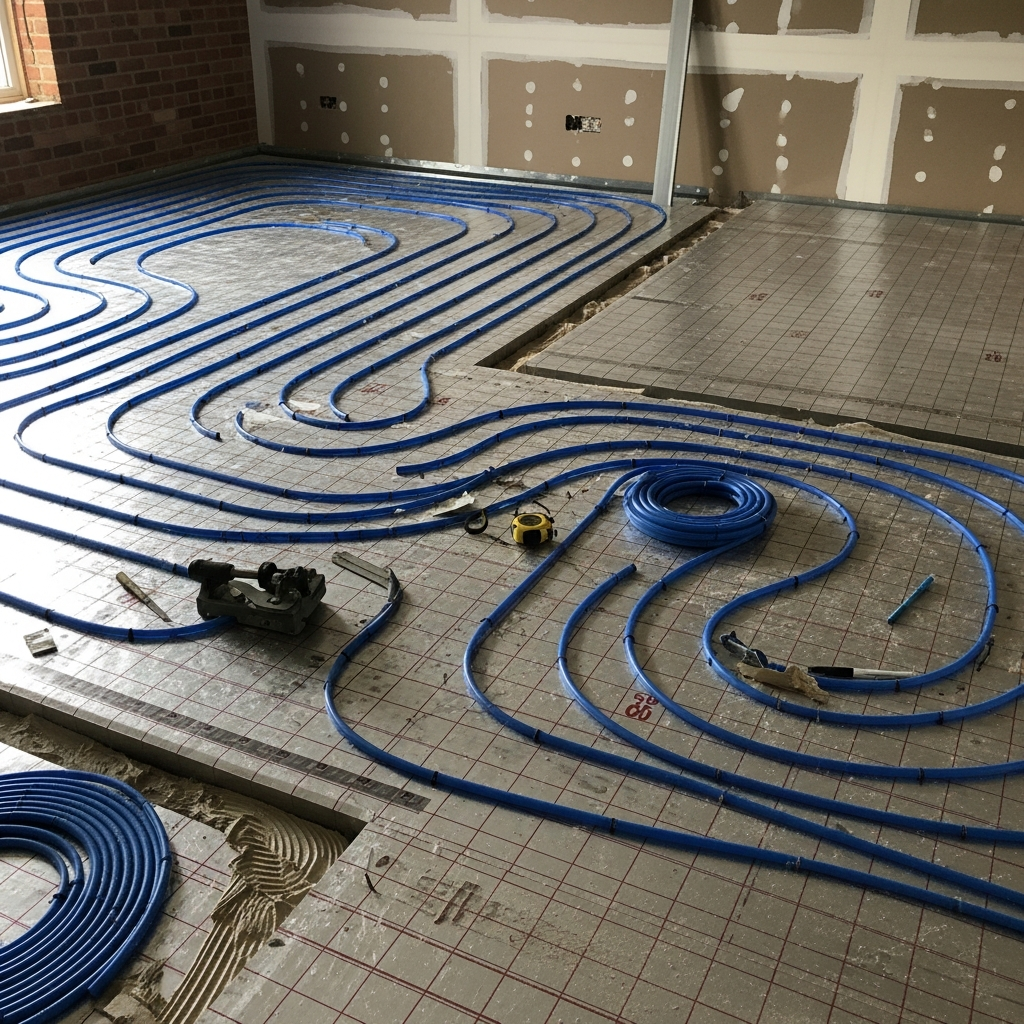
Wet underfloor heating (often called hydronic UFH) circulates warm water through a network of pipes buried beneath your floor. The entire floor surface becomes a large, low-temperature radiator, emitting heat gently and evenly across the room. The term "wet" distinguishes it from electric underfloor heating, which uses electrical resistance cables or mats rather than water.

A typical wet UFH system includes a manifold (the central distribution point), pipe loops running through each room, insulation beneath the pipes to direct heat upwards, and a heat source — ideally a heat pump.

How Wet Underfloor Heating Works

Your heat pump heats water to between 30°C and 45°C. This water flows to a manifold, usually located in a cupboard or utility room. The manifold splits the flow into separate circuits, one for each room or zone. Water travels through the pipe loops under the floor, releasing heat gradually as it goes, before returning to the manifold and back to the heat pump to be reheated.

Because the entire floor emits heat, the water temperature does not need to be high. A flow temperature of 35°C to 40°C is sufficient in a well-insulated home, which is exactly where heat pumps achieve their best efficiency. At these temperatures, a heat pump can deliver a coefficient of performance (COP) of 3.5 to 4.5, meaning you get 3.5 to 4.5 units of heat for every unit of electricity consumed.

Pipe Layouts for Underfloor Heating

The layout of the pipes determines how evenly the floor heats. There are two main patterns used in the UK.

Serpentine (S-Pattern) Layout

The pipe runs back and forth across the room in parallel lines, like a snake. This is the simplest layout and works well for rectangular rooms. However, the warmest water enters at one edge of the room, so there can be a slight temperature gradient from one side to the other. In practice, with properly spaced pipes, the difference is barely noticeable.

Spiral (Snail) Layout

The pipe spirals inward from the edge of the room to the centre, then spirals back out. This alternates the flow and return pipes next to each other, creating a more even temperature distribution across the floor. It is the preferred layout for larger rooms and is the standard recommendation from most UFH manufacturers.

Pipe Spacing

Standard pipe spacing in the UK is 150mm to 200mm between pipe centres. Closer spacing (100mm to 150mm) is used near external walls or large windows where heat loss is greatest. Wider spacing (200mm to 300mm) may be used in bathrooms or well-insulated rooms with lower heat demands. Your installer will calculate the exact spacing based on a room-by-room heat loss assessment.

Pipe Materials

Most wet UFH systems use PEX (cross-linked polyethylene) or PE-RT (polyethylene of raised temperature) pipes, typically 16mm diameter. These are flexible, durable, and rated to last over 50 years. Some premium systems use multilayer composite pipes (PEX-Al-PEX) that include an aluminium layer for added rigidity and lower expansion.

Screed Systems vs Overlay Systems

This is the biggest decision when choosing a wet UFH system. The two main approaches suit very different situations.

Screed Systems (New Build and Major Renovation)

In a screed system, pipes are laid on top of insulation boards across the structural floor, then covered with a layer of screed — a sand and cement mix typically 65mm to 75mm deep. The screed encases the pipes and acts as a thermal mass, storing heat and releasing it slowly.

Advantages:

  • Excellent thermal mass — the floor stores heat and releases it gradually, smoothing out temperature fluctuations
  • Lower material costs per square metre
  • Works with any floor finish — tile, stone, engineered wood, or vinyl
  • The standard approach for new builds in the UK

Disadvantages:

  • Adds 75mm to 100mm of floor build-up (insulation plus screed)
  • Screed needs 3 to 7 days to dry before floor finishes can be applied (up to 6 weeks for full drying depending on thickness)
  • Slow response time — takes 2 to 4 hours to heat up from cold
  • Not suitable for retrofit unless you are stripping the floor back to the slab

The typical cost for a screed UFH system is £40 to £60 per square metre for materials, plus the cost of the screed itself (£15 to £25 per square metre for liquid screed, laid by a specialist).

Overlay Systems (Retrofit and Renovation)

Overlay systems are designed to fit on top of an existing floor with minimal build-up — typically 15mm to 25mm. The pipes sit in pre-formed channels in thin insulated panels, and the floor finish goes directly on top. Some systems use aluminium diffuser plates to spread heat evenly from the pipe across the floor surface.

Advantages:

  • Minimal floor height increase — as little as 15mm
  • Can be fitted over existing floors without major disruption
  • Faster response time than screed systems — heats up in 30 to 60 minutes
  • Ideal for renovation projects and individual room upgrades

Disadvantages:

  • More expensive per square metre — typically £60 to £90 for materials
  • Less thermal mass, so temperature fluctuates more
  • Some systems limit floor finish choices — check compatibility with your chosen flooring
  • Aluminium diffuser plates can be noisy if not fitted correctly

Floor Finishes and Underfloor Heating

Not all floor finishes conduct heat equally. The best options for UFH are:

  • Porcelain and ceramic tiles — excellent thermal conductivity, the ideal UFH floor finish
  • Natural stone — very good conductivity, though thicker stone slabs respond more slowly
  • Engineered wood — suitable if rated for UFH (check with the manufacturer); avoid solid hardwood as it can warp
  • Vinyl and LVT — good conductivity and fine with UFH, but check the maximum temperature rating
  • Carpet — workable but acts as insulation; keep the combined tog rating of carpet and underlay below 1.5 tog
  • Laminate — suitable if rated for UFH; leave expansion gaps as per manufacturer instructions

The general rule is: thinner, denser floor finishes deliver heat more effectively. Thick carpet with heavy underlay is the worst choice, significantly reducing the system's output and efficiency.

Why Wet UFH and Heat Pumps Are the Perfect Match

Heat pumps and wet underfloor heating are engineered for each other. Here is why:

  • Low flow temperatures — UFH works at 30-45°C, exactly where heat pumps are most efficient. Compare this to radiators, which typically need 45-55°C with a heat pump
  • Higher COP — lower flow temperatures mean higher coefficients of performance, reducing electricity consumption
  • Even heat distribution — no cold spots, no hot spots, just consistent warmth at ankle level rising gently
  • Works with constant heating patterns — heat pumps prefer steady-state heating rather than blast-and-cool cycles, and UFH with thermal mass supports exactly this approach

An MCS-certified installer will design your UFH system to match your heat pump's output at the flow temperature that gives the best balance of comfort and efficiency. In a well-insulated new build, this can be as low as 30°C to 35°C.

Wet UFH Costs in the UK

Here is a realistic cost breakdown for a wet underfloor heating installation in a UK home.

Materials Only

  • Screed system: £40 to £60 per m² (pipes, insulation, manifold, fixings)
  • Overlay system: £60 to £90 per m² (pre-formed panels, pipes, diffuser plates, manifold)
  • Manifold: £200 to £500 depending on the number of circuits
  • Controls and actuators: £150 to £400

Installation Labour

  • Pipe laying: £15 to £30 per m²
  • Liquid screed (if applicable): £15 to £25 per m²
  • Manifold and plumbing connections: £300 to £600

Typical Total Costs

  • 3-bedroom new build (80m² UFH area): £5,000 to £8,000 fully installed with screed
  • 3-bedroom retrofit (80m² UFH area): £7,000 to £12,000 fully installed with overlay

These costs are for the UFH system only and do not include the heat pump itself. For full heat pump installation costs, see our dedicated guide. Remember that the Boiler Upgrade Scheme grant of £7,500 covers the heat pump and can make the overall project surprisingly affordable.

Installation Considerations

Insulation Is Critical

UFH must have insulation beneath the pipes to direct heat upwards into the room, not downwards into the subfloor. On a ground floor, this means at least 50mm of rigid insulation (PIR or EPS). On upper floors, 25mm to 30mm is usually sufficient. Without proper insulation, you will waste energy heating the floor void or the ground below.

Zoning and Controls

Each room or area should be a separate circuit on the manifold, controlled by its own thermostat and actuator valve. This allows you to set different temperatures in different rooms — warmer in the living room, cooler in bedrooms. Modern zone controls can be managed via smartphone apps for maximum convenience.

Pressure Testing

Before the screed is poured or the floor finish is laid, the system must be pressure tested to check for leaks. This is done at 6 bar for at least 24 hours. Any leak found after the screed is down means expensive remedial work, so this step is not optional.

Commissioning

After installation, the system should be commissioned by gradually increasing the water temperature over several days. This is particularly important with screed systems to avoid cracking. Your installer will provide a commissioning schedule — typically starting at 20°C and increasing by 5°C per day until the design flow temperature is reached.

Can You Add Wet UFH to an Existing Home?

Yes, but it is more involved than a new build installation. The main options are:

  • Overlay system on existing floors — the least disruptive option, adding 15-25mm of height
  • Dig out and re-screed ground floors — more disruptive but gives a full screed system; consider this during a major renovation
  • Between joists on suspended timber floors — specialist systems clip pipes between joists with aluminium diffuser plates beneath the floorboards
  • Single-room installation — you can install UFH in one room (often a kitchen or bathroom) and use radiators in the rest of the house

Door thresholds and floor level changes are the main practical challenge when retrofitting. Your installer will assess whether the floor height increase creates issues with doors, stairs, or adjoining rooms.

Frequently Asked Questions

How long does wet underfloor heating last?

The pipes are rated to last 50 years or more. The manifold, pump, and actuators may need replacing after 15 to 20 years, but these are accessible components. UFH is a fit-and-forget system for the most part.

Can wet underfloor heating heat a whole house?

Absolutely. In a well-insulated home, UFH alone can provide all the heating you need. In older, less insulated properties, you may need supplementary radiators in rooms with very high heat loss, such as conservatories.

Is wet underfloor heating expensive to run?

When paired with a heat pump, wet UFH is one of the cheapest heating systems to run. The low flow temperatures mean high heat pump efficiency, and the even heat distribution means no energy is wasted overheating parts of the room. Typical running costs are £600 to £1,000 per year for a well-insulated three-bedroom house.

Does wet underfloor heating work upstairs?

Yes. Upper-floor UFH systems typically use between-joist or overlay installations. The heat output is more than sufficient for bedrooms and bathrooms, which generally have lower heating demands than ground-floor living spaces.

How long does underfloor heating take to warm up?

A screed system takes 2 to 4 hours to reach temperature from a cold start, which is why constant low-temperature heating works better than on/off scheduling. Overlay systems respond faster, typically within 30 to 60 minutes.

Can I install wet underfloor heating myself?

The pipe laying itself is relatively straightforward, and some homeowners do this to save on labour costs. However, the manifold connections, pressure testing, and integration with your heat pump should be done by a qualified installer. Any work connected to a heat pump system should be carried out or signed off by an MCS-certified professional.