Mini Split Heat Pump UK: What You Need to Know
Mini splits heat and cool individual rooms for as little as 3p per hour — but they cannot replace your boiler or qualify for the £7,500 grant. Here is when they make sense and when they do not.

The term “mini split” is everywhere in the heating world — but it is primarily an American term. In the UK, you are more likely to hear these systems described as ductless heat pumps, air-to-air heat pumps, or simply split-system air conditioning units that also heat. Whatever you call them, they are a distinct technology from the air-to-water heat pumps that dominate UK installations.
This guide explains what mini split heat pumps are, how they differ from the standard air-to-water systems most UK installers fit, what they cost, and whether one might be right for your home.
Not sure which heat pump type suits your home?
Answer a few questions about your property and get a personalised recommendation in 60 seconds.
Check my suitability →In this guide:
What Is a Mini Split Heat Pump?
A mini split heat pump is a ductless heating and cooling system that consists of two main components: an outdoor compressor unit and one or more indoor wall-mounted units. Refrigerant lines connect the two through a small hole in the wall — typically just 60-80mm in diameter.
Each indoor unit heats or cools the room it is installed in by blowing conditioned air directly into the space. There is no ductwork, no radiators, and no hot water cylinder involved.
The “mini” refers to the compact size compared to larger commercial split systems. The “split” means the system is divided between indoor and outdoor components, connected by refrigerant lines.
Single Split vs Multi Split
A single split system has one outdoor unit connected to one indoor unit. It heats and cools a single room.
A multi split system has one outdoor unit connected to multiple indoor units — typically two to five. Each indoor unit can be controlled independently, so you can heat the living room to 21°C while keeping the bedroom at 18°C, or turn off unused rooms entirely.

Mini Split vs Air-to-Water Heat Pump: Key Differences
This is the most important distinction for UK homeowners to understand. When most people in the UK talk about heat pumps, they mean air-to-water heat pumps — the type that replaces your gas boiler and heats water for radiators and hot water.
Mini splits are fundamentally different:
| Feature | Mini Split (Air-to-Air) | Air-to-Water Heat Pump |
|---|---|---|
| Heats rooms via | Blown warm air from wall units | Radiators or underfloor heating |
| Provides hot water | No | Yes |
| Provides cooling | Yes | Some models, limited |
| BUS grant eligible | No | Yes (£7,500) |
| Replaces gas boiler | Not fully (no hot water) | Yes, completely |
| Typical cost | £1,500–£4,000 per room | £8,000–£14,000 whole house |
Air-to-water heat pumps are by far the more common choice for UK homes seeking a full boiler replacement.
How Much Does a Mini Split Heat Pump Cost in the UK?
Mini split costs vary significantly depending on brand, capacity, and number of rooms:
Single Room System
A single split system capable of heating and cooling one room typically costs £1,200–£2,500 fully installed. Budget brands start lower, but premium units sit at the higher end.
Multi-Room System
A multi split system serving three to four rooms typically costs £4,000–£8,000 installed. Each additional indoor unit adds roughly £800–£1,500 to the total.
Running Costs
Mini splits are highly efficient — many achieve a COP of 4.0 or higher, meaning they produce 4kW of heat for every 1kW of electricity consumed. For a single room, running costs might be as low as 3-5p per hour. A multi split system heating several rooms could cost 10-20p per hour depending on the outside temperature and how many rooms are active.
For context on how these compare to other systems, see our heat pump running costs guide. Pairing any electric heating with solar panels can further reduce your electricity bills.
Pros of Mini Split Heat Pumps
Heating and Cooling in One System
This is the standout advantage. A mini split provides both heating in winter and cooling in summer from the same unit. With UK summers getting hotter — 2022 and 2023 both saw temperatures above 35°C — air conditioning is becoming a genuine consideration for many UK homes.
Room-by-Room Control
Each indoor unit operates independently with its own thermostat and remote control. You heat only the rooms you are using, when you are using them. For households where different people want different temperatures, or where some rooms are rarely used, this offers genuine flexibility.
No Disruption to Existing Heating
You can install a mini split alongside your existing boiler and radiators. It does not require removing or replacing anything. Many people use a mini split to supplement their existing heating — heating the living room efficiently with the mini split while the boiler handles the rest of the house.
Quick and Simple Installation
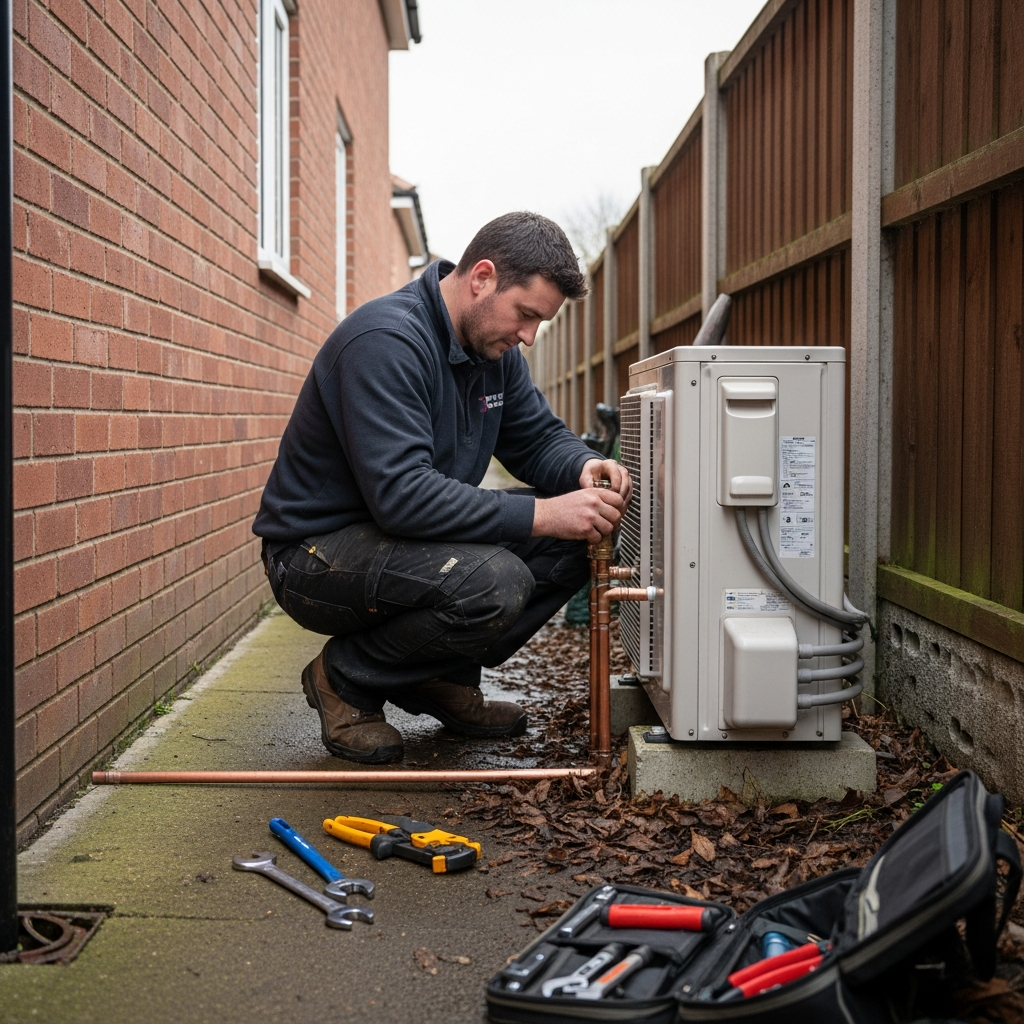
A single split system can be installed in a day. There is no need for a hot water cylinder, no pipework to radiators, and no major disruption. The indoor unit mounts on a wall, the outdoor unit sits outside, and refrigerant lines connect through a small hole.
Excellent Efficiency
Mini splits are among the most efficient heating systems available. Top models achieve seasonal efficiencies of 400-500%, significantly outperforming even the best gas boilers.
Cons of Mini Split Heat Pumps
No Hot Water
This is the biggest limitation. A mini split heats air, not water. You still need a separate system for domestic hot water — whether that is an existing gas boiler, an electric immersion heater, or a dedicated hot water heat pump.
Not Eligible for the BUS Grant
The Boiler Upgrade Scheme grant of £7,500 is only available for air-to-water and ground source heat pumps. Air-to-air mini splits do not qualify. This is a significant financial consideration — see our heat pump grants guide for full details on what is eligible.
Aesthetics
Wall-mounted indoor units are visible and not to everyone's taste. Modern units are increasingly sleek — typically white, slim, and about 80-100cm wide — but they are still a visible appliance on your wall.
Blown Air Can Feel Draughty
Mini splits heat by blowing warm air into the room, which some people find less comfortable than the radiant warmth from radiators or underfloor heating. Modern units have sophisticated airflow management to minimise this, but it is a different heating experience. If radiant warmth matters to you, read our guide on radiators for heat pumps.
Multiple Units Needed for Whole-House Heating
To heat an entire house, you need an indoor unit in every room you want heated. For a three-bedroom house, that could mean four or five units — the costs add up, and each room has a visible wall unit.
Considering a full air-to-water heat pump instead? See what it would cost for your home.
Calculate my heat pump costs →Personalised estimate in 60 seconds. No obligation.
When Does a Mini Split Make Sense in the UK?
Mini splits are not the right choice for everyone, but they are excellent in specific situations:
- Supplementing an existing boiler — adding efficient heating (and cooling) to your main living space while keeping the boiler for hot water and bedrooms
- Home offices — heating a single room that is used during the day without running the whole-house heating system
- Properties without gas — if you are currently on electric storage heaters, a mini split in each room is far cheaper to run
- Flats and apartments — where a full air-to-water system is difficult to install, a mini split can be a practical alternative
- Summer cooling — if cooling is as important to you as heating, a mini split delivers both from one system
- Listed buildings or conservation areas — a small wall-mounted unit may be easier to get permission for than a full heat pump installation
If you want a system that replaces your boiler entirely — handling central heating and hot water — then an air-to-water heat pump is what you need. Read our complete guide to air source heat pumps for the full picture. To compare with your current gas setup, see our heat pump vs gas boiler guide.

Installation: What Is Involved?
Mini split installation is relatively straightforward compared to a full air-to-water heat pump installation.
What the Installer Does
- Mounts the indoor unit on an internal wall (usually high up, near the ceiling)
- Drills a hole through the external wall (60-80mm diameter) for refrigerant lines, electrical cable, and condensate drain
- Installs the outdoor unit — either on the ground on a mounting pad or on wall brackets
- Connects refrigerant lines between indoor and outdoor units
- Connects the electrical supply
- Commissions and tests the system
Do You Need Planning Permission?
In England, a single air source heat pump (including mini splits) is usually permitted development, meaning no planning permission is needed. The main conditions are that the unit must be at least one metre from the property boundary and must comply with noise limits — the MCS 020 planning standard.
In conservation areas, listed buildings, and flats, you may need permission. Check with your local planning authority before proceeding.
Who Can Install One?
Mini split installation should be carried out by an F-gas registered engineer. Since the system contains refrigerant, only qualified technicians should handle the refrigerant lines and charge the system. Many air conditioning installers fit mini splits — it does not need to be a specialist heat pump company.
Brands Available in the UK
The main mini split brands available in the UK include well-established manufacturers with strong support networks. When comparing options, focus on efficiency ratings, warranty length, and local engineer availability rather than price alone.
Avoid very cheap unbranded units from marketplace sellers. They often lack proper UK support, use older refrigerants, and may not meet current F-gas regulations.
Want quotes for a full air-to-water heat pump instead?
Get free, no-obligation quotes from MCS-certified installers who can assess your home and recommend the right system.
Get my free quotes →We connect you with vetted professionals. No sales calls from us.
Frequently Asked Questions
Can a mini split heat pump replace my gas boiler?
Not completely. A mini split heats rooms via blown air but does not heat water. You would still need a separate hot water source — an immersion heater, a dedicated hot water heat pump, or your existing boiler. For a full boiler replacement, you need an air-to-water heat pump.
Are mini split heat pumps eligible for the BUS grant?
The £7,500 Boiler Upgrade Scheme grant covers air-to-water and ground source heat pumps. Air-to-air systems, including mini splits, qualify for a lower £2,500 grant introduced on 28 April 2026. See our grants guide for what does qualify.
How much does it cost to run a mini split?
A mini split heating a single room costs roughly 3-5p per hour to run, depending on the room size, insulation, and outside temperature. They are significantly cheaper to run than direct electric heaters, fan heaters, or portable radiators.
Can I install a mini split myself?
You can mount the indoor and outdoor units and run the cable, but the refrigerant connection and charging must be done by an F-gas registered engineer. It is illegal to handle fluorinated refrigerants without the proper certification.
How noisy are mini split heat pumps?
Indoor units typically operate at 19-25 dB on the lowest fan setting — quieter than a whisper. The outdoor unit runs at 40-50 dB, comparable to a quiet conversation. Most people find them unobtrusive.
Do mini splits work in cold weather?
Yes. Modern mini splits operate effectively down to -15°C or lower. Some models are rated to -25°C. UK winters rarely drop below -5°C in most areas, so cold weather performance is not a concern.
About Mini Split and Air Source Heat Pump Systems
Mini split (air-to-air) heat pumps and air-to-water heat pumps both use refrigerant cycles to extract renewable heat from outside air. While mini splits are ideal for single-room or supplementary heating, air-to-water systems provide whole-house heating and hot water — qualifying for the £7,500 BUS grant. Combining an air-to-water heat pump with solar panels can further reduce electricity costs. This guide is part of our resource hub covering heat pump costs, installation, and running costs for UK homeowners.