How Does a Ground Source Heat Pump Work?
A ground source heat pump harvests free heat stored beneath your garden — where the temperature sits at a stable 10-13°C all year round — and concentrates it to warm your home. For every unit of electricity it uses, it produces up to 4.5 units of heat, making it the most efficient heating system available to UK homeowners.
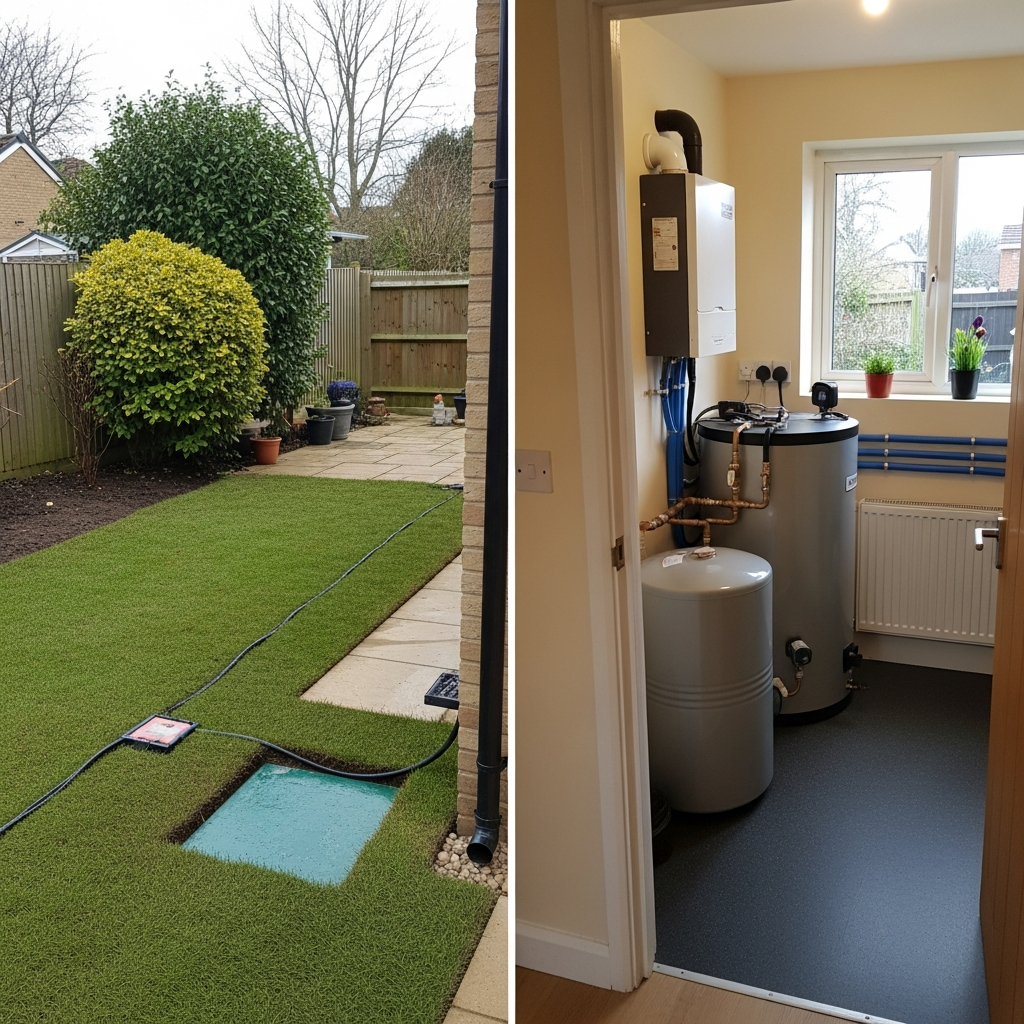
Ground source heat pumps might sound complicated, but the underlying principle is something you already understand. If you have ever noticed that a cellar stays cool in summer and relatively warm in winter, you have experienced the same phenomenon that makes ground source heating work.
This guide explains exactly how a ground source heat pump extracts warmth from the earth beneath your garden and turns it into useful heat for your home — in plain English, without the jargon. For a comprehensive overview of the technology including costs and suitability, see our complete guide to ground source heat pumps.
Wondering if a ground source heat pump suits your home?
Try the free calculatorInstant cost and savings estimate. No email required.
The Basic Principle
A ground source heat pump moves heat from one place to another. It does not generate heat by burning fuel — it harvests heat that already exists in the ground.
The ground beneath your feet acts as an enormous thermal store. Solar energy warms the earth's surface, and at depths of just 1-2 metres, the temperature stays remarkably stable at around 10-13°C throughout the entire year. Even in the depths of a Scottish winter, the ground a couple of metres down remains at this temperature.
A ground source heat pump taps into this free, renewable warmth. It extracts it from the ground, concentrates it to a higher temperature, and uses it to heat your radiators, underfloor heating, and hot water.
The Four Key Components
Every ground source heat pump system has four main parts, each playing a specific role in the process.
1. The Ground Loop
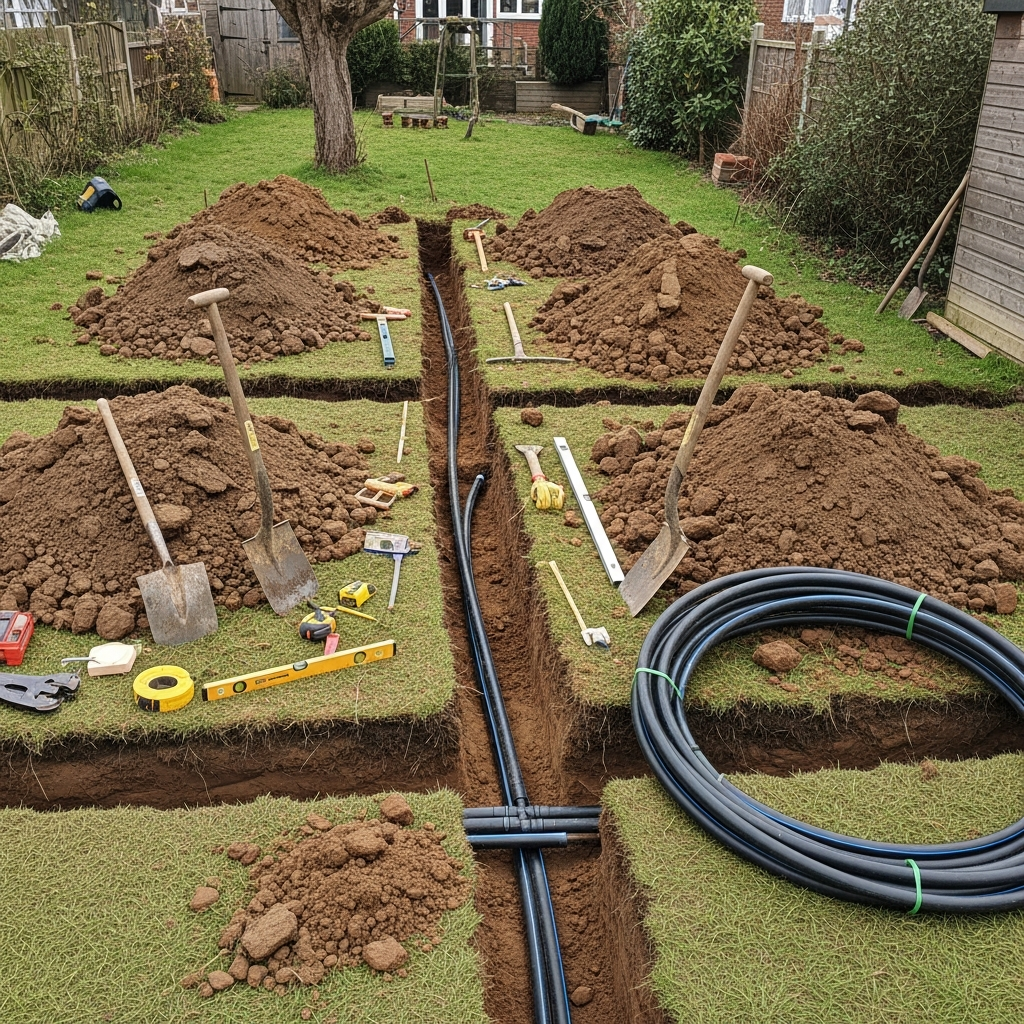
A network of plastic pipes buried in your garden, filled with a mixture of water and antifreeze (known as brine). These pipes are laid either horizontally in trenches at 1.2-2 metres deep, or vertically in boreholes drilled 60-200 metres into the ground.
As the brine circulates through the ground loop, it absorbs heat from the surrounding soil or rock. Even though 10-13°C might not feel warm to you, it contains a significant amount of thermal energy that the heat pump can use.
2. The Evaporator
When the warmed brine returns to the heat pump, it passes through a heat exchanger called the evaporator. Here, the heat from the brine is transferred to a separate circuit containing a refrigerant — a fluid with a very low boiling point.
The refrigerant absorbs enough heat to evaporate — turning from a liquid into a gas — even at these relatively low temperatures.
3. The Compressor
This is where the clever bit happens. The compressor squeezes the refrigerant gas, which dramatically increases its temperature. Think about pumping up a bicycle tyre — the pump gets hot because compressing a gas raises its temperature.
The compressor takes the refrigerant from around 5-10°C and compresses it to 50-65°C or higher. This is the only part of the process that requires electricity, and it is remarkably efficient — for every unit of electricity the compressor uses, the system delivers 3.8-4.5 units of heat.
4. The Condenser
The hot, compressed refrigerant gas passes through another heat exchanger — the condenser — where it transfers its heat to the water in your central heating system. As the refrigerant releases heat, it cools and condenses back into a liquid.
This heated water is then pumped around your radiators or underfloor heating, and to your hot water cylinder, just like a conventional boiler would.
The Full Cycle Step by Step
- Ground absorbs solar energy — the earth stores warmth from the sun, maintaining a stable 10-13°C at depth
- Brine circulates through the ground loop — absorbing heat from the soil and warming from about 3°C to 7°C
- Heat transfers to the refrigerant — in the evaporator, the brine's warmth causes the refrigerant to evaporate into a gas
- Compressor raises the temperature — the refrigerant gas is compressed, boosting its temperature to 50-65°C
- Heat is delivered to your home — in the condenser, the hot refrigerant transfers its heat to your central heating water
- Refrigerant cools and recirculates — through the expansion valve, the refrigerant drops in temperature and pressure, ready to start again
- Cooled brine returns underground — to absorb more heat from the ground
Why Ground Temperature Matters
The stable ground temperature is the single biggest advantage ground source heat pumps have over air source heat pumps.
An air source heat pump extracts heat from the outdoor air. On a mild 10°C day, this works brilliantly. But on a -5°C January morning — when you need the most heat — the air source system has to work much harder because there is less thermal energy available. Its efficiency drops noticeably.
A ground source heat pump faces no such challenge. Whether the air temperature above is 25°C or -10°C, the ground at 1.5 metres deep remains at 10-13°C. The heat pump operates at the same efficiency all year round.
SCOP 3.8 - 4.5
Ground source (consistent year-round)
SCOP 2.8 - 3.5
Air source (varies with outdoor temp)
SCOP stands for Seasonal Coefficient of Performance — the average efficiency across an entire year. A SCOP of 4.0 means that for every 1 kWh of electricity consumed, the heat pump produces 4 kWh of heat.
Compare ground source heat pump quotes in your area
Get free quotesMCS-certified installers only. No obligation.
Horizontal Loops vs Boreholes: How Each Works
Horizontal Ground Loops
Pipes are laid in trenches at 1.2-2 metres deep, arranged in coils (called "slinkies") or straight runs. The trenches are typically 1-2 metres apart. The pipes absorb heat from the relatively shallow ground, which is warmed primarily by solar radiation.
Horizontal loops need a substantial garden — roughly two to three times the floor area of your home.
Vertical Boreholes
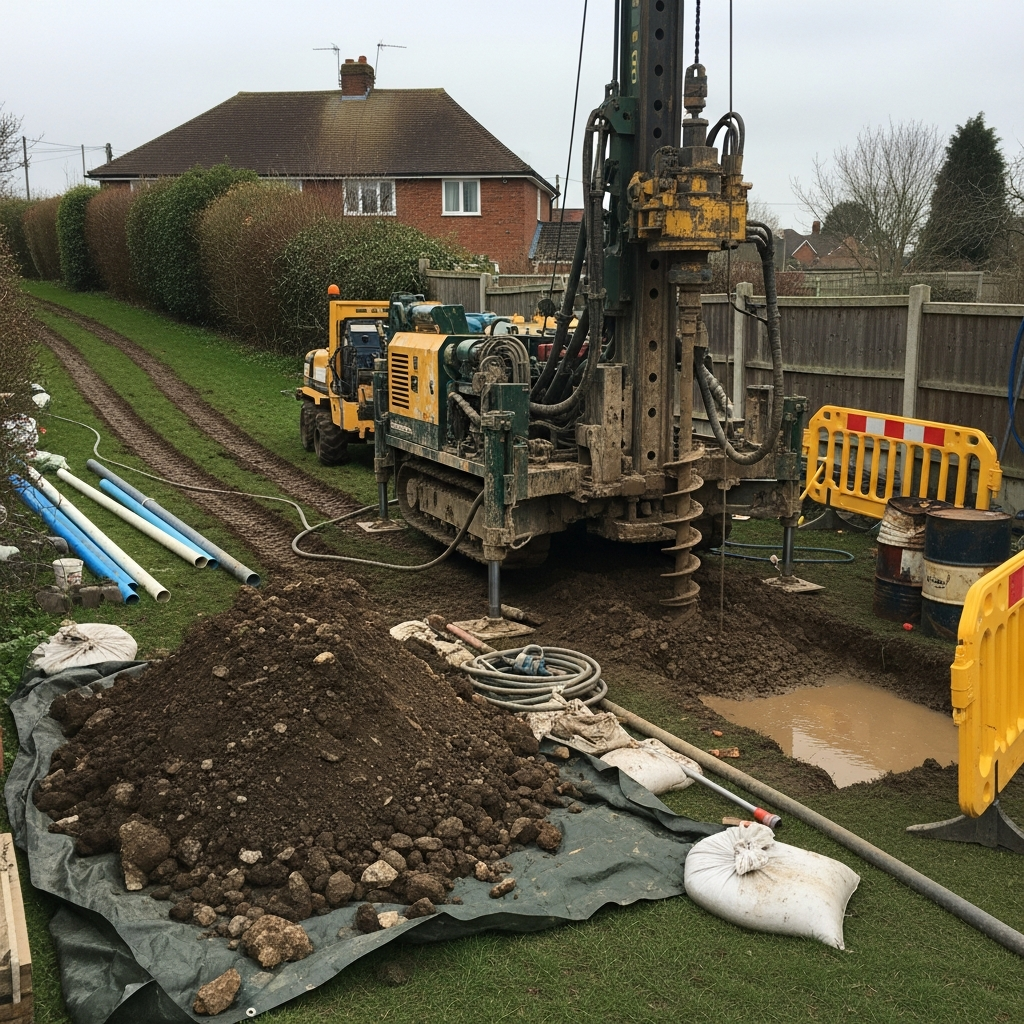
Holes are drilled 60-200 metres deep, and a U-shaped pipe is inserted into each borehole, which is then filled with a thermally conductive grout. At these depths, the ground temperature is even more stable and is actually warmed partly by the earth's core rather than just solar energy.
Boreholes are slightly more efficient than horizontal loops because the deeper ground is warmer and more stable. They also take up far less garden space. However, the drilling cost is significantly higher.
Read our full comparison in the horizontal vs vertical ground source heat pump guide.
What Temperature Does a Ground Source Heat Pump Produce?
A ground source heat pump typically heats water to 45-55°C for your central heating. This is lower than a gas boiler (which typically runs at 60-80°C), but it is by design — heat pumps are most efficient at lower flow temperatures.
For underfloor heating, which only needs 30-40°C, a ground source heat pump is operating in its sweet spot and at maximum efficiency.
For radiators, slightly larger radiators may be needed to deliver the same heat output at the lower flow temperature. Many existing radiators are already oversized and work fine without replacement. See our guide on whether you need new radiators for a heat pump.
For hot water, the heat pump typically heats the cylinder to 50-55°C, with a periodic boost to 60°C for legionella prevention.
Efficiency and the Coefficient of Performance
The COP (Coefficient of Performance) is the key metric for any heat pump. It tells you how much heat you get for each unit of electricity consumed.
A ground source heat pump with a COP of 4.0 produces 4 kWh of heat for every 1 kWh of electricity. That means 75% of the heat delivered to your home is free — harvested from the ground. Only 25% comes from the electricity you pay for.
The result is genuinely low running costs. If you pair a ground source heat pump with solar panels to offset electricity costs, the combination delivers some of the lowest heating bills achievable in the UK. Find out exactly how much in our heat pump running costs guide.
Can a Ground Source Heat Pump Cool Your Home?
Yes — and this is a bonus feature that many people overlook. Ground source heat pumps can provide passive cooling in summer by simply circulating the cool brine from the ground loop through your underfloor heating system.
Because the ground is naturally cooler than the air in summer, this process requires almost no electricity — just enough to run the circulation pump. It can lower indoor temperatures by 2-4°C, which makes a noticeable difference during heatwaves.

Maintenance and Lifespan
Ground source heat pumps are among the lowest-maintenance heating systems available:
- Annual service: A qualified engineer should check the system once a year — typical cost £100-£200
- Ground loop: No maintenance required. The sealed, buried pipes have no moving parts and typically last 50+ years
- Heat pump unit: Expected lifespan of 20-25 years
- Compressor: The only major moving part; may need replacing once during the unit's lifetime
Compare this to a gas boiler, which needs annual servicing, has a typical lifespan of 12-15 years, and contains numerous components that can fail. For a detailed comparison, see our heat pump vs gas boiler guide.
Frequently Asked Questions
Does a ground source heat pump work in cold weather?
Absolutely. The ground temperature at 1.5 metres or deeper stays at 10-13°C regardless of what is happening above. A ground source heat pump works just as efficiently during a -10°C cold snap as on a mild spring day.
How deep are ground source heat pump pipes buried?
Horizontal loops are buried at 1.2-2 metres deep. Vertical boreholes are drilled to 60-200 metres. Both access stable ground temperatures, though boreholes reach even more consistent warmth.
Does the ground get colder over time?
A well-designed system accounts for this. The ground around the loop does cool slightly during the heating season, but it naturally regenerates during summer. In the UK, solar gain is more than sufficient to replenish the heat extracted each winter.
Can a ground source heat pump replace a gas boiler?
Yes. A GSHP provides both space heating and hot water, fully replacing a gas boiler. You will no longer need a gas supply, and your heating becomes entirely electric — powered by the most efficient technology available.
How much electricity does a ground source heat pump use?
For a typical home needing 12,000 kWh of heat per year, a GSHP with a COP of 4.0 would use about 3,000 kWh of electricity — costing roughly £735 per year at current rates. That is significantly less than the gas equivalent.
What is the difference between ground source and geothermal?
In the UK, "ground source" and "geothermal" are often used interchangeably for domestic systems. Technically, true geothermal energy comes from the earth's internal heat at great depths, while domestic ground source heat pumps primarily use solar energy stored in the shallow ground. The result for the homeowner is the same.
See what a ground source system would cost for your home
Get your free estimateInstant results. No email or signup required.
How Ground Source Technology Fits the Bigger Picture
Ground source heat pumps use a refrigeration cycle to harvest renewable heat from the earth — the same fundamental science behind air source heat pumps, but with the advantage of a far more stable heat source. Combined with home solar energy systems and government support through the Boiler Upgrade Scheme, ground source technology forms a key part of the UK's transition away from fossil fuel heating. Understanding the science helps homeowners make confident decisions about which renewable heating system best suits their property.