Home Heat Pump Guide

Heat Pump for a New Build Home

If you are buying or building a new home, there is a very good chance it will come with a heat pump. The Future Homes Standard, which comes into full effect in 2025, effectively requires all new homes in England to use low-carbon heating — and for the vast majority of developers, that means heat pumps.

This is actually excellent news. A heat pump designed into a new build from the start performs significantly better than one retrofitted into an existing home. The insulation is right, the heating system is optimised, and the running costs are low from day one.

The Future Homes Standard: What It Means

The Future Homes Standard (FHS) is the government's framework for ensuring new homes are built to be highly energy efficient and ready for a zero-carbon future. Key requirements include:

  • 75-80% reduction in carbon emissions compared to current Building Regulations
  • No fossil fuel heating: Gas boilers will not be permitted in new homes from 2025 onwards
  • High insulation standards: Enhanced fabric performance with lower U-values for walls, roofs, and floors
  • Airtightness: New homes must achieve much better airtightness, reducing heat loss from draughts
  • Ventilation: Mechanical ventilation with heat recovery (MVHR) to maintain air quality in airtight buildings

In practice, this means virtually all new homes built from 2025 will have a heat pump as standard, combined with excellent insulation and energy-efficient design.

What Changed in 2023 (Part L Interim Update)

Even before the full Future Homes Standard, the 2021 interim update to Part L of the Building Regulations (which came into force in June 2023) required a 31% reduction in carbon emissions for new homes compared to the previous standard. Many developers responded by switching to heat pumps ahead of the 2025 deadline.

Why New Builds and Heat Pumps Are a Perfect Match

1. Insulation Is Built In

New build homes are highly insulated by design. The latest Building Regulations require:

  • Wall U-value of 0.18 W/m²K or better (compared to 1.0-2.0 for an uninsulated Victorian home)
  • Roof U-value of 0.11 W/m²K or better
  • Floor U-value of 0.13 W/m²K or better
  • Triple-glazed windows with U-values of 0.8-1.2 W/m²K

This level of insulation means the heating demand is much lower than in an existing home. A 3-bedroom new build might need only 4-6 kW of heat, compared to 8-12 kW for an equivalent older property. This means a smaller, cheaper heat pump that runs more efficiently.

2. Underfloor Heating as Standard

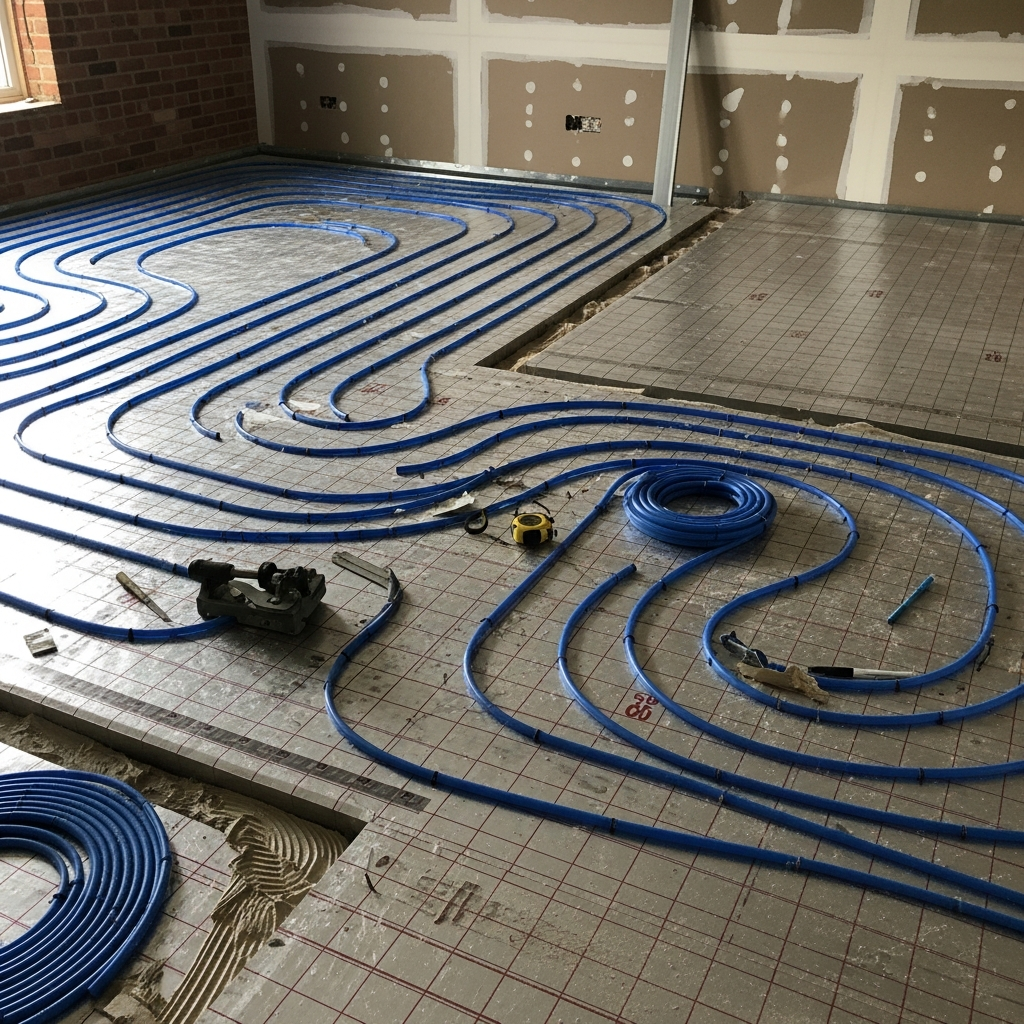
Many new build developments now include underfloor heating on the ground floor as standard. UFH operates at 30-35°C, which is the sweet spot for heat pump efficiency. At these flow temperatures, a heat pump can achieve COP values of 4.0-5.0, meaning it produces 4-5 kWh of heat for every 1 kWh of electricity.

3. Correct Sizing from the Start

When a heat pump is part of the building design, the system can be precisely sized to match the home's heat loss calculation. There is no guesswork, no compromises, and no need to upgrade radiators or pipework. Everything is designed to work together as an integrated system.

4. Optimal Placement

The air source heat pump position is planned from the architectural stage, ensuring adequate airflow, minimum noise impact, and discreet placement — often integrated into the building design rather than bolted on as an afterthought.

What to Expect from a New Build Heat Pump

Running Costs

A new build home with a heat pump should have significantly lower running costs than an older home with any heating system:

Home type Heating system Annual heating cost (est.)
New build 3-bed (FHS compliant) Air source heat pump £350 – £550
Existing 3-bed semi (well insulated) Air source heat pump £700 – £1,000
Existing 3-bed semi (average insulation) Gas boiler £850 – £1,100
Existing 3-bed semi (poor insulation) Gas boiler £1,100 – £1,500

The combination of excellent insulation and an efficient heat pump means new build heating costs can be less than half those of a typical older home. Use our calculator for personalised estimates.

Comfort

New build homes with heat pumps and underfloor heating provide exceptionally consistent comfort:

  • Even temperatures throughout the home with no hot or cold spots
  • No radiators taking up wall space
  • No temperature swings — the thermal mass of the floor maintains steady warmth
  • MVHR provides a constant supply of fresh, filtered air without opening windows

Hot Water

New builds with heat pumps include a hot water cylinder (typically 150-200 litres). This provides plenty of hot water for a typical family. The heat pump heats the cylinder efficiently, and scheduling can ensure hot water is ready when you need it.

Buying a New Build with a Heat Pump

If you are buying a new build from a developer, here are the key questions to ask about the heating system:

  • What brand and model of heat pump is installed? Research the manufacturer's reputation and warranty terms
  • What is the designed flow temperature? Lower is better — 35°C or below indicates an optimised system
  • Is underfloor heating included? If only on the ground floor, ask what emitters are used upstairs (fan convectors or larger radiators are preferable)
  • What is the hot water cylinder size? 150 litres is minimum for a family; 200-250 litres is better for larger households
  • What is the predicted EPC rating? Most new builds with heat pumps achieve EPC A
  • What warranty does the heat pump have? Most manufacturers offer 5-7 years; some offer 10+
  • What handover training is provided? You should receive clear instructions on operating the heat pump, setting schedules, and understanding the controls

Self-Build: Designing with a Heat Pump from the Start

If you are self-building, you have the opportunity to design the entire home around the heat pump system for maximum efficiency and comfort.

Design Principles

  • Compact form: A compact building shape minimises the surface area through which heat is lost. Sprawling designs with many wings and extensions lose more heat
  • South-facing glazing: Large south-facing windows capture solar heat, reducing the load on the heat pump. Avoid excessive north-facing glazing
  • Thermal mass: Concrete floors and masonry walls absorb heat during the day and release it at night, smoothing temperature variations
  • Airtightness: Target an airtightness of 3 m³/hr/m² or better at 50 Pa. This dramatically reduces heat loss from draughts
  • MVHR: Mechanical ventilation with heat recovery recovers 80-95% of the heat from exhaust air, further reducing the heat pump's workload

Choosing Between ASHP and GSHP

For self-builds, both options are viable:

  • Air source is cheaper, simpler, and sufficient for most well-insulated new builds
  • Ground source is more efficient, invisible, and silent — ideal if you have the land and budget

Common Concerns About New Build Heat Pumps

"Will I be cold?"

No. A properly designed new build with a heat pump is warmer and more comfortable than an older home with a gas boiler. The combination of excellent insulation, airtightness, and even heat distribution from UFH creates a consistently comfortable environment.

"Is the hot water enough?"

For most families, yes. A 200-litre cylinder provides enough hot water for multiple showers, baths, and domestic use. The heat pump typically reheats the cylinder in 1-2 hours. If you have a very large household, a larger cylinder (250-300 litres) can be specified.

"What happens in a power cut?"

A heat pump needs electricity to operate, just like a gas boiler needs electricity for its pump, fan, and controls. In a power cut, neither system works. However, a well-insulated new build retains its heat for much longer than an older home — you might not even notice a short power cut.

"Can I add solar panels?"

Absolutely, and this is strongly recommended. Solar PV panels generate free electricity during the day, which can power your heat pump and reduce your bills further. Many new builds now include solar panels as standard. A 4kW solar PV system can generate enough electricity to cover 30-50% of a heat pump's annual consumption.

The Cost Advantage for New Builds

Installing a heat pump in a new build is significantly cheaper than retrofitting one into an existing home:

  • No need to upgrade insulation — it is built to modern standards
  • No need to replace radiators — the system is designed for low-temperature operation
  • No need to retrofit a hot water cylinder — it is part of the build specification
  • Pipework and electrical connections are installed during construction, not retrofitted through finished rooms

The additional cost of a heat pump over a gas boiler in a new build is estimated at just £3,000-£5,000 — far less than the £7,000-£12,000 premium for retrofitting. And with the BUS grant, even this modest premium can be offset.

For full cost information, see our detailed guide.

Frequently Asked Questions

Are all new build homes required to have heat pumps?

The Future Homes Standard does not specifically mandate heat pumps — it requires low-carbon heating that meets the carbon emission targets. In practice, heat pumps are the most cost-effective way to meet these targets, so the vast majority of new builds will have them. Some developments may use communal heating networks or other low-carbon solutions.

Can I choose to have a gas boiler in a new build instead?

From 2025 onwards, new homes in England will not be permitted to install gas boilers as the primary heating system. If you are buying from a developer, the heating system is part of the specification. If you are self-building, you must comply with current Building Regulations, which effectively require low-carbon heating.

What EPC rating will a new build with a heat pump achieve?

Most new builds complying with the Future Homes Standard will achieve EPC A or high B. The combination of excellent insulation, airtightness, and an efficient heat pump produces very high energy performance ratings.

Do new builds with heat pumps hold their value?

Yes. Evidence from the housing market shows that energy-efficient homes command a premium. An EPC A-rated home is more attractive to buyers due to lower running costs, and this advantage will increase as energy prices rise and energy efficiency becomes a bigger factor in mortgage affordability assessments.

Should I get a new build with a heat pump or an older home and retrofit one?

From a heating perspective, a new build is the simpler choice. The system will be optimised from day one, running costs will be lower, and there are no retrofit challenges. However, property choice involves many factors beyond heating — location, character, size, and budget all matter. Our guide to whether heat pumps are worth it can help you evaluate the heating element of your decision.