Home Heat Pump Guide

Ground Source Heat Pump and Underfloor Heating
If you are investing in a ground source heat pump, pairing it with underfloor heating is the single best way to maximise its efficiency and your comfort. The two technologies are designed for each other — underfloor heating operates at exactly the temperatures where heat pumps perform best.

This guide explains why the combination works so well, what it costs, how it compares to radiators, and what to consider if you are planning this setup for your UK home.

Why Ground Source and Underfloor Heating Work So Well Together

The efficiency of any heat pump depends heavily on the temperature difference between the heat source and the heat output. The smaller this gap, the less work the compressor has to do, and the higher the COP (coefficient of performance).

The Flow Temperature Advantage

Underfloor heating operates at flow temperatures of 30-45°C. Radiators typically need 45-65°C (depending on size and the building's heat loss). A ground source heat pump delivering heat at 35°C to underfloor heating will achieve a significantly higher COP than the same unit delivering heat at 55°C to standard radiators.

In practical terms, this can mean the difference between a COP of 4.0-4.5 (with underfloor heating at 35°C) and a COP of 3.0-3.5 (with radiators at 50°C). That is a 15-30% improvement in efficiency — translating directly into lower electricity bills and lower running costs.

Stable Ground Temperature Plus Large Emitter Area

A ground source heat pump draws from the earth at a stable 8-12°C. Underfloor heating distributes heat across the entire floor area, needing only gentle warmth to heat the room. The small temperature lift from 10°C ground to 35°C floor is where the heat pump operates at maximum efficiency.

Compare this to an air source heat pump feeding radiators in mid-winter: lifting from -2°C air to 55°C flow temperature. The temperature lift is nearly four times greater, and the efficiency suffers accordingly.

How Much More Efficient Is GSHP With Underfloor Heating?

Based on real-world UK installations and manufacturer data:

GSHP + underfloor heating (35°C flow): SCOP 3.8-4.5

GSHP + oversized radiators (45°C flow): SCOP 3.2-3.8

GSHP + standard radiators (55°C flow): SCOP 2.8-3.2

For a home using 15,000 kWh of heat per year at 25p/kWh electricity:

With underfloor heating (SCOP 4.0): 3,750 kWh electricity = £938/year

With standard radiators (SCOP 3.0): 5,000 kWh electricity = £1,250/year

Annual saving with underfloor heating: approximately £312

Over 20 years, that is £6,240 in running cost savings — a significant contribution towards the cost of installing underfloor heating in the first place.

Use our heat pump calculator to model the specific savings for your property.

Types of Underfloor Heating for Heat Pumps

Wet (Water) Underfloor Heating

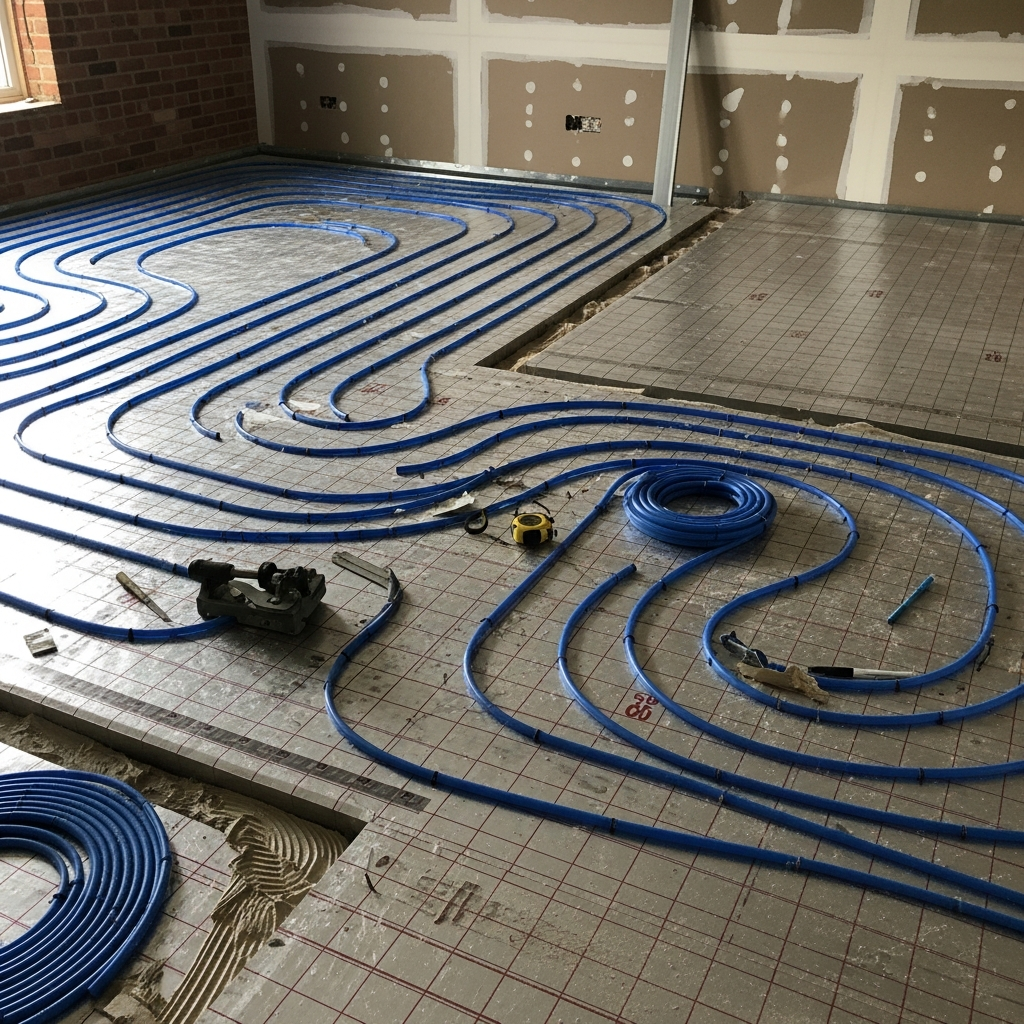
This is the type that connects to a heat pump. Warm water from the heat pump circulates through a network of pipes embedded in the floor. The floor acts as a giant low-temperature radiator, gently warming the room from below.

Wet underfloor heating is the only type suitable for connection to a ground source heat pump. Electric underfloor heating mats are not connected to the heat pump and would negate the efficiency benefits.

Screed Systems

Pipes are laid on insulation boards and covered with a screed layer (typically 50-75mm of sand and cement or liquid screed). This is the most common installation method for new builds and major renovations. The screed provides thermal mass, storing heat and releasing it slowly — this works perfectly with the steady, continuous operation of a heat pump.

Pros: High thermal mass for steady heat output, even surface temperature, excellent efficiency.

Cons: Adds 75-100mm to floor height, long drying time for screed, best installed during a major build or renovation.

Low-Profile Systems

Designed for retrofit installations where raising the floor height is not practical. Pipes sit in grooved insulation boards or metal plates, with a thin layer of self-levelling compound or overlay board on top. Total height increase is typically 15-30mm.

Pros: Suitable for retrofit without major disruption, lower floor height increase.

Cons: Less thermal mass (faster response but less heat storage), higher cost per square metre, slightly lower heat output capacity.

Suspended Floor Systems

For timber-framed or suspended ground floors, pipes can be clipped between joists with aluminium heat spreader plates above or below. This avoids any increase in floor height.

Pros: No floor height increase, suitable for existing timber floors.

Cons: Lower heat output than screed systems, requires access to the floor void.

Cost of Underfloor Heating With a Ground Source Heat Pump

Underfloor Heating Costs

Screed system (new build/renovation): £40-£70 per m² installed, including insulation, pipe, manifold, and screed.

Low-profile retrofit system: £60-£100 per m² installed.

Suspended floor system: £50-£80 per m² installed.

For a typical 3-bedroom house with 75 m² of underfloor heating on the ground floor:

Screed system: £3,000-£5,250

Low-profile: £4,500-£7,500

Suspended floor: £3,750-£6,000

Combined GSHP + UFH Costs

The total cost of a ground source heat pump plus underfloor heating for a typical home:

GSHP system (including ground loop): £18,000-£35,000

Underfloor heating: £3,000-£7,500

Total: £21,000-£42,500

Less the BUS grant of £7,500, the net cost is £13,500-£35,000. This is a significant investment, but the running costs are the lowest of any heating configuration, and the system will last 20-25+ years (with the ground loop lasting 50-100+ years).

Design Considerations

Room-by-Room Control

Underfloor heating should be zoned, with individual thermostats for each room or zone. A manifold in a central location distributes heated water to each circuit, with actuators opening and closing circuits based on demand. This allows you to keep bedrooms cooler than living areas, for example.

Modern smart thermostats can learn your patterns and optimise heating schedules, working with the heat pump's weather compensation to maximise efficiency.

Floor Coverings

Not all floor coverings work equally well with underfloor heating:

Stone and ceramic tiles: Excellent. High thermal conductivity means heat transfers readily from the pipe through the tile to the room. This is the most efficient combination.

Engineered wood: Good. Thinner than solid wood, with reasonable thermal conductivity. Check the manufacturer's guidance — most engineered wood floors are suitable.

Laminate: Acceptable. Most modern laminates are compatible, but check the thermal resistance rating. Lower is better.

Carpet: The worst option for underfloor heating. Carpet acts as insulation, preventing heat from reaching the room. If you must have carpet, choose the thinnest, lowest tog rating available. In rooms with thick carpet, you may need to raise the flow temperature, reducing the efficiency advantage.

Vinyl and LVT: Good. Thin and reasonably conductive. Check temperature limits — most vinyl should not exceed 27°C surface temperature.

Insulation

The floor beneath the underfloor heating must be well insulated to direct heat upwards into the room, not downwards into the ground. This is especially important on ground floors. A minimum of 50mm rigid insulation (such as PIR board) should be installed beneath the heating pipes. In new builds, 100mm or more is standard.

Without adequate insulation, you lose heat downwards and the heat pump works harder — undermining the efficiency benefits. This is non-negotiable in a good installation.

Underfloor Heating vs Radiators With a Ground Source Heat Pump

If underfloor heating is not practical for every room, you can use a mix of underfloor heating and radiators. Many UK homes have underfloor heating on the ground floor (where new flooring or renovation makes it feasible) and appropriately sized radiators upstairs.

When Underfloor Heating Is Best

New builds: Underfloor heating can be designed in from the start, at minimal additional cost compared to retrofitting.

Major renovations: If you are replacing floors anyway, adding underfloor heating is cost-effective.

Extensions: An ideal opportunity to install underfloor heating in the new space.

Ground floors: Where insulation can be laid on the slab and new flooring installed.

When Radiators Make More Sense

Upper floors in existing homes: Retrofitting underfloor heating upstairs means lifting all floors and potentially reducing ceiling height in rooms below. Oversized radiators are often more practical.

Budget constraints: If funds are tight, investing in the heat pump itself and using existing or oversized radiators may deliver better overall value than stretching the budget to include underfloor heating.

Rooms with thick carpet: If thick carpet is non-negotiable (some bedrooms), radiators may actually perform better than underfloor heating struggling to push heat through carpet.

Response Time and Comfort

A common concern about underfloor heating is response time. Screed-based systems are slow to warm up and slow to cool down — typically taking 2-4 hours to bring a cold room up to temperature. This is sometimes perceived as a disadvantage.

However, with a ground source heat pump, this "slow response" is actually a benefit. Heat pumps work best when running continuously at a steady output rather than cycling on and off. The thermal mass of a screed floor acts as a heat battery, storing energy and releasing it gradually. The heat pump tops up the heat store at a steady, efficient rate rather than blasting heat in short bursts.

The result is remarkably even, draught-free warmth. No hot spots near radiators, no cold patches in room centres. The floor surface sits at a comfortable 23-27°C — warm enough to feel pleasant underfoot but not hot.

For most homeowners, the comfort of underfloor heating is the primary reason they choose it. The efficiency benefits with a heat pump are a welcome bonus.

Installation Process

Installing underfloor heating alongside a ground source heat pump typically follows this sequence:

1. Design. A heat loss calculation for each room determines the pipe spacing, circuit lengths, and flow temperatures needed. This should be done as part of the overall heat pump system design — not separately. Read our installation guide for what to expect.

2. Prepare the floor. Insulation is laid on the subfloor. Edge insulation strips are fitted around the room perimeter to allow for expansion.

3. Lay the pipes. Pipes are clipped to the insulation or laid in grooved boards, following the designed layout. Typical pipe spacing is 100-200mm, depending on the room's heat demand.

4. Pressure test. The circuits are filled with water and pressure-tested to check for leaks before they are covered.

5. Screed or overlay. Screed is poured over the pipes (for screed systems) or overlay boards are fitted (for low-profile systems).

6. Connect to the heat pump. The underfloor heating manifold is connected to the heat pump's heating circuit. Controls, zone valves, and thermostats are installed.

7. Commission. The system is gradually brought up to temperature over several days (screed needs to be dried slowly to prevent cracking) and the controls are calibrated.

Frequently Asked Questions

Is underfloor heating necessary with a ground source heat pump?

Not necessary, but highly recommended. A ground source heat pump works with radiators too — you may just need to oversize them. But underfloor heating allows the heat pump to operate at its most efficient, saving 15-30% on running costs compared to standard radiators. It also provides superior comfort.

Can I have underfloor heating downstairs and radiators upstairs?

Yes, this is very common and works well. The heat pump supplies both circuits through a manifold or low-loss header. The underfloor heating runs at a lower flow temperature than the radiators, managed by a mixing valve or separate circuits. Many installers design systems exactly this way.

Does underfloor heating work with all floor types?

It works with most floor types, but some are better than others. Stone and tile are ideal. Engineered wood and laminate work well. Thick carpet reduces performance — choose thin, low-tog carpet if you must. Always check the floor covering manufacturer's guidance on underfloor heating compatibility.

How long does underfloor heating take to warm up?

Screed systems take 2-4 hours from cold. Low-profile systems respond faster — typically 30-60 minutes. With a heat pump running continuously (as recommended), the floor maintains a steady temperature and response time is not an issue. You set the desired temperature and the system maintains it.

Can I retrofit underfloor heating in an existing house?

Yes, but it is easier and cheaper during a renovation. Low-profile systems add only 15-30mm to floor height and can be fitted over existing floors. Screed systems add 75-100mm and are more suited to major renovations or extensions. Upper floors are harder to retrofit without significant disruption.

What is the ideal flow temperature for underfloor heating with a GSHP?

Typically 30-40°C, depending on the floor construction, insulation, and room heat loss. Lower is better for efficiency — a well-designed system in a well-insulated house might achieve comfort at just 30-32°C flow temperature, giving a COP above 4.5. Your installer should design for the lowest practical flow temperature. Check if heat pumps are worth it for your property.