The Anatomy of an Air Source Heat Pump (Cutaway Diagram)
Understanding what is inside a heat pump removes the mystery and helps you appreciate why this technology is so reliable, efficient, and low-maintenance. Unlike a gas boiler — which contains a combustion chamber, gas valve, ignition system, flue, heat exchanger, pump, and numerous safety sensors — an air source heat pump is fundamentally simple. It uses the same refrigeration cycle that has kept your fridge cold for decades, just running in reverse to produce heat instead of cold.
This guide walks you through every component of a modern air source heat pump, explains what each part does in plain English, and shows how they work together to extract heat from the outside air and deliver it to your radiators and hot water.
See how this technology works for your home
Get Your Free Cost EstimateFree, 2-minute assessment based on your home details.
The Four Core Components
Every heat pump — from a domestic 5kW unit to an industrial installation — relies on the same four core components working in a continuous cycle:
The refrigerant — a fluid with a very low boiling point — circulates between these four components continuously, absorbing heat from outside air and releasing it inside your home. The cycle repeats thousands of times per day, quietly and efficiently.
The Evaporator: Capturing Heat from the Air
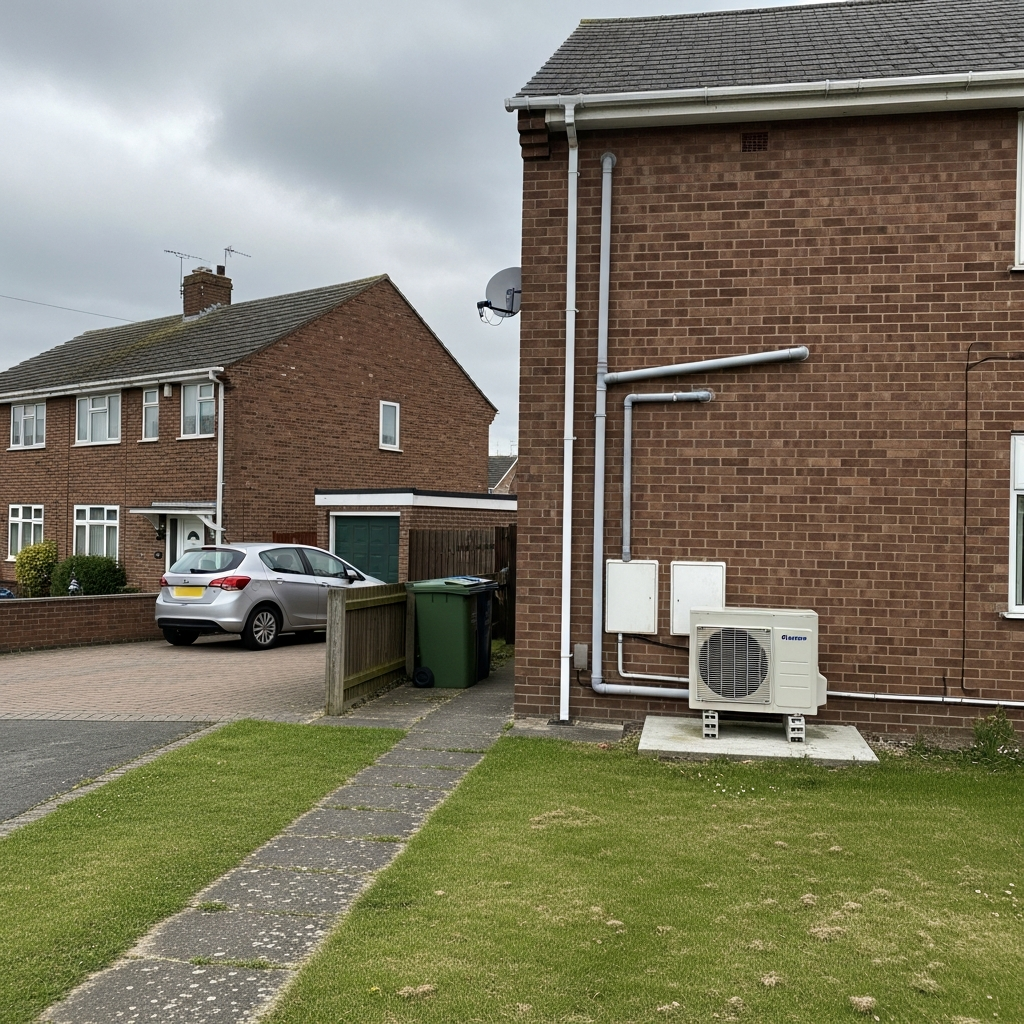
The evaporator is a large heat exchanger — essentially a network of thin metal fins with refrigerant flowing through copper or aluminium tubes within them. It is located in the outdoor unit, directly exposed to the outside air.
How it works: The refrigerant arrives at the evaporator as a cold, low-pressure liquid (typically at -10°C to -20°C, depending on conditions). Even cold outside air at 0°C or -5°C is warmer than this refrigerant. Heat flows from the warmer air to the colder refrigerant, causing the refrigerant to boil (evaporate) and become a gas. This is the same process that makes a cold glass of water "sweat" — except in reverse.
The fan draws air across the evaporator fins to maximise heat transfer. The larger the evaporator surface area, the more heat can be absorbed — which is why heat pumps have those characteristic metal-finned surfaces.
The Compressor: The Heart of the System
The compressor is the most important component — and the only one that consumes significant electricity. It takes the low-temperature refrigerant gas from the evaporator and compresses it to high pressure, which dramatically increases its temperature.
How it works: When gas is compressed, its temperature rises (the same principle that makes a bicycle pump warm). The compressor takes refrigerant gas at perhaps 5°C and compresses it to a temperature of 50-70°C — hot enough to heat your home and hot water.
Modern inverter compressors are the key technology that makes today's heat pumps so much better than older models. An inverter allows the compressor to vary its speed continuously — running slowly and quietly in mild weather (using minimal electricity) and ramping up to full speed only on the coldest days. This is far more efficient than the old fixed-speed compressors that could only run at full power or not at all.
The main compressor types used in residential heat pumps are:
- Scroll compressors: Used by Mitsubishi, Daikin, and others. Two spiral-shaped scrolls compress the gas.
- Rotary compressors: Used by Samsung and others. Compact design with a rotating mechanism.
- Twin-rotary compressors: Used in some premium models for extra-smooth operation and reduced vibration.
The Condenser: Delivering Heat to Your Home
The condenser is another heat exchanger, but this one transfers heat from the hot refrigerant gas to your heating water. In a monobloc heat pump (the most common UK type), the condenser is inside the outdoor unit. In a split system, it may be located indoors.
How it works: The hot, high-pressure refrigerant gas (at 50-70°C) flows through the condenser. Your heating water (at 35-45°C) flows through the other side. Heat transfers from the hotter refrigerant to the cooler water, heating it up. As the refrigerant releases its heat, it condenses back into a liquid — ready for the next cycle.
The heated water then flows to your radiators and/or hot water cylinder, exactly as it would from a gas boiler. From your radiators' perspective, the heat source is irrelevant — they receive hot water and emit heat into the room regardless of where that hot water came from.
The Expansion Valve: Completing the Loop
The expansion valve (sometimes called a metering device or thermostatic expansion valve) is the final piece of the cycle. It reduces the pressure of the liquid refrigerant, causing its temperature to drop dramatically.
How it works: The warm liquid refrigerant (at approximately 30-40°C after releasing its heat) passes through a narrow restriction. The pressure drops, and with it the temperature — the refrigerant emerges at -10°C to -20°C, cold enough to absorb heat from outside air again. The cycle restarts.
Modern heat pumps use electronic expansion valves (EEVs) that can precisely control the refrigerant flow rate based on operating conditions, optimising efficiency across a wide range of temperatures.
See this technology in action for your home
Get Free Installer QuotesInstallers can explain the system design specific to your property.
The Refrigerant: R290 and R32
The refrigerant is the working fluid that carries heat through the cycle. Modern heat pumps primarily use two refrigerants:
| Property | R290 (Propane) | R32 |
|---|---|---|
| Boiling point | -42°C | -52°C |
| Global warming potential | 3 (excellent) | 675 (moderate) |
| Flammability | Mildly flammable | Mildly flammable |
| Charge amount needed | Small (~500g) | Larger (~2-3kg) |
| Cold weather performance | Excellent | Good |
| Industry direction | Becoming standard | Being phased towards R290 |
R290 propane is becoming the industry standard due to its extremely low environmental impact (GWP of just 3) and excellent thermodynamic properties. Leading brands including Vaillant, Nibe, and Viessmann have already transitioned to R290.
The Fan and Airflow System
The fan draws ambient air across the evaporator to maximise heat absorption. Modern heat pumps use large, slow-turning axial fans that move high volumes of air quietly. The fan speed is variable — matched to the compressor speed for optimal efficiency.
Adequate airflow around the outdoor unit is essential for performance. This is why installers recommend at least 300mm clearance from walls and 1-2m of open space in front of the unit. Restricted airflow reduces efficiency and can increase noise.
The Inverter Controller: The Brain
The inverter controller is the electronic brain that manages the entire system. It continuously adjusts compressor speed, fan speed, expansion valve position, and defrost timing based on inputs from temperature sensors, the weather compensation sensor, and the thermostat.
Modern inverter controllers also enable smart features: integration with time-of-use tariffs, weather forecast anticipation, remote monitoring via smartphone apps, and adaptive learning of household heating patterns. These features can improve efficiency by 10-20% compared to basic control systems.
The Defrost System
When outdoor temperatures are between -5°C and +5°C with high humidity, frost can form on the evaporator fins. The defrost system periodically reverses the refrigeration cycle briefly — sending hot gas to the evaporator to melt any frost. This typically lasts 2-5 minutes and occurs every 30-90 minutes during frosty conditions.
Modern heat pumps use intelligent defrost control that monitors evaporator temperature and airflow rather than running on fixed timers. This means defrost only happens when actually needed, minimising energy waste.
Indoor Components: Cylinder and Controls
The indoor components of a heat pump system include:
- Hot water cylinder: Typically 200-250 litres, stores hot water heated by the heat pump. Larger than a standard gas boiler cylinder to accommodate the heat pump's lower but sustained heat output.
- Circulation pump: Moves heated water through the radiator circuit. Usually integrated into the system.
- Buffer tank (optional): A small water tank that smooths out heating demand and prevents the compressor from cycling too frequently.
- Controller/thermostat: The user interface. Modern systems offer touchscreen controllers and smartphone apps.
- Weather compensation sensor: A small outdoor temperature sensor that allows the system to automatically adjust flow temperature based on conditions.
Why Simplicity Means Reliability
A heat pump has far fewer components than a gas boiler. No combustion chamber, no gas valve, no flue, no ignition system, no condensate trap, no pressure relief valve venting steam. The main moving parts are the compressor, the fan, and the expansion valve. This simplicity is why heat pumps typically last 20-25 years (versus 12-15 for gas boilers) and require less maintenance.
The technology is proven: it is the same refrigeration cycle used in every fridge, freezer, and air conditioning unit worldwide. Billions of compressors have been manufactured and run reliably for decades. A heat pump is simply this proven technology applied to heating your home instead of cooling your food.
Ready to see this technology in your home?
Get Your Free Cost EstimateSimple, proven technology. Grant-funded. See what it costs for your home.
Frequently Asked Questions
What are the main components?
Four core components: evaporator (absorbs heat), compressor (amplifies heat), condenser (delivers heat), and expansion valve (resets the cycle). Supporting components include the fan, inverter controller, and defrost system.
How does it produce heat from cold air?
The refrigerant boils at -42°C (R290). Even cold air at 0°C or -5°C is warm enough to evaporate the refrigerant. The compressor then pressurises this gas to reach 50-70°C — hot enough for your heating.
What refrigerant do modern heat pumps use?
R290 (propane) is becoming standard due to its low environmental impact (GWP 3) and excellent performance. R32 is still used in some models but being phased out.
What is the compressor?
The heart of the system — it pressurises refrigerant gas to increase its temperature. Modern inverter compressors vary speed for optimal efficiency at all conditions.
What does the expansion valve do?
It reduces refrigerant pressure after heat delivery, cooling it back down to absorb heat again from the outside air. It completes the cycle.
How many moving parts are there?
Very few: compressor, fan, and expansion valve. No combustion, no ignition, no flue. This simplicity gives heat pumps their 20-25 year lifespan and low maintenance needs.
Understanding Your Heat Pump
Air source heat pumps use proven refrigeration technology with few moving parts. The BUS grant makes this technology affordable. Proper installation ensures reliable performance for 20-25 years. Combined with solar panels, it creates a clean, efficient, and increasingly affordable home energy system. Understanding the components helps you appreciate why heat pumps are reliable, efficient, and built to last.