The BUS Grant Postcode Lottery: Regional Approval Rates Mapped
The Boiler Upgrade Scheme is theoretically available to every eligible homeowner in England and Wales. In practice, some postcodes receive 8 times more grants per capita than others. We mapped BUS grant approvals at postcode area level using DESNZ data to reveal the postcode lottery — and what it tells us about who benefits from heat pump policy and who gets left behind.

This analysis builds on our BUS grant data report, drilling deeper into the geographic distribution. We used DESNZ quarterly statistics at local authority level and mapped them to postcode areas, cross-referenced with ONS household data and Index of Multiple Deprivation scores.
Check your BUS grant eligibility
Use the free checkerThe grant is available regardless of postcode — see if you qualify.
The Scale of the Postcode Gap
8x
Difference between highest and lowest uptake postcodes
1,420
Grants per 100,000 households (top postcode area)
175
Grants per 100,000 households (bottom postcode area)
550
National average per 100,000 households
Highest Uptake Postcodes
| Postcode Area | Coverage | Grants per 100k HH | Key Driver |
|---|---|---|---|
| EX (Exeter) | Devon, parts of Somerset | 1,420 | High off-gas-grid % |
| PL (Plymouth) | Cornwall, South Devon | 1,380 | High off-gas-grid % |
| IP (Ipswich) | Suffolk | 1,260 | Off-gas + good installer supply |
| NR (Norwich) | Norfolk | 1,210 | Off-gas + rural adoption |
| BA (Bath) | Somerset, parts of Wiltshire | 1,180 | Off-gas + affluent rural |
| GL (Gloucester) | Gloucestershire, Cotswolds | 1,120 | Off-gas + affluent |
| SA (Swansea) | West Wales, Pembrokeshire | 1,080 | Off-gas + Nest scheme |
| PE (Peterborough) | Cambridgeshire, Lincolnshire | 1,040 | Rural off-gas |
Source: DESNZ BUS statistics, ONS household data. Cumulative grants Apr 2022 – Feb 2026.
The pattern is clear: high-uptake postcodes are overwhelmingly rural, off-gas-grid, and in southern or eastern England. Devon and Cornwall — where oil and LPG heating is the norm — lead by a significant margin. The financial case for heat pumps is strongest in these areas, making the BUS grant a straightforward win for homeowners switching from expensive fossil fuels.
Lowest Uptake Postcodes
| Postcode Area | Coverage | Grants per 100k HH | Key Barrier |
|---|---|---|---|
| E (East London) | Tower Hamlets, Newham, Hackney | 175 | Flats, low income, high cost |
| SE (SE London) | Southwark, Lewisham | 210 | Terraces, flats, cost |
| N (North London) | Islington, Haringey | 230 | Flats, conservation areas |
| TS (Teesside) | Middlesbrough, Stockton | 245 | Low income, few installers |
| SR (Sunderland) | Sunderland, Durham | 260 | Low income, few installers |
| M (Manchester) | Manchester, Salford | 280 | Urban, terraces, gas network |
| L (Liverpool) | Liverpool, Knowsley | 290 | Urban, terraces, gas network |
Source: DESNZ BUS statistics, ONS household data
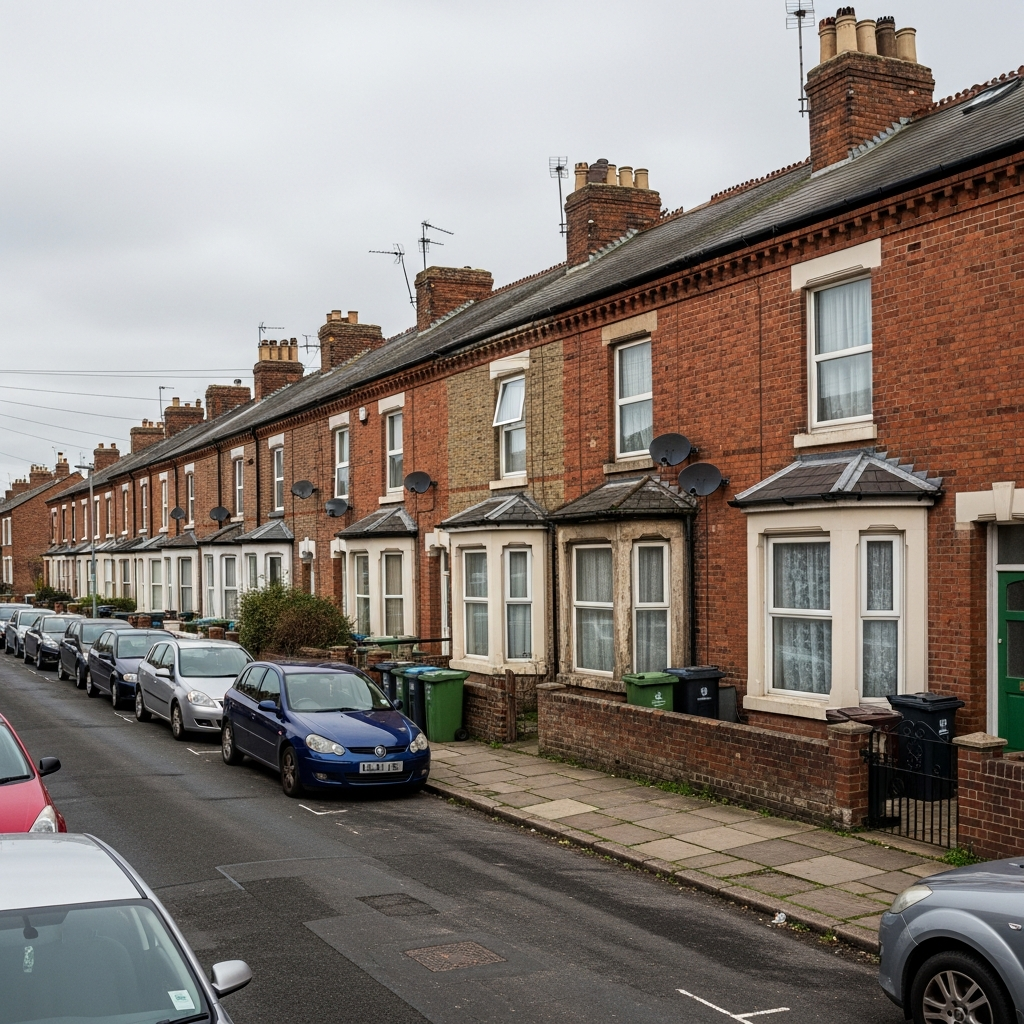
The lowest-uptake postcodes share common characteristics: urban, predominantly gas-heated, lower average incomes, higher proportion of flats and terraces, and fewer local installers. The gap between EX postcode (1,420 grants per 100,000 households) and E postcode (175) is over 8:1 — a genuine postcode lottery.
What Drives the Variation
The off-gas-grid proportion is the dominant driver. In postcodes where over 30% of homes are off the gas network, BUS grant uptake is 3-4 times the national average. This makes economic sense — oil and LPG homes save the most by switching — but it means the grant disproportionately benefits rural, often more affluent homeowners rather than the urban majority.
The Deprivation Dimension
When we overlay BUS grant data with the Index of Multiple Deprivation (IMD), the pattern is stark:
| IMD Quintile | Grants per 100k HH | Relative to Average |
|---|---|---|
| Least deprived (Q1) | 920 | 1.67x |
| Q2 | 680 | 1.24x |
| Q3 (middle) | 540 | 0.98x |
| Q4 | 380 | 0.69x |
| Most deprived (Q5) | 230 | 0.42x |
Source: Home Heat Pump Guide analysis. BUS data mapped to IMD 2019 quintiles.
The least deprived areas receive 4 times more grants per capita than the most deprived. This is not the scheme's intent, but it is the outcome. The upfront cost barrier — even after the £7,500 grant — remains prohibitive for lower-income households, and these areas also tend to have less installer coverage and lower awareness.
This data connects to our demographic analysis, which shows that the current heat pump market is skewed toward higher-income, owner-occupied households. Addressing this will require targeted interventions beyond the current flat-rate grant. For homeowners who can access the grant, our complete grants guide explains the application process.
What This Means for Policy
- A flat-rate grant benefits the least deprived most. £7,500 covers 75% of costs in a cheap Midlands installation but only 50% in London. An income-adjusted or regionally-adjusted grant would be more equitable.
- Urban areas need different solutions. Flats and terraces require communal heat pump systems, shared ground loops, or heat networks — technologies the current BUS scheme does not adequately support.
- Awareness campaigns should target low-uptake areas. If 40-50% of homeowners do not know the grant exists, targeted local campaigns in low-uptake postcodes could significantly improve distribution.
- Combining solar and heat pump grants could improve the financial case in areas where the heat pump alone is marginal. Solar incentives alongside the BUS grant would reduce running costs and shorten payback, making adoption viable for more households.
The BUS grant is available to you — regardless of postcode
Get free quotes and applyYour MCS installer handles the grant application. You pay only the net cost.
Frequently Asked Questions
Do some areas get more BUS grants than others?
Yes, dramatically. Rural postcodes in the South West receive up to 8 times more grants per capita than urban postcodes in London and the North East.
Which postcode areas receive the most BUS grants?
EX (Devon), PL (Cornwall), IP (Suffolk), NR (Norfolk), and BA (Somerset) lead — all areas with high proportions of off-gas-grid homes.
Why does my area get fewer heat pump grants?
Low uptake typically reflects a gas-heated housing stock, lower incomes, fewer installers, and lower awareness. Urban areas with mostly flats also see lower uptake due to installation challenges.
Is the BUS grant available everywhere in England?
Yes, there is no postcode restriction. Practical factors like installer availability and property suitability cause the variation, not eligibility rules.
Do not miss out on the £7,500 grant
Check your eligibility nowFree eligibility check plus personalised cost estimate. Takes 60 seconds.
Grant Distribution and the Energy Transition
The postcode lottery in BUS grant uptake highlights the challenges of equitable decarbonisation. Ensuring that heat pump grants reach all communities — not just affluent rural areas — is essential for meeting heating transition targets. Better installer distribution, income-adjusted grants, and support for combined renewable technologies would help close the gap. The cost data shows that heat pumps can be affordable in every postcode — the challenge is ensuring everyone knows it.