Home Heat Pump Guide

Total Cost of Ownership: Heat Pump vs Gas Boiler Over 20 Years

Comparing a heat pump to a gas boiler on installation cost alone is like comparing a Tesla to a petrol car based on the sticker price. The upfront number tells you almost nothing about what you will actually spend over the life of the system. What matters is the total cost of ownership — every pound spent on installation, fuel, maintenance, repairs, and eventual replacement across two decades.

This guide calculates the complete 20-year cost for both systems in a typical UK home. No cherry-picked figures. No best-case scenarios. Just a realistic comparison that accounts for every expense you will face.

The Assumptions Behind Our Numbers

Before diving into figures, you need to understand the assumptions. Different assumptions produce wildly different results, which is why so many online comparisons contradict each other.

Our baseline scenario uses:

  • Property: Three-bedroom semi-detached house, reasonably insulated
  • Annual heat demand: 12,000 kWh
  • Gas boiler efficiency: 92% (modern condensing boiler, well maintained)
  • Heat pump seasonal COP: 3.0 (realistic UK average for a well-installed ASHP)
  • Gas unit rate: 6.76p/kWh (Ofgem cap, early 2026)
  • Electricity unit rate: 24.50p/kWh (Ofgem cap, early 2026)
  • Annual energy price inflation: 3% for both gas and electricity
  • BUS grant applied: £7,500 towards heat pump installation

We will also run the numbers without the grant, and with a time-of-use electricity tariff, so you can see how sensitive the comparison is to these variables.

Category 1: Installation Cost

Gas Boiler Installation

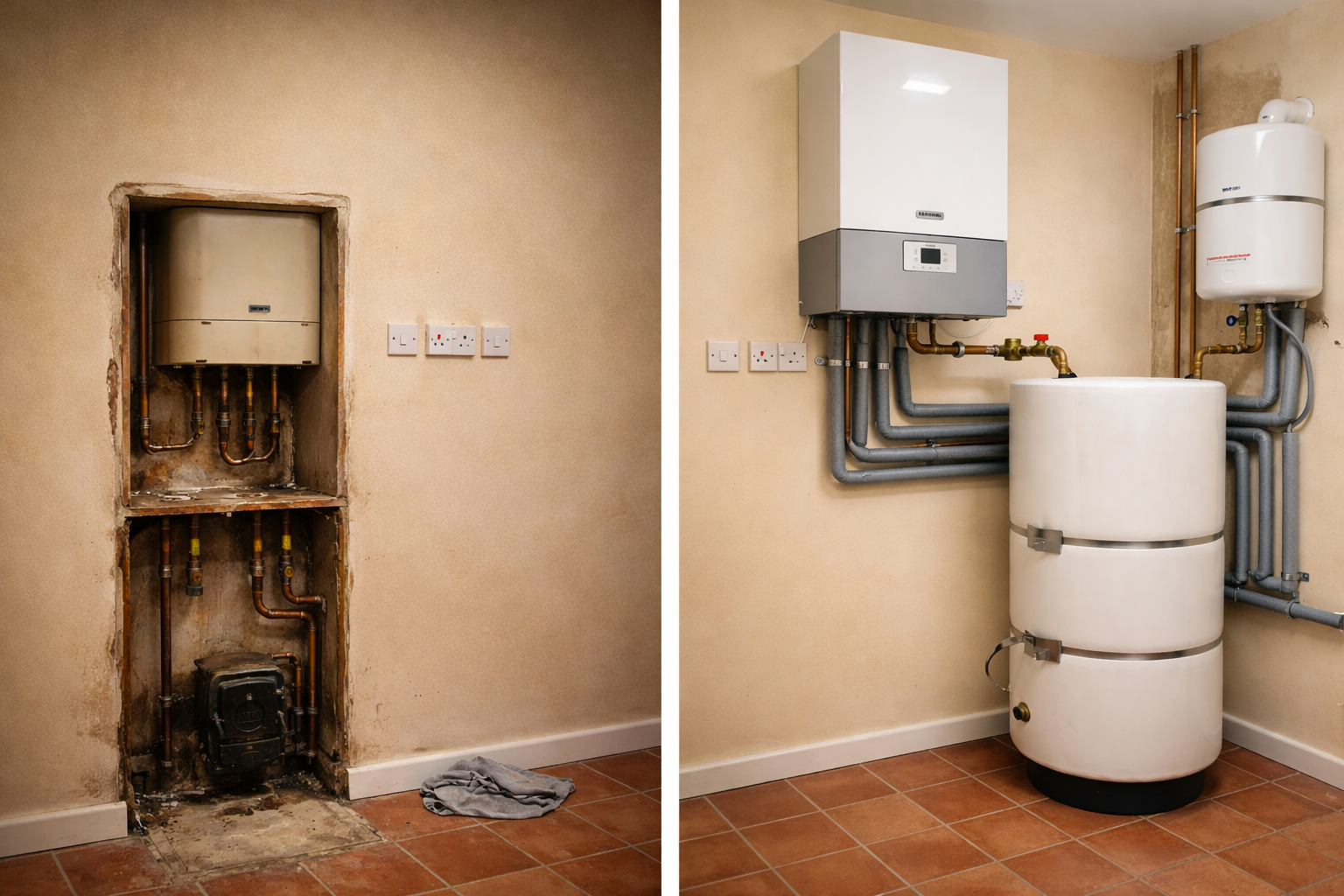
A new gas boiler installation in 2026 typically costs:

  • Budget combi boiler (Baxi, Ideal): £2,000 to £2,800 installed
  • Mid-range combi boiler (Worcester Bosch, Vaillant): £2,800 to £3,800 installed
  • System boiler with cylinder: £3,500 to £5,000 installed

For our comparison, we will use £3,200 — a mid-range combi boiler professionally installed.

Heat Pump Installation

A typical air source heat pump installation for this property costs:

  • Heat pump unit, hot water cylinder, controls: £5,000 to £7,000
  • Installation labour: £2,500 to £4,000
  • Radiator upgrades (if needed): £1,000 to £3,000
  • Pipework modifications: £500 to £2,000
  • Total before grant: £10,000 to £14,000

We will use £12,000 as our total before grant, which becomes £4,500 after the £7,500 BUS grant. For the full breakdown, see our heat pump cost guide.

Installation cost difference: £1,300 more for the heat pump (after grant). Without the grant, it is £8,800 more.

Category 2: Annual Running Costs

Gas Boiler Running Costs

With 12,000 kWh heat demand and 92% boiler efficiency:

  • Gas consumed: 12,000 / 0.92 = 13,043 kWh
  • Year 1 cost: 13,043 x £0.0676 = £882 per year
  • Standing charge: 12 x £0.3194 = £117 per year (gas meter)
  • Total year 1: £999

Heat Pump Running Costs

With 12,000 kWh heat demand and seasonal COP of 3.0:

  • Electricity consumed: 12,000 / 3.0 = 4,000 kWh
  • Year 1 cost: 4,000 x £0.2450 = £980 per year
  • No additional standing charge (already paying for electricity)
  • Gas standing charge saved: £117 per year (if gas meter removed)
  • Total year 1: £980 (or £863 with gas standing charge saved)

At current prices, running costs are remarkably similar. The heat pump saves roughly £19 per year at standard rates — or £136 per year if you cancel the gas supply entirely. For more detail, see our running costs guide.

Category 3: Maintenance Costs

Gas Boiler Maintenance

  • Annual service: £80 to £120 per year (legally required for landlords, strongly recommended for all)
  • Typical repairs over 15 years: Fan replacement (£250-400), PCB board (£300-500), diverter valve (£200-350), pump (£200-300)
  • Average annual maintenance cost including repairs: £150 to £200 per year

We will use £175 per year.

Heat Pump Maintenance

  • Annual service: £100 to £200 per year
  • Typical repairs over 20 years: Fan motor (£300-500), reversing valve (£400-700), control board (£300-600)
  • Average annual maintenance cost including repairs: £130 to £180 per year

We will use £155 per year. Heat pumps have fewer moving parts than gas boilers and no combustion components, so the overall maintenance burden is slightly lower.

Category 4: Replacement Cost

Gas Boiler Lifespan

A well-maintained gas boiler typically lasts 12 to 15 years. Over a 20-year period, you will almost certainly need one replacement. At today's prices, that is another £3,200. With inflation at 3% per year, a replacement at year 13 would cost approximately £4,800.

Heat Pump Lifespan

Heat pumps typically last 20 to 25 years. Over our 20-year comparison period, you are unlikely to need a full replacement. You may need to replace the compressor towards the end of the period, costing £1,500 to £2,500 at today's prices. We will budget £2,500 at year 18, which with inflation comes to approximately £4,250.

The 20-Year Total Cost Comparison

Scenario 1: With BUS Grant, Standard Electricity Rate

Gas boiler total cost over 20 years:

  • Initial installation: £3,200
  • Running costs (20 years, 3% inflation): £26,850
  • Maintenance (20 years): £3,500
  • Replacement at year 13: £4,800
  • Total: £38,350

Heat pump total cost over 20 years:

  • Initial installation (after grant): £4,500
  • Running costs (20 years, 3% inflation): £26,330
  • Maintenance (20 years): £3,100
  • Compressor replacement at year 18: £4,250
  • Total: £38,180

Result: The heat pump saves £170 over 20 years. Essentially, the two systems cost roughly the same. The heat pump's higher upfront cost is offset by slightly lower running costs, lower maintenance, and no full replacement needed.

Scenario 2: With BUS Grant, Time-of-Use Tariff

If you switch to a time-of-use electricity tariff achieving a blended rate of 18p/kWh for the heat pump:

  • Heat pump running costs drop to approximately £19,350 over 20 years
  • Heat pump total: £31,200
  • Saving versus gas boiler: £7,150 over 20 years (£358 per year)

Scenario 3: Without BUS Grant, Standard Rate

  • Heat pump installation: £12,000
  • Other costs unchanged
  • Heat pump total: £45,680
  • Gas boiler saves £7,330 over 20 years

Without the grant and without a time-of-use tariff, the gas boiler is cheaper over 20 years. This is why the BUS grant matters so much to the financial case.

What Could Change the Numbers

Energy Price Rebalancing

The UK government has stated its intention to move environmental levies from electricity bills to gas bills. If this happens, the electricity-to-gas price ratio would narrow significantly, making heat pumps cheaper to run relative to gas. A shift of even 3p per kWh (reducing electricity, increasing gas) would save heat pump owners approximately £120 per year and add approximately £390 per year to gas boiler costs.

Gas Boiler Ban Effect

From 2035, new gas boiler installations in new-build homes will be restricted. As gas boilers become less common, maintenance costs may rise (fewer engineers, harder-to-source parts). This could add significantly to the gas boiler's 20-year cost in the latter years.

Carbon Pricing

If a household carbon tax or expanded emissions trading scheme is introduced, gas heating costs would increase. Even a modest £50 per tonne CO2 would add roughly £100 per year to gas heating bills.

Heat Pump Technology Improvements

Newer heat pump models are achieving higher seasonal COPs. If your replacement heat pump in 15-20 years achieves COP 4.0 instead of 3.0, running costs would drop by 25%.

Which Properties Favour Each System?

Heat Pumps Win For:

  • Well-insulated properties where the heat pump achieves COP 3.0 or better
  • Properties where the BUS grant is available
  • Homeowners willing to use time-of-use tariffs
  • Off-gas properties currently using oil or LPG (savings are dramatic)
  • Properties with solar panels offsetting some electricity

Gas Boilers Win For:

  • Poorly insulated properties where the heat pump COP drops below 2.5
  • Properties requiring extensive radiator upgrades, pushing installation cost above £15,000
  • Short-term ownership where upfront cost matters most
  • Properties where the grant is unavailable

If you are unsure whether your property suits a heat pump, use our suitability checker or try the cost calculator for a personalised estimate.

The Non-Financial Factors

Total cost of ownership is not the only consideration. Heat pumps produce zero direct carbon emissions, contributing to the UK's net zero targets. They also eliminate the risk of carbon monoxide from a faulty boiler, remove the need for a gas supply, and future-proof your home against tightening regulations on fossil fuel heating.

For a broader assessment beyond pure cost, our are heat pumps worth it guide covers the full picture.

Frequently Asked Questions

Is a heat pump cheaper than a gas boiler over 20 years?

With the BUS grant and standard electricity rates, the 20-year cost is roughly equal for a typical three-bedroom home. With a time-of-use electricity tariff, the heat pump saves approximately £7,000 over 20 years. Without the grant, the gas boiler is currently cheaper on total cost alone.

How long does it take for a heat pump to pay for itself?

With the BUS grant and a time-of-use tariff, the payback period is approximately 4 to 6 years for homes switching from gas. For homes switching from oil or LPG, payback can be as quick as 3 to 5 years even at standard electricity rates.

What if energy prices change dramatically?

If electricity gets relatively cheaper compared to gas (as the government intends), the heat pump wins decisively. If both rise equally in percentage terms, the comparison stays roughly the same because the heat pump uses less energy in kWh terms.

Should I wait for heat pump prices to drop?

Prices may fall slightly as the market matures, but the BUS grant may not be available indefinitely. Waiting also means continuing to pay gas running costs. In most cases, acting while the grant is available is financially sensible.

Does the comparison change for a larger or smaller house?

Larger houses with higher heat demand see greater running cost differences (in absolute terms), but installation costs also rise. The percentage comparison stays broadly similar. Smaller properties with lower heat demand see less financial benefit from a heat pump because the fixed installation cost is spread over fewer kWh of savings.

What about hydrogen boilers?

Hydrogen-ready boilers are marketed as a future option, but no UK town has converted to hydrogen heating, the costs are unknown, and the government's hydrogen village trial was cancelled. Basing a 20-year financial decision on hydrogen availability would be speculative at best.