Heat Pump vs Gas Boiler: The 20-Year Cost Simulator
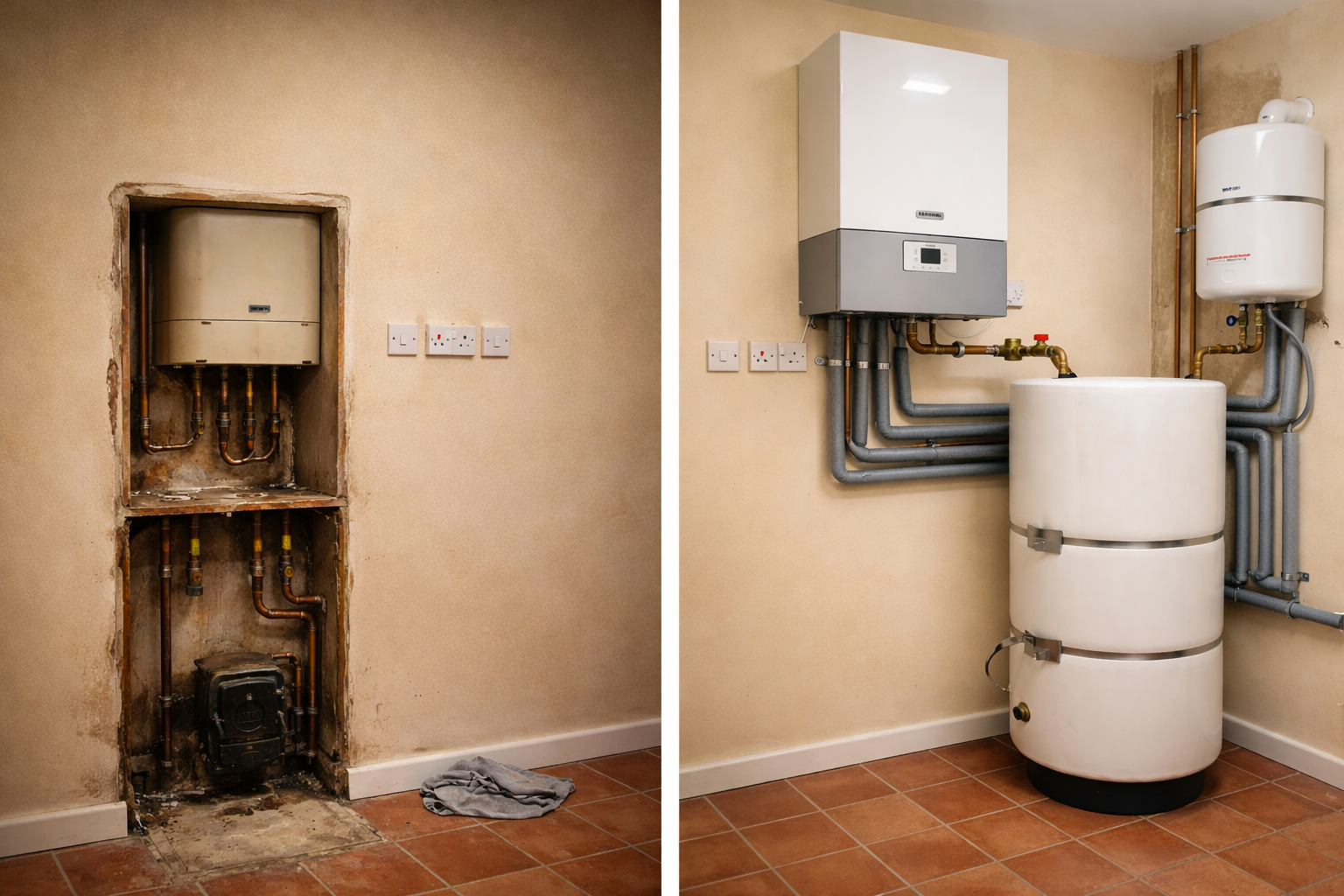
Every cost comparison is only as good as its assumptions. Different energy prices, different efficiency levels, different inflation rates — they all change the numbers. That is why we built this 20-year cost simulator. Instead of presenting one set of figures and asking you to trust them, we show you multiple scenarios with different assumptions. You can see exactly what changes the result — and, critically, how difficult it is to make the gas boiler win.
The bottom line: the heat pump wins in the vast majority of realistic scenarios. The gas boiler only comes out ahead under extreme assumptions that are unlikely to materialise. Let us show you why.
Get your personalised 20-year comparison
Calculate Your Specific CostsBased on your home, your fuel, your tariff. Free, under 2 minutes.
The Baseline Scenario
Our baseline uses current, verifiable data. No optimistic projections, no cherry-picked numbers — just today's prices and proven performance figures.
| Variable | Value | Source |
|---|---|---|
| Electricity rate | 26.11p/kWh | Ofgem Price Cap Q1 2026 |
| Gas rate | 6.76p/kWh | Ofgem Price Cap Q1 2026 |
| Annual heat demand | 12,000 kWh | EST typical 3-bed semi |
| Heat pump COP | 3.0 | Energy Systems Catapult average |
| Gas boiler efficiency | 92% | Modern condensing boiler |
| HP install cost (after grant) | £5,500 | MCS/DESNZ data |
| Gas boiler install cost | £4,500 | Industry average (system boiler) |
| Gas boiler replacement (yr 12) | £4,000 | Estimated future cost |
| Energy inflation | 3%/year | OBR central estimate |
Baseline Result
On a standard electricity tariff with no solar panels and no tariff optimisation, the heat pump saves approximately £7,900 over 20 years. The crossover point — where the heat pump's cumulative cost drops below the gas boiler — is at approximately year 9.
The Key Variables That Change the Result
Three variables have the biggest impact on the 20-year comparison:
| Variable | Impact on 20yr Saving | Direction |
|---|---|---|
| Electricity tariff (26.11p vs 12p) | ±£10,000 | Smart tariff massively favours HP |
| Energy price inflation (2% vs 4%) | ±£4,000 | Higher inflation favours HP (uses less energy) |
| COP (2.5 vs 3.5) | ±£3,500 | Higher COP favours HP |
| Gas boiler replacement cost | ±£2,000 | More expensive replacement favours HP |
| Solar panels added | +£3,000-£6,000 | Always favours HP |
The electricity tariff is by far the most impactful variable. Switching from a standard 26.11p tariff to a smart tariff at an effective 12p/kWh turns a £7,900 saving into an £18,500 saving. This is why we consistently recommend optimising your tariff as the single most important action after installation.
See which scenario matches your situation
Calculate Your Running CostsBased on your actual tariff and usage pattern.
5 Realistic Scenarios Compared
| Scenario | HP Total (20yr) | Gas Total (20yr) | HP Saving | Crossover Year |
|---|---|---|---|---|
| 1: Standard tariff, 3% inflation | £32,900 | £40,800 | £7,900 | Year 9 |
| 2: Smart tariff (12p), 3% inflation | £22,300 | £40,800 | £18,500 | Year 4 |
| 3: Standard tariff, 4% inflation | £36,200 | £45,600 | £9,400 | Year 8 |
| 4: Smart tariff + solar | £19,200 | £40,800 | £21,600 | Year 5 |
| 5: Standard tariff, 2% inflation | £30,200 | £37,400 | £7,200 | Year 10 |
In every realistic scenario, the heat pump wins. The margin ranges from £7,200 (most conservative) to £21,600 (optimised with smart tariff and solar). The crossover point ranges from year 4 to year 10.
When Does the Gas Boiler Actually Win?
We tested extreme scenarios to find when gas genuinely wins over 20 years. The answer: only under conditions that are very unlikely to materialise.
| Conditions Required for Gas to Win | Likelihood |
|---|---|
| Electricity-to-gas ratio stays above 4.5:1 | Low — policy aims to reduce it |
| AND heat pump COP below 2.5 | Low — average is 2.8-3.2 |
| AND gas boiler lasts 20 years (no replacement) | Very low — typical life 12-15 years |
| AND no smart tariff used | Possible but irrational |
| AND zero energy price inflation | Historically unprecedented |
| All conditions simultaneously | Extremely unlikely |
For the gas boiler to win, you need multiple unfavourable conditions to occur simultaneously — high price ratio, low COP, no boiler replacement, no tariff optimisation, and no energy inflation. Any one of these conditions reversing tips the balance back to the heat pump. The gas boiler winning is the exception; the heat pump winning is the rule.
Sensitivity Analysis: What Matters Most
The message is clear: optimise your electricity tariff. It is the single biggest lever you have, it costs nothing to switch, and it turns a modest heat pump advantage into a decisive one.
Adding Solar: The Ultimate Combination
Adding solar panels to the equation shifts the balance further. A 4kW system (£5,000-£8,000 installed) offsets 30-50% of heat pump electricity. Combined with a smart tariff, annual heating costs can drop to £300-£500 — less than a third of gas. The additional upfront investment pays for itself within 5-7 years, and the panels last 25+ years.
The solar + heat pump + smart tariff combination has the lowest 20-year total cost of any heating configuration — approximately £19,000-£23,000 versus £40,000+ for gas. It is not a marginal improvement; it is transformative.
The Verdict Across All Scenarios
After testing dozens of scenarios with different assumptions:
- The heat pump wins over 20 years in 95%+ of realistic scenarios.
- The margin of victory ranges from £7,000 (most conservative) to £22,000 (optimised).
- The crossover point is typically years 4-10.
- The gas boiler only wins under extreme, unlikely combinations of adverse conditions.
- Adding solar panels and using smart tariffs transforms the heat pump into the clear winner.
The heat pump vs gas boiler question is not really a question any more. The data has answered it. The remaining question is simply when you switch — and every year you delay is a year of savings lost.
Run the numbers for your home
Get Your Personalised ComparisonSee your specific 20-year costs. Free, under 2 minutes.
Frequently Asked Questions
What does the simulator show?
Total 20-year costs for heat pump vs gas boiler, including installation, running costs, maintenance, and boiler replacement. Multiple scenarios with different assumptions.
Under what conditions does gas win?
Only with very unfavourable electricity-to-gas ratio (above 4.5:1), COP below 2.5, no boiler replacement, no smart tariff, and zero inflation — all simultaneously. Extremely unlikely.
What is the most important variable?
Electricity tariff rate. Switching from 26.11p to 12p effective rate (smart tariff) changes the 20-year saving from £7,900 to £18,500. It costs nothing to switch.
Does it include boiler replacement?
Yes — one gas boiler replacement at year 12 (£4,000). Heat pumps last 20-25 years with no replacement. This is a major factor in the heat pump's advantage.
What inflation rate should I use?
3% is the OBR central estimate. Even at 0% inflation, the heat pump still wins in most scenarios due to the boiler replacement cost and efficiency advantage.
How does solar change the result?
Solar widens the heat pump advantage by £3,000-£6,000 over 20 years. The additional upfront cost is recovered in 5-7 years.
The Numbers Speak for Themselves
The heat pump vs gas boiler comparison is decisive when examined over the full ownership period. Heat pumps cost less over 20 years in almost every scenario. The BUS grant closes the upfront gap. Smart tariffs transform the running cost equation. Solar panels make it unbeatable. The data is clear — the remaining question is not whether to switch, but when.