Best Heat Pump for Underfloor Heating
Underfloor heating and heat pumps are a natural pairing. UFH operates at flow temperatures of 30 to 40°C — precisely the range where heat pumps perform at their most efficient. Combine the two, and you get the lowest possible running costs and the most comfortable heating experience a UK home can offer.
But not all heat pumps are equally suited to underfloor heating. Some brands are optimised for low flow temperatures, with compressors, controls, and heat exchangers designed to extract maximum efficiency from the gentle warmth UFH requires. This guide identifies the best options and explains what to look for.
Why Underfloor Heating Maximises Heat Pump Efficiency
The fundamental principle is simple: the lower the flow temperature, the higher the COP. A heat pump delivering water at 35°C to underfloor heating will achieve a COP of 4.0 to 5.0. The same heat pump delivering water at 55°C to undersized radiators drops to a COP of 2.5 to 3.0.
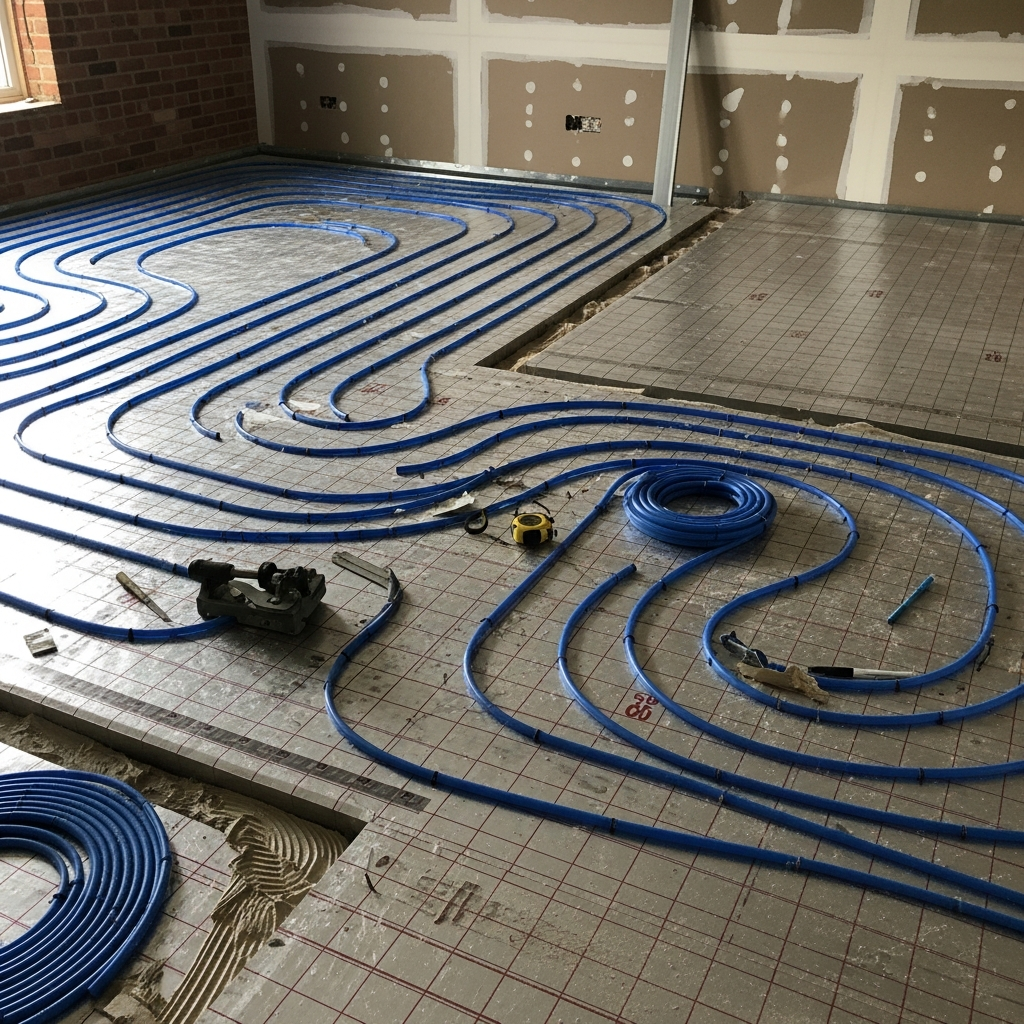
UFH can run at such low temperatures because the entire floor acts as a radiator — the emitting surface is enormous compared to a few wall-mounted radiators. This large surface area compensates for the lower water temperature, delivering the same total heat output with far less energy input.
In practical terms, a home with UFH and a good heat pump might spend £500 to £700 per year on heating. The same home with standard radiators and the same heat pump might spend £750 to £1,000. The UFH advantage is worth £200 to £350 per year — every year, for the life of the system.
What Makes a Heat Pump Good for UFH?
Low Minimum Output
UFH heats slowly and steadily. A heat pump paired with UFH needs to modulate down to very low output levels to avoid overshooting the set temperature. Variable-speed compressors that can modulate down to 20 to 30% of maximum output are essential. Fixed-speed units tend to cycle on and off, which reduces comfort and efficiency.
Precise Weather Compensation
Weather compensation adjusts the flow temperature based on outdoor conditions. On a mild 10°C day, the system might send water at 28°C. On a cold -5°C day, it might increase to 38°C. For UFH, this modulation must be smooth and precise — abrupt changes in flow temperature create uncomfortable hot and cold patches.
Low Flow Temperature Optimisation
Some heat pumps are designed primarily for radiator retrofits and work best at 45 to 55°C. Others are engineered from the ground up for low-temperature operation. The best UFH-optimised units use compressors, expansion valves, and heat exchangers specifically tuned for the 25 to 40°C range.
Best Heat Pumps for Underfloor Heating
Vaillant aroTHERM plus — Best Overall for UFH
The Vaillant aroTHERM plus is purpose-built for low-temperature heating. Its R290 compressor excels at the 30 to 40°C range that UFH demands, and its variable-speed operation modulates down to remarkably low output levels.
- COP at A7/W35: 5.08 — the highest on the market
- COP at A7/W30: Approximately 5.5
- Minimum modulation: 20% of rated output
- Weather compensation: Advanced curve with outdoor sensor
- UFH integration: Native support for mixing valves and zone control
Vaillant's system controller handles up to 6 UFH zones natively, and the weather compensation is among the most precise in the industry. If budget allows, this is the best heat pump you can pair with underfloor heating.
NIBE S2125 — Scandinavian UFH Expertise
In Sweden, underfloor heating with a heat pump is the default heating system. NIBE has been engineering this combination for decades, and the S2125 reflects that experience.
- COP at A7/W35: 4.80
- COP at A7/W30: Approximately 5.2
- Minimum modulation: 25% of rated output
- Weather compensation: Self-learning adaptive curve
- UFH integration: Full zone control via NIBE SMO S40 controller
NIBE's self-learning weather compensation adjusts automatically based on your home's thermal response, getting more efficient over the first heating season. The myUplink smart system provides detailed energy monitoring per zone.
Samsung EHS Mono — Best Value for UFH
The Samsung EHS Mono offers excellent low-temperature performance at a budget price. While it lacks the refinement of the Vaillant or NIBE at very low flow temperatures, it delivers strong COP at the 35°C that most UFH systems run at.
- COP at A7/W35: 4.65
- Minimum modulation: 30% of rated output
- Weather compensation: Standard curve with outdoor sensor
- UFH integration: Compatible with third-party UFH controllers
Samsung pairs well with established UFH manifold systems from brands like Polypipe, JG Speedfit, and Uponor. The SmartThings app allows basic scheduling and monitoring, though it lacks the zone-level granularity of NIBE or Vaillant.
Daikin Altherma 3 — Reliable UFH Partner
The Daikin Altherma 3 is a proven choice for UFH, with thousands of installations across the UK. Daikin's EKCC controller manages up to 8 UFH zones.
- COP at A7/W35: 4.60
- Minimum modulation: 25% of rated output
- Weather compensation: Advanced with room temperature feedback
- UFH integration: Native 8-zone control via EKCC
Daikin's room temperature feedback feature uses a wireless room sensor to fine-tune flow temperature, which works particularly well with UFH where the slow thermal response of a concrete screed floor needs anticipatory control.
Mitsubishi Ecodan — Proven Track Record
The Mitsubishi Ecodan has been installed with UFH in thousands of UK homes. While it does not lead on COP at A7/W35, its real-world reliability and excellent installer support make it a dependable choice.
- COP at A7/W35: 4.20
- Minimum modulation: 30% of rated output
- Weather compensation: Standard with optional room correction
- UFH integration: Compatible with FTC6 controller and third-party manifolds
UFH + Heat Pump: Key Design Considerations
Screed vs Overlay UFH
There are two types of wet underfloor heating:
- Screed (wet) systems: Pipes are embedded in a 50 to 75mm concrete screed. This provides excellent thermal mass — the floor stores heat and releases it slowly. Ideal for new builds and major renovations where floor levels can accommodate the depth.
- Overlay (dry) systems: Pipes sit in grooved boards above the existing floor, typically adding 15 to 25mm of height. Faster to install and suitable for retrofitting into existing homes without major floor work.
Both work well with heat pumps, but screed systems have better thermal mass, which allows the heat pump to run at lower output for longer — improving COP. Overlay systems respond faster but may require slightly higher flow temperatures.
Buffer Tanks
UFH systems with small zones can present a challenge for heat pumps. If only one or two zones call for heat, the heat pump may be oversized for the demand and cycle on and off frequently. A buffer tank (typically 50 to 100 litres) stores heated water and prevents short cycling, maintaining consistent efficiency.
Not every installation needs a buffer tank — it depends on the heat pump's modulation range and the number of zones. Your installer should assess this during design.
Mixing Valves
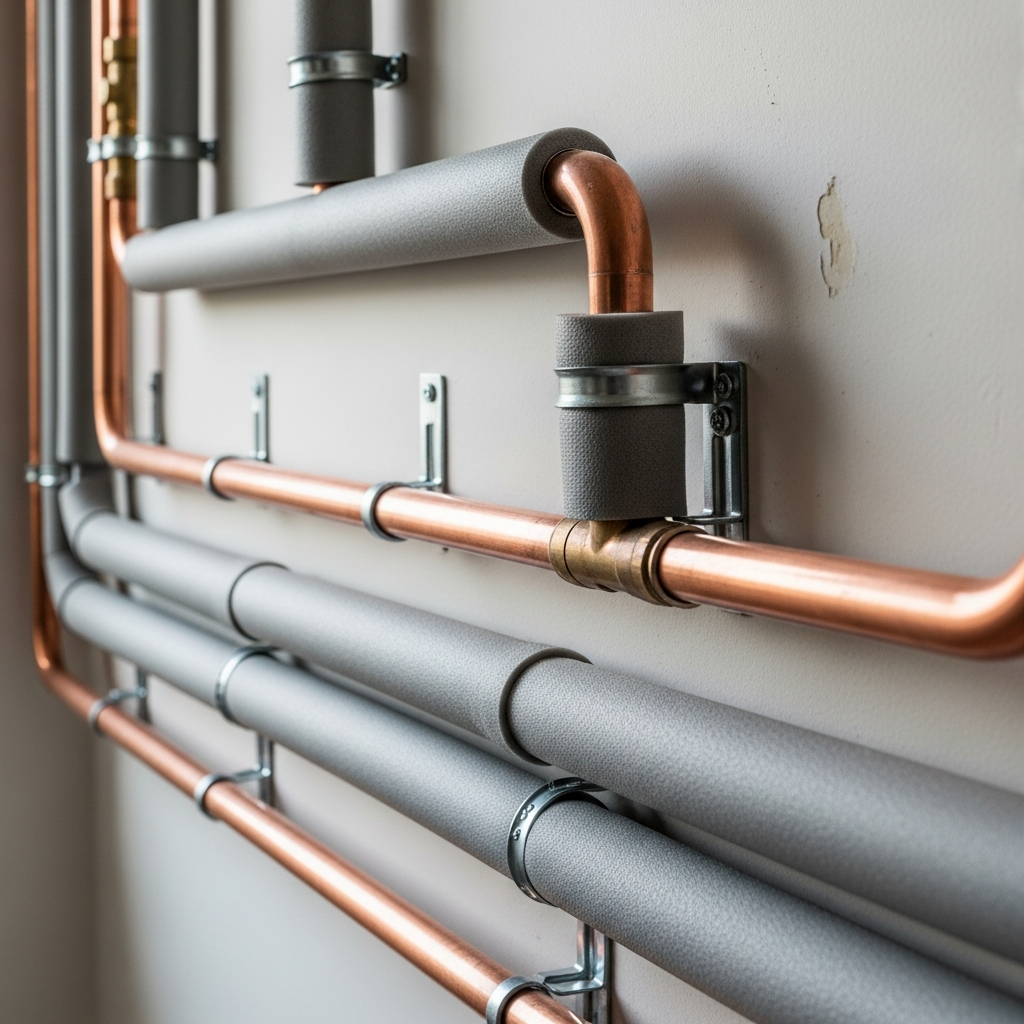
In mixed systems (UFH downstairs, radiators upstairs), a thermostatic mixing valve blends the heat pump's output to deliver lower temperatures to the UFH and higher temperatures to the radiators. This is a common and effective arrangement for UK retrofit projects.
However, the ideal approach is to design the entire system for low flow temperatures — using oversized radiators upstairs and UFH downstairs — so the heat pump runs at maximum efficiency without mixing valves.
Retrofit UFH with a Heat Pump
Installing underfloor heating during a heat pump retrofit is increasingly popular. The most common approach is:
- Ground floor: Install overlay UFH boards on top of the existing floor, adding 15 to 25mm of height. This is straightforward in most rooms but may require trimming doors and adjusting thresholds.
- First floor: Keep or upgrade radiators. UFH on upper floors is possible but more disruptive and expensive.
The cost of retrofit overlay UFH is typically £40 to £70 per square metre, including materials and labour. For a 40 square metre ground floor, expect to pay £1,600 to £2,800. This investment pays for itself through improved COP within 5 to 8 years.
UFH Heat Pump Comparison Table
| Brand | COP at W35 | Min Modulation | Native Zone Control | Installed Cost (after grant) |
|---|---|---|---|---|
| Vaillant aroTHERM plus | 5.08 | 20% | 6 zones | £10,000–£14,000 |
| NIBE S2125 | 4.80 | 25% | 8 zones | £9,500–£13,000 |
| Samsung EHS Mono | 4.65 | 30% | Via third-party | £7,500–£10,500 |
| Daikin Altherma 3 | 4.60 | 25% | 8 zones | £8,500–£12,000 |
| Mitsubishi Ecodan | 4.20 | 30% | Via FTC6 | £8,500–£11,500 |
Our Recommendations
New build with full UFH: Vaillant aroTHERM plus or NIBE S2125. These units extract the maximum possible efficiency from low flow temperatures and have the best native zone control.
Retrofit with ground floor UFH: Samsung EHS Mono or Daikin Altherma 3. These offer strong low-temperature performance at a more accessible price point, with good compatibility with overlay UFH systems.
Mixed UFH and radiator system: Daikin Altherma 3 or Mitsubishi Ecodan. Both handle mixed emitter systems well, with good weather compensation that manages two different circuit temperatures.
Frequently Asked Questions
Do I need underfloor heating for a heat pump?
No. Heat pumps work with radiators too, provided they are correctly sized. However, UFH delivers the best efficiency because it runs at the lowest flow temperatures. If you have the opportunity to install UFH — particularly during a renovation — it is worth the investment.
Can I use electric underfloor heating with a heat pump?
Electric UFH and a heat pump are separate systems — the electric mats do not connect to the heat pump. This defeats the purpose, as electric heating is 100% efficient while a heat pump is 300 to 500% efficient. Always choose wet (hydronic) UFH to benefit from the heat pump's efficiency.
How warm does the floor get with a heat pump?
The floor surface temperature is typically 23 to 27°C — comfortably warm to walk on but not hot. This gentle warmth is one of the great comforts of UFH. The floor never feels cold, and heat rises evenly throughout the room.
Is underfloor heating slow to heat up?
Screed-based UFH takes 1 to 3 hours to reach full temperature from cold. However, with a heat pump running weather compensation, the system rarely turns off completely — it modulates to maintain a steady temperature. In practice, you set it and forget it. Overlay systems respond faster, typically reaching temperature in 30 to 60 minutes.
Can I have UFH downstairs and radiators upstairs?
Yes, this is the most common arrangement in UK retrofit projects. A mixing valve delivers lower-temperature water to the UFH whilst sending higher-temperature water to the radiators. The ideal approach is to oversize the upstairs radiators so they can run at a similar flow temperature to the UFH, maximising efficiency.
What floor coverings work with UFH and a heat pump?
Tile and stone are ideal — they conduct heat well and have minimal insulating effect. Engineered wood performs well too. Thick carpet with heavy underlay acts as an insulator and reduces UFH effectiveness, potentially requiring higher flow temperatures. If you want carpet, choose a thin, low-tog option.